

Part-Payment vs Foreclosure: Which one is a better strategy to save more interest?
Part-payment vs foreclosure: learn which option saves more interest based on timing, penalties, loan type and liquidity, and how to choose the smarter move.
Part-Payment vs Foreclosure which is better?
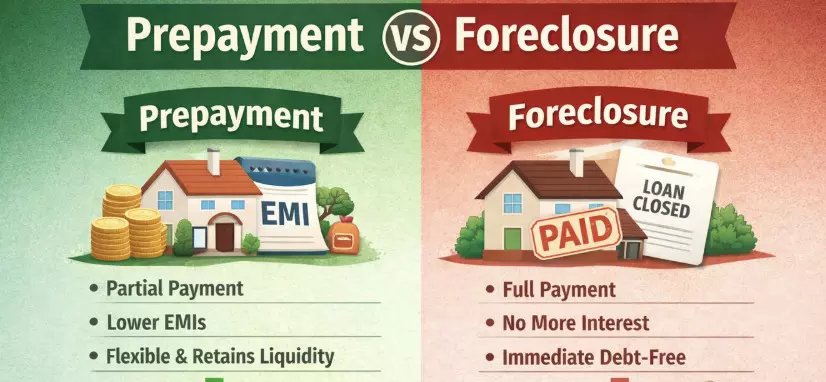
Foreclosure ends interest quickly but can strain savings and involve penalties. Regular part-payments, especially on long-term loans, reduce the principal early, save a lot on interest, and keep cash available. The best choice depends on balancing interest savings with financial comfort.
When borrowers have surplus cash, a common dilemma arises should the money be used to part-pay the loan or to close it entirely through foreclosure?
At first glance, foreclosure appears to be the obvious choice. Closing the loan stops interest immediately. However, in reality, the decision is influenced by penalties, timing and how banks calculate interest. In many cases, part-payments can deliver substantial savings without the drawbacks of full closure.
Understanding how both options work can help borrowers choose what actually saves money rather than what simply feels decisive.
How part-payment reduces interest
A part-payment is a lump-sum payment made over and above the regular EMI while keeping the loan active. Banks typically adjust this amount against the principal outstanding.
Once the principal reduces, interest is recalculated on the lower balance. This leads to savings in one of three ways — a shorter loan tenure, a lower EMI, or a combination of both, depending on the borrower’s preference.
Part-payments are especially effective for long-term loans such as home loans. When made in the early years, they can significantly reduce total interest and cut several years off the loan tenure.
Most floating-rate home loans allow part-payments without penalty. However, fixed-rate loans, personal loans and business loans often come with limits or charges.
What foreclosure really involves
Foreclosure means closing the loan before its scheduled end by paying the entire outstanding principal along with accrued interest and charges.
From an interest perspective, foreclosure stops all future interest. But this benefit can be offset by foreclosure or pre-closure charges, which are common for fixed-rate and unsecured loans.
Another key consideration is liquidity. Using a large sum to close the loan may reduce the borrower’s emergency buffer or investment capacity.
Which option saves more interest?
In pure interest terms, foreclosure results in the maximum savings because interest stops entirely once the loan is closed.
However, early part-payments often capture a significant portion of these savings without triggering heavy penalties. Reducing principal early in the loan tenure has a disproportionate impact on interest outgo.
For borrowers who prefer to retain liquidity, regular part-payments can come close to foreclosure-level savings over time, particularly for home loans. The difference narrows further when foreclosure penalties are high.
Charges to check before deciding
Before choosing either option, borrowers should review the loan agreement carefully.
Floating-rate home loans generally allow part-payments and foreclosure without penalty. Fixed-rate loans often carry charges.
Personal loans and business loans almost always have foreclosure penalties, especially in the first half of the tenure.
Borrowers should also check for lock-in periods during which prepayment or foreclosure may not be permitted. Administrative charges, documentation fees and GST on penalties can add to the overall cost.
When part-payment makes more sense
Part-payment is suitable when borrowers want flexibility and liquidity, or when surplus funds are available intermittently rather than as a lump sum.
It works particularly well for long-tenure loans, where disciplined early part-payments can deliver substantial interest savings without exhausting savings.
When foreclosure is the better choice
Foreclosure makes sense when penalties are minimal, interest rates are high, and the borrower is comfortable using a large amount of cash to become debt-free.
It can also be attractive near the end of the loan tenure if interest savings still exceed closure charges.
The bottom line
There is no single winner between part-payment and foreclosure. The right choice depends on loan type, timing, penalties and personal cash-flow comfort.
The common mistake is assuming foreclosure is always cheaper. In reality, well-timed part-payments can deliver most of the benefit with fewer financial trade-offs.
Before deciding, borrowers should ask one key question: Will this reduce interest meaningfully without weakening my financial cushion?
The answer usually points to the right option.





