

Shipping lanes cannot become battle zones, says Safesea Group Chairman Anchan
Shipping lanes cannot become battle zones, says Safesea Group Chairman Anchan
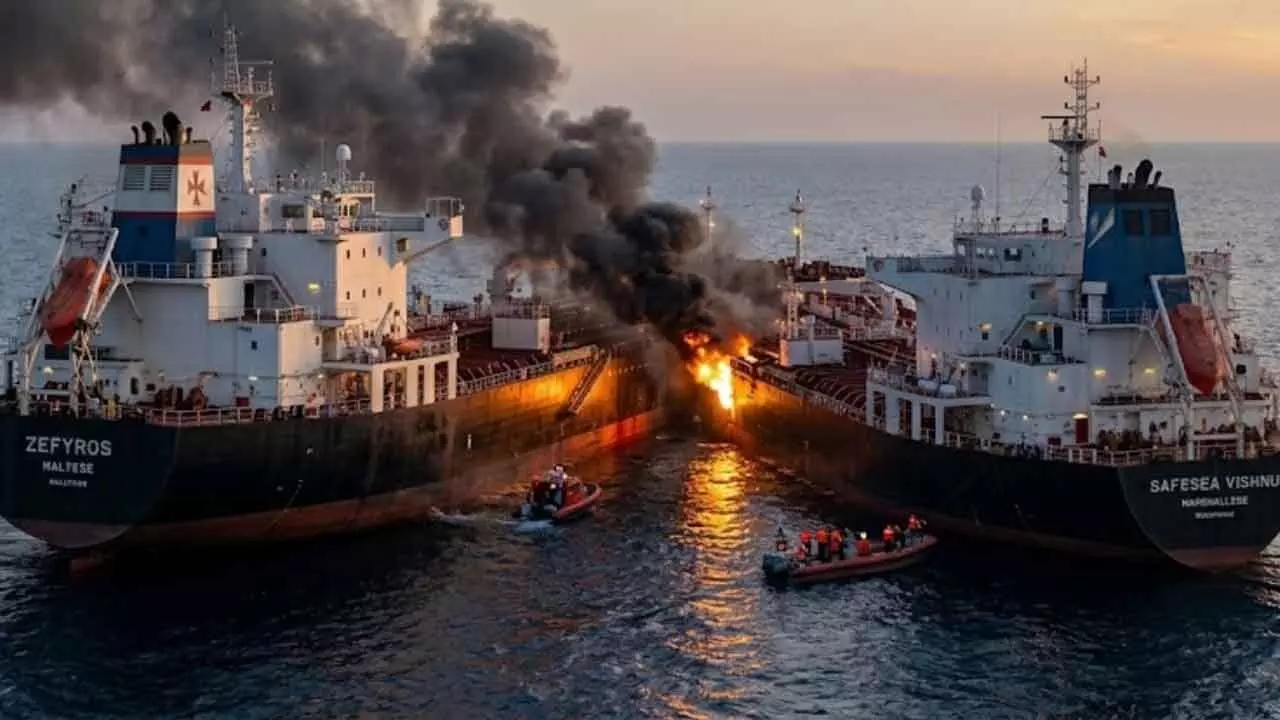
The attack on US-owned crude oil tanker Safesea Vishnu that killed an Indian crew member appears to have been “deliberate and calculated”, the maritime company's chief has said.
Chairman of maritime company Safesea Group Chairman SV Anchan emphasised that the strike must serve as a wake-up call for governments that commercial shipping lanes cannot become battle zones and the lives of seafarers must never be treated as collateral damage.
"The devastating attack on MT Safesea Vishnu is a stark reminder that the world’s merchant seafarers are increasingly being exposed to the dangers of geopolitical conflict,” Anchan in a statement Thursday.
On March 11, the Marshall Islands-flagged Safesea Vishnu was attacked off Khor Al Zubair port near Basra, Iraq by an Iranian “suicide” boat.
Tragically, in the attack, an Indian crew member, who was one of the top seafarers on the vessel, was killed.
"From our initial assessment after speaking to the surviving crew members, the attack appears to have been deliberate and calculated. Two unmanned boats with explosives rammed into the port side of the vessels. This speaks about the extremists’ mindsets of the Iranian regime," the statement said.
Giving the first detailed account of the harrowing incident, Anchan recounted how the crew members on his ship came under attack on the night of March 11 at 23:45 local time and “found themselves fighting for their lives”.
Anchan said in the statement that the vessel was anchored at Khor Al Zubair and was engaged in routine ship-to-ship loading operations. It had already completed part of its cargo operations alongside the berth and had shifted to anchorage to complete the loading of approximately 53,000 metric tons of naphtha.
He said the timing chosen for the strike placed the crew in an extremely vulnerable position. "At anchorage, with the vessel in a laden condition, evacuation options were severely limited. When the explosion and resulting fire engulfed the port side of the vessel, the crew had only moments to react,” he said.
He further added that lowering the lifeboats on the port side became impossible due to the fire and damage. On the starboard side, a receiving vessel was double banked for cargo transfer operations, further restricting escape routes.
As the fire spread rapidly across the ship, the situation became desperate, the statement noted, adding that the mooring ropes eventually gave way, causing the receiving vessel to drift away — an event that ultimately created a narrow window for survival.
"In those terrifying moments, all 28 crew members were forced to jump into the water to escape the burning vessel. Their courage and instinct for survival saved lives,” Anchan said.
He expressed gratitude to the Iraqi Coast Guard and local authorities, saying their rapid action prevented a far greater tragedy, and due to their swift response, almost all the crew were rescued.
However, despite these heroic rescue efforts, the maritime community suffered a heartbreaking loss when one brave seafarer lost his life. "Despite being recovered from the water and receiving immediate medical attention, including CPR from the responding teams, he could not be revived,” the statement said.
The statement emphasised that beyond the technical and operational response to the attack, the incident raises a much larger and more urgent question for the international community.
“How long will the world allow merchant seafarers to be caught in the crossfire of regional conflicts?"
"The global shipping industry carries more than 90 per cent of world trade. Every nation depends on it. Every economy relies on the uninterrupted movement of energy, food, and essential goods across the seas. Yet the people who make this system work — the seafarers themselves — are increasingly being placed at risk,” it said.





