

Middle East or West Asia? The name shift explained
Why is the “Middle East” increasingly being called “West Asia”? Explore the historical, political, and geographical reasons behind this global shift in terminology.
Middle East or West Asia? The name shift explained
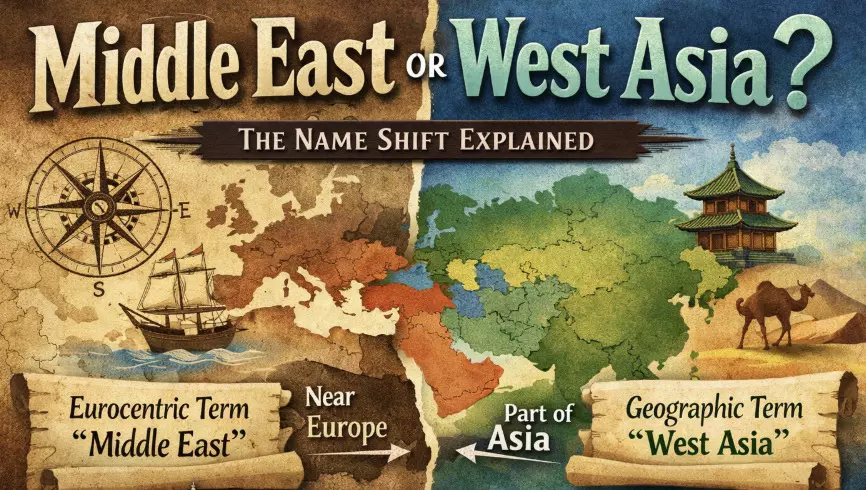
The shift from calling the region “Middle East” to “West Asia” isn’t sudden—it’s part of a gradual change in how geography, politics, and identity are understood. The two terms refer largely to the same region, but they come from very different perspectives.
1. Origins of the term “Middle East”
The term “Middle East” was coined from a European viewpoint during the 19th and early 20th centuries. It positioned the region relative to Europe: “Near East” (the Balkans and Ottoman territories), “Middle East” (areas around the Persian Gulf), and “Far East” (East Asia). In other words, it’s a Eurocentric label—it describes the region based on how “far” it is from Europe, not based on its own geography or identity. Over time, “Middle East” became widely used in politics, media, and international relations, especially during colonial rule and later during events like the Cold War.
2. Why “West Asia” is gaining usage
“West Asia” is a more geographically neutral and precise term. Instead of describing the region relative to Europe, it locates it within the Asian continent. Countries like Saudi Arabia, Iran, Iraq, Jordan, and the Gulf states are all part of Asia geographically, so calling them “West Asia” aligns better with standard continental naming.
This shift is especially noticeable in countries like India, where official government communication and academic texts increasingly prefer “West Asia.” For example, India’s foreign policy discussions often refer to “West Asia and North Africa (WANA)” rather than “Middle East.”
3. Political and cultural sensitivity
Another reason for the change is sensitivity to colonial language. Many scholars and policymakers argue that “Middle East” reflects a colonial mindset, where Europe is the center of the world. Using “West Asia” removes that bias and gives the region a more self-referential identity.
Additionally, “West Asia” avoids some of the political baggage associated with “Middle East,” which is often linked in media narratives to conflict, oil politics, and instability. By using a more neutral term, institutions aim to present the region in a broader, less stereotyped way.
4. Academic and institutional influence
Universities, international organizations, and research bodies have played a role in popularizing “West Asia.” In academic writing—especially in geography, history, and international relations—the term is often preferred for its accuracy. Over time, this academic usage has started influencing media, policy documents, and public discourse.
5. Not a complete replacement
Despite the shift, “Middle East” is still widely used, especially in global media, diplomacy, and everyday conversation. It remains the more familiar term worldwide. The transition to “West Asia” is gradual and context-dependent—formal or academic settings are more likely to use it, while casual or global discussions still lean toward “Middle East.”
6. Broader regional framing
Sometimes, “West Asia” is used as part of a larger regional grouping like “West Asia and North Africa (WANA)” instead of “Middle East and North Africa (MENA).” This reflects an effort to standardize regional terminology based on geography rather than historical naming conventions.
The move from “Middle East” to “West Asia” is driven by a desire for geographical accuracy, cultural neutrality, and decolonized language. It reflects a broader global trend of rethinking how regions are named and understood. While “Middle East” isn’t disappearing anytime soon, “West Asia” is steadily gaining ground, especially in formal and academic contexts.





