

LPG price surge prompts shift to electric cooking in India
Rising LPG prices push Indian households toward induction cooking. But electricity reliability, upfront costs and cooking habits still keep LPG dominant.
LPG price surge prompts shift to electric cooking in India
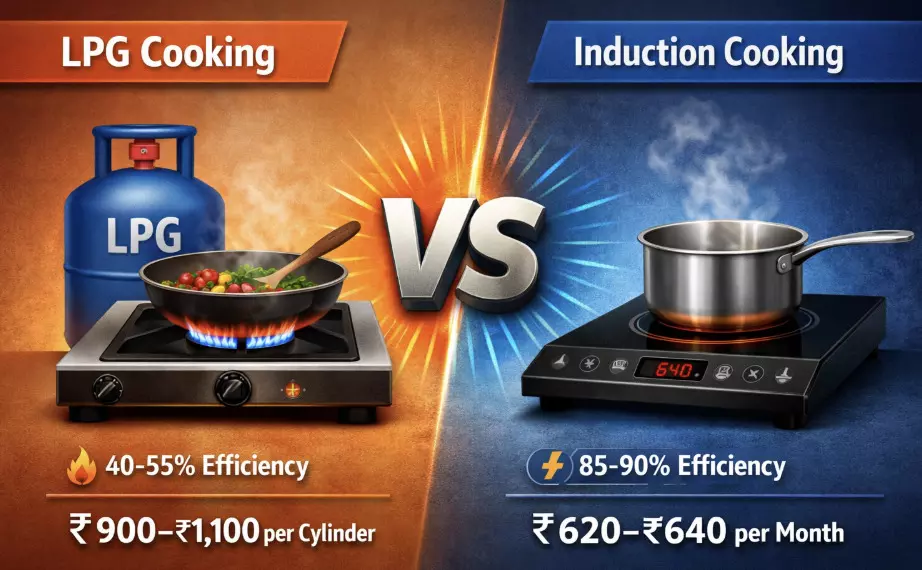
Rising LPG prices and supply disruptions linked to global energy tensions are pushing many Indian households to consider induction cooktops as an alternative. While electric cooking may offer cost savings due to higher efficiency, challenges such as unreliable electricity supply and cooking preferences continue to keep LPG the dominant fuel in most homes.
Rising prices and supply concerns around liquefied petroleum gas (Liquefied Petroleum Gas) are prompting Indian households to reconsider induction cooktops as a primary cooking option rather than just a backup appliance.
Traditionally used by students, bachelors, or during LPG refill delays, induction cooktops are now gaining renewed attention as disruptions in global energy routes push up LPG prices and create supply bottlenecks in several cities.
India relies heavily on imported LPG, making domestic prices vulnerable to international energy markets. Ongoing geopolitical tensions in the Middle East have increased shipping risks and raised global energy costs, which is now being reflected in domestic LPG prices.
LPG Prices Rising Across Cities
Recent price adjustments have increased the cost burden on households and businesses alike.
Domestic LPG cylinders have become around ₹60 costlier in recent weeks.
Commercial LPG cylinders used by restaurants have seen price hikes of about ₹115.
Some cities, including Noida, Lucknow, and Pune, have reported supply delays and longer refill waiting times.
These disruptions are forcing restaurants and community kitchens to explore electric cooking options to maintain operations.
LPG vs Induction: Cost Comparison
A standard domestic LPG cylinder contains 14.2 kg of gas and typically costs ₹900–₹1,100, depending on the city and subsidy availability.
However, traditional gas stoves are not highly efficient. Experts estimate that only about 40–55% of the heat generated by LPG stoves is actually used for cooking, with the rest lost to surrounding air.
Induction cooktops operate using electromagnetic technology that heats the cooking vessel directly rather than through a flame. This allows them to achieve efficiency levels of about 85–90%.
To generate the same amount of usable cooking heat as one LPG cylinder, households would require approximately 75–80 units of electricity.
At an average electricity tariff of ₹8 per unit, the total cost would come to around ₹620–₹640, which is considerably lower than the cost of an LPG cylinder.
For households cooking two to three hours daily, this could translate into monthly savings ranging from ₹180 to over ₹1,000, depending on local electricity tariffs and subsidy benefits.
Research Supports Lower Electric Cooking Costs
Research by the Institute for Energy Economics and Financial Analysis (IEEFA) indicates that electric cooking may be significantly cheaper for households that do not receive LPG subsidies.
According to the study:
Average annual spending on non-subsidised LPG: about ₹8,000
Average annual cost of electric cooking: about ₹5,800
However, for households that receive government LPG subsidies, cooking with gas may still remain the more economical option.
Why LPG Still Dominates Indian Kitchens
Despite potential savings from electric cooking, LPG continues to be the preferred cooking fuel across India.
One major reason is reliable access to electricity, which remains inconsistent in several parts of the country. Frequent power cuts can make induction-based cooking impractical for daily use.
Cooking habits also play an important role. Many traditional Indian dishes rely on open flame cooking, which makes tasks such as puffing rotis, preparing tadka, or roasting vegetables easier on LPG stoves.
Upfront Costs and Kitchen Compatibility
Switching to induction cooking also involves some initial investment.
Basic induction cooktops cost roughly ₹2,000–₹4,000.
Households may need to buy compatible cookware made from magnetic materials such as stainless steel or cast iron.
Challenges for Commercial Kitchens
For restaurants and large kitchens, the transition to electric cooking can be significantly more expensive.
Industry estimates suggest that converting a commercial kitchen to electric cooking could cost around ₹3.5 lakh or more, including new equipment and electrical infrastructure upgrades.
Restaurants would also need reliable power supply and backup systems to ensure uninterrupted cooking operations.
Outlook
While rising LPG prices are encouraging experimentation with electric cooking, a full transition may take time. Factors such as power reliability, cooking traditions, and upfront costs will likely determine how quickly Indian kitchens adopt induction-based cooking solutions.





