

India-EU Trade Deal: How PM Modi reached 27 countries with one message
PM Modi reached 27 countries with one message spotlighting India-EU trade deal, blending diplomacy and culture as pact boosts trade, mobility, autos, and green cooperation.
India-EU Trade Deal
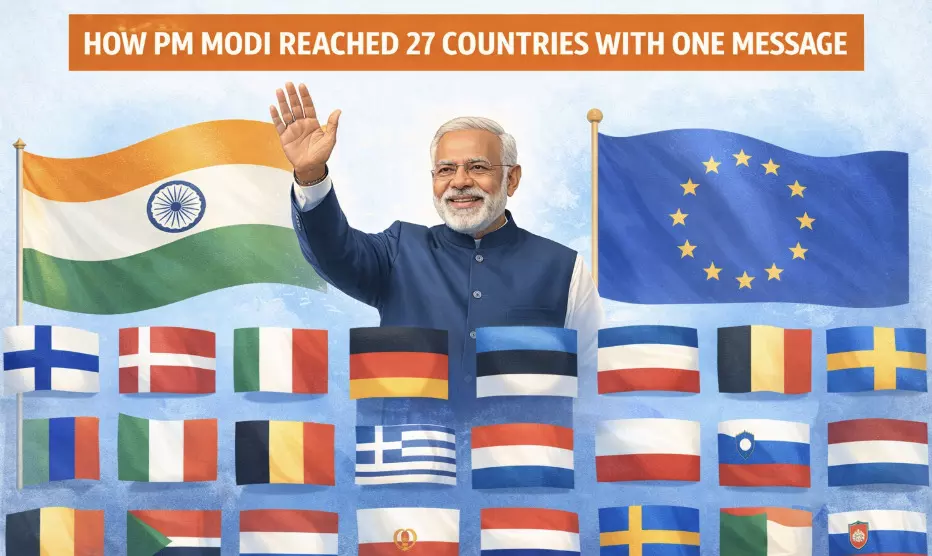
Prime Minister Modi reached millions of Europeans by posting in 24 languages after the India-European Union trade deal. Geopolitical experts are calling it a multilingual masterstroke that transformed the trade agreement into a cultural connection. Amidst US pressure, this deal symbolizes India's growing activism in Europe.
India EU deal
In 2014 when Narendra Modi became Prime Minister for the first time after winning the Lok Sabha elections, and he was being talked about globally. A British newspaper at the time described him as 'India's first social media Prime Minister'. After 12 years, PM Modi has mastered the art of reaching people through social media.
On Tuesday, after the India-European Union trade deal, PM Modi introspectively used this achievement to reach millions of people in Europe. In fact, PM Modi posted information about the India-EU trade deal on his social media accounts in 24 different languages.
PM Modi's masterstroke
Geopolitical experts are calling this PM Modi's multilingual masterstroke. Because Narendra Modi has conveyed his message to 27 countries through these posts in different languages. Amidst the global turmoil caused by US President Donald Trump's shifting policies, this "Mother of All Deals" between India and the European Union is considered highly significant.
Linguistic diversity Professor Marios discussed with Prime Minister Modi that embracing a transformed trade agreement will impact economic document into a cultural milestone. Professor Marios noted that this made the Free Trade Agreement (FTA) appear less to be a formal process and more like strengthening human and personal connection.
Thanks given to 27 countries in their respective languages
India’s trade deal with the European Union, amidst US pressure, is considered an important milestone. Finalized on January 27th after a long wait of two decades, this deal is not just a trade agreement but also a reflection of India's growing engagement with Europe. This is why PM Modi thanked all 27 member countries of the European Union in their respective languages after the deal was finalized.
This deal is crucial amidst US pressure
The decisions of US President Donald Trump have had a serious impact on both India and the European Union. While India is facing a 50 percent tariff, it is also being pressured to enter into a one-sided trade agreement in favor of the US. The European Union is also troubled by Trump; Europe is facing difficulties due to its opposition to Donald Trump's proposed acquisition of Greenland. Using tariffs as a weapon in trade negotiations and punishing other countries, including allies, has been a key part of Trump's strategy.
Key features of the agreement
India will be in a position to eliminate tariffs on approximately 92-97% of EU goods in a phased manner.
Labour-intensive sectors: This will boost zero duty on Indian exports worth US$33 billion, including textiles, apparel, leather, gems, jewelry, and marine products.
Auto Liberalization: EU luxury car manufacturers can now enter the Indian market at reduced tariffs (from 110% to 10%), while protecting domestic manufacturing.
In the space of services and mobility, India has gained access to 144 sub-sectors of the European Union (IT, finance, education). This mobility framework will facilitate visas for skilled professionals, intra-corporate transferees, and even practitioners of Indian traditional medicine (AYUSH).
Sustainability and Carbon Border Adjustment Mechanism (CBAM): Forward-looking provisions shall be implemented on the EU's (CBAM) to ensure technical assistance and dialogue to help Indian MSMEs comply with green standards.
Agricultural Exceptions: India successfully protected sensitive sectors such as dairy, cereals, and poultry, which will boost and safeguard local farmers.
Implementation challenges
Non-Tariff Barriers (NTBs): This is an important milestone EU's stringent sanitary and phytosanitary (SPS) standards remain a bottleneck for Indian agricultural exports.
Regulatory Harmonization: Bridging the gap between Indian and EU regulations on digital trade, data privacy, and AI.
Intellectual Property (IP): The EU's demand for stronger IPR protection measures, such as data exclusivity, could pose a challenge for India's generic drug industry.
CBAM Compliance: Indian heavy industries (steel, cement) face the challenge of meeting the EU's higher carbon neutrality costs.
Domestic Sensitivities: Balancing the influx of high-tech EU services and products without displacing smaller Indian MSMEs.
India–EU automotive industry
Luxury car manufacturers to benefit
In a press statement issued by India and the European Union, car tariffs will be slowly reduced from 110% to 10%. This will make special models from European companies like Volkswagen, Mercedes-Benz, and BMW cheaper in the Indian market.
The minimal tariffs will boost European automakers like Volkswagen, Renault, and Stellantis, and also luxury car manufacturing companies like Mercedes-Benz and BMW, which manufacture cars locally in India, which were facing difficulties in achieving significant growth due to siginificant tariffs. At present, most of Mercedes-Benz and BMW's popular cars in India are manufactured through local assembly, meaning parts are imported and assembled here.
India is the world's third largest car market
It’s worth noting that India is currently the world's third-largest car market after the US and China. However, EU manufacturers have a share of less than 4% in India's market of 4.4 million annual car sales. Despite this, India had kept its auto sector quite protected. High taxes made it difficult for foreign companies to sell their expensive cars in the Indian market. Now, after this deal, it will be easier for companies like Mercedes, BMW, Audi, and Volkswagen to expand their reach in India.
How much tariff will be levied on which product?
Under this deal, the tariff on EU alcohol will be reduced to 40%. The tariff on EU beer will be reduced to 50%. The tariff on EU olive oil will be completely eliminated. The tariff on EU edible oil will also be completely eliminated. Tariffs on EU fruit juices and processed foods will be removed. India will receive support of 500 million euros from the EU. The EU will help in reducing greenhouse gas emissions. An agreement has also been reached between India and the EU on security and defense. Through this deal, tariffs have been reduced or eliminated on 96.6% of EU products.
6 million unit market by 2030
Experts say that India's car market could grow to 6 million units annually by 2030. Seeing this potential, many European companies are preparing for new investments in India. Renault is returning to India with a new strategy, while the Volkswagen group is finalizing the next phase of investment through its Skoda brand.





