

Hyderabad shines as India’s top diversified investment hub: WEF 2026, Davos
Hyderabad secured ₹24,000 crore in investments at WEF 2026, spanning AI, beauty tech, defence manufacturing, clean energy, and global capability centres.
Hyderabad shines as India’s top diversified investment hub: WEF 2026, Davos
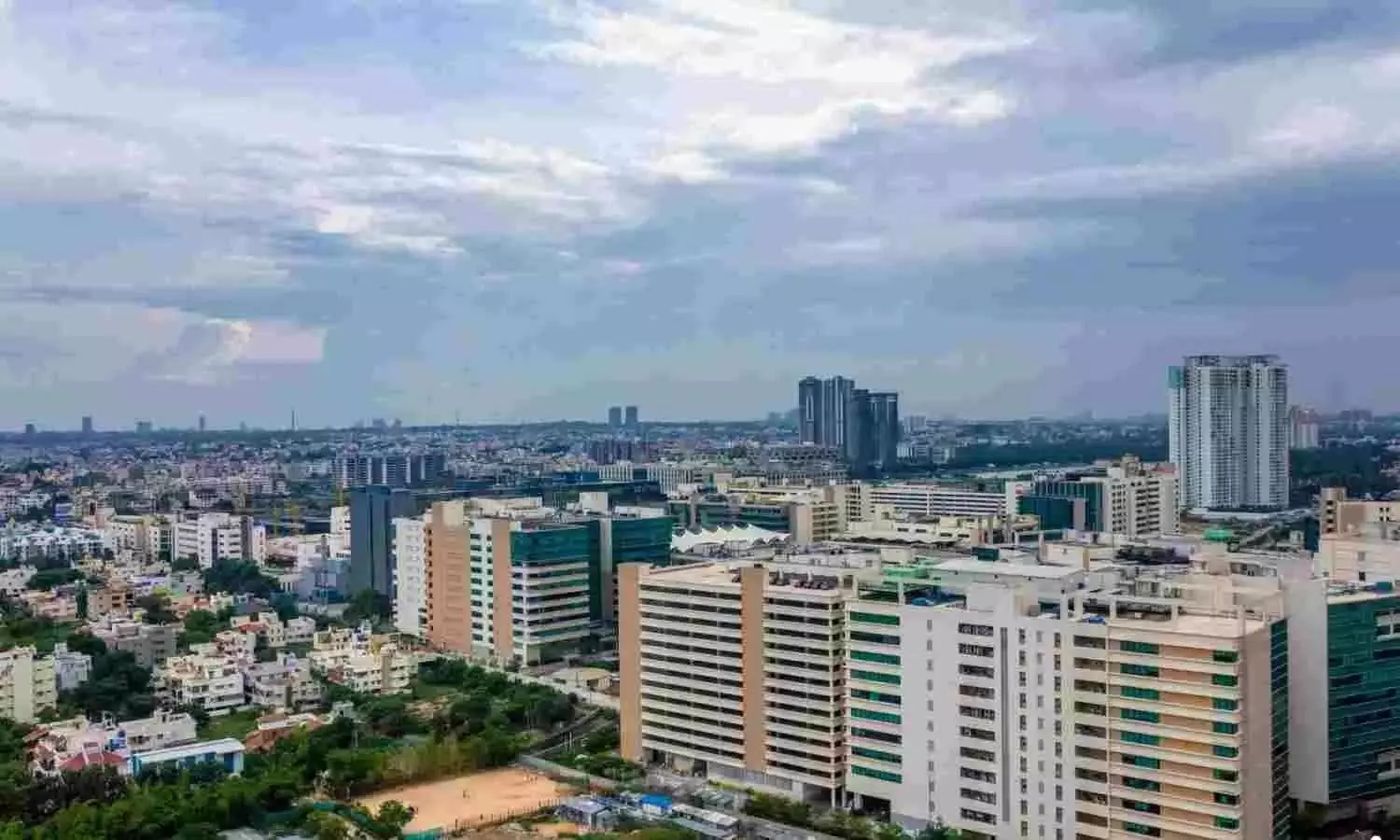
Hyderabad is rapidly strengthening its status as a global technology and manufacturing powerhouse after securing major investment commitments at the World Economic Forum 2026 in Davos, spanning AI, beauty tech, defence manufacturing, clean energy, and global capability centres.
Hyderabad’s transformation into one of India’s most diversified destinations for global investments gathered fresh momentum at the World Economic Forum (WEF) 2026 in Davos. On the second day of the annual global summit, Telangana announced investment commitments and memorandums of understanding (MoUs) worth nearly ₹24,000 crore, cutting across advanced technology, artificial intelligence (AI), manufacturing, clean energy, and global capability centres (GCCs).
The breadth of announcements—ranging from an AI-powered beauty technology hub by French cosmetics giant L’Oréal to defence electronics manufacturing, clean energy projects, and expanded R&D centres—highlights Hyderabad’s growing appeal as a city that offers both scale and specialization. Industry leaders and policymakers see this diversification as a key differentiator that positions Hyderabad ahead of traditional single-sector hubs.
L’Oréal’s AI-powered global beauty tech hub
Among the most significant announcements was L’Oréal’s decision to invest approximately ₹3,500 crore to establish its first AI-powered global beauty technology hub in Hyderabad by 2030. According to a report by The Times of India, the facility will focus on artificial intelligence, generative AI (GenAI), and data-led innovations across beauty science, consumer insights, and digital product development.
The centre is expected to generate close to 2,000 high-skilled technology jobs and integrate India more deeply into L’Oréal’s global innovation and digital ecosystem. Once operational, Hyderabad will become a central node in the company’s worldwide technology network.
“We believe that the future of beauty lies at the intersection of science, technology and creativity,” said Nicolas Hieronimus, CEO of L’Oréal. “Hyderabad will now sit at the heart of our artificial intelligence and digital ambition.”
Industry observers say the decision reflects Hyderabad’s growing reputation as an AI and data science hub, supported by a strong talent pipeline, competitive costs, and a supportive policy environment.
Defence and electronics manufacturing gains traction
In a parallel development, defence manufacturer Apollo Micro Systems announced an investment of ₹30,000 lakh (₹300 crore) to build an integrated electronics and electro-mechanical manufacturing facility in Hyderabad, according to Dalal Street Investment Journal. The facility will focus on advanced electronics, defence-grade systems, and electro-mechanical components, strengthening Telangana’s position in the strategic manufacturing space.
This investment aligns with India’s broader push under the “Make in India” and defence indigenisation initiatives, which aim to reduce dependence on imports and build domestic manufacturing capabilities in sensitive and high-value sectors.
Hyderabad’s existing defence and aerospace ecosystem—including organisations such as DRDO labs, public sector units, and a growing network of private defence firms—has made it a natural choice for such investments.
Unilever explores a global capability centre
Adding to Hyderabad’s expanding GCC ecosystem, FMCG major Unilever is exploring the possibility of setting up a global capability centre in the city, reported The Economic Times. While details are still being evaluated, such a move would further cement Hyderabad’s reputation as a preferred destination for multinational corporations looking to centralise digital, analytics, finance, supply chain, and innovation functions.
Over the past decade, Hyderabad has emerged as one of India’s top GCC hubs, alongside Bengaluru and Pune. Companies are increasingly drawn to the city for its large English-speaking workforce, strong engineering talent, and infrastructure designed specifically to support large-scale corporate operations.
Blaize expands Hyderabad R&D footprint
California-based AI and semiconductor firm Blaize also signed a memorandum of understanding with the Telangana government to scale up its Hyderabad research and development centre, according to The Siasat Daily. The expansion is expected to focus on next-generation AI compute technologies, edge AI solutions, and hardware-software co-design.
The move underscores Hyderabad’s growing relevance not just as a services destination, but as a centre for deep technology research and product development.
Clean energy and advanced manufacturing push
Beyond technology and manufacturing, Telangana also announced MoUs in clean energy and advanced infrastructure. A notable proposal includes a ₹6,000 crore small modular reactor (SMR) project from a joint venture between Slovakia-based IQ Capital and India’s Green House Enviro. While still at a proposal stage, the project signals the state’s intent to explore next-generation energy solutions alongside conventional renewables.
These announcements reflect Telangana’s strategy to balance industrial growth with sustainability, positioning Hyderabad as a future-ready city aligned with global climate and energy transitions.
Why Hyderabad stands out
Experts say Hyderabad’s rise as a diversified investment destination is the result of multiple converging factors.
First, policy continuity and proactive governance have played a crucial role. Successive state governments have focused on ease of doing business, fast-track clearances, and investor-friendly policies. Dedicated industrial corridors, sector-specific parks, and strong public-private engagement have reduced execution risks for global companies.
Second, the city offers a rare mix of IT, deep tech, life sciences, manufacturing, and aerospace capabilities. This diversity allows multinational firms to co-locate multiple functions—R&D, manufacturing, digital services, and global operations—within the same ecosystem.
Third, Hyderabad’s talent pool has expanded beyond traditional IT skills to include AI, data science, semiconductor design, life sciences, and advanced manufacturing. The presence of top universities, research institutions, and a growing startup ecosystem further strengthens this advantage.
Finally, infrastructure development—from metro connectivity and international air links to large technology parks and industrial clusters—has kept pace with investment inflows, ensuring scalability.
A city moving beyond sector silos
The WEF 2026 announcements reinforce the view that Hyderabad is no longer competing solely as an IT outsourcing hub. Instead, it is positioning itself as a multi-sector global node where technology, manufacturing, energy, and innovation intersect.
As global companies look to diversify supply chains, build resilient operations, and tap into emerging markets, Hyderabad’s balanced ecosystem offers a compelling proposition. The investments announced at Davos suggest that global confidence in the city’s long-term potential continues to deepen.
With AI-led innovation, advanced manufacturing, clean energy, and GCC expansion all unfolding simultaneously, Hyderabad appears well on its way to becoming one of India’s most diversified and future-ready global investment destinations.





