

Why Interim Total Rewards Leadership Is the Smartest Move During a Transition Year
find out why hiring interim total rewards leadership is a strategic move during transition years. See how it supports strategy, continuity, and compliance.
image for illustrative purpose
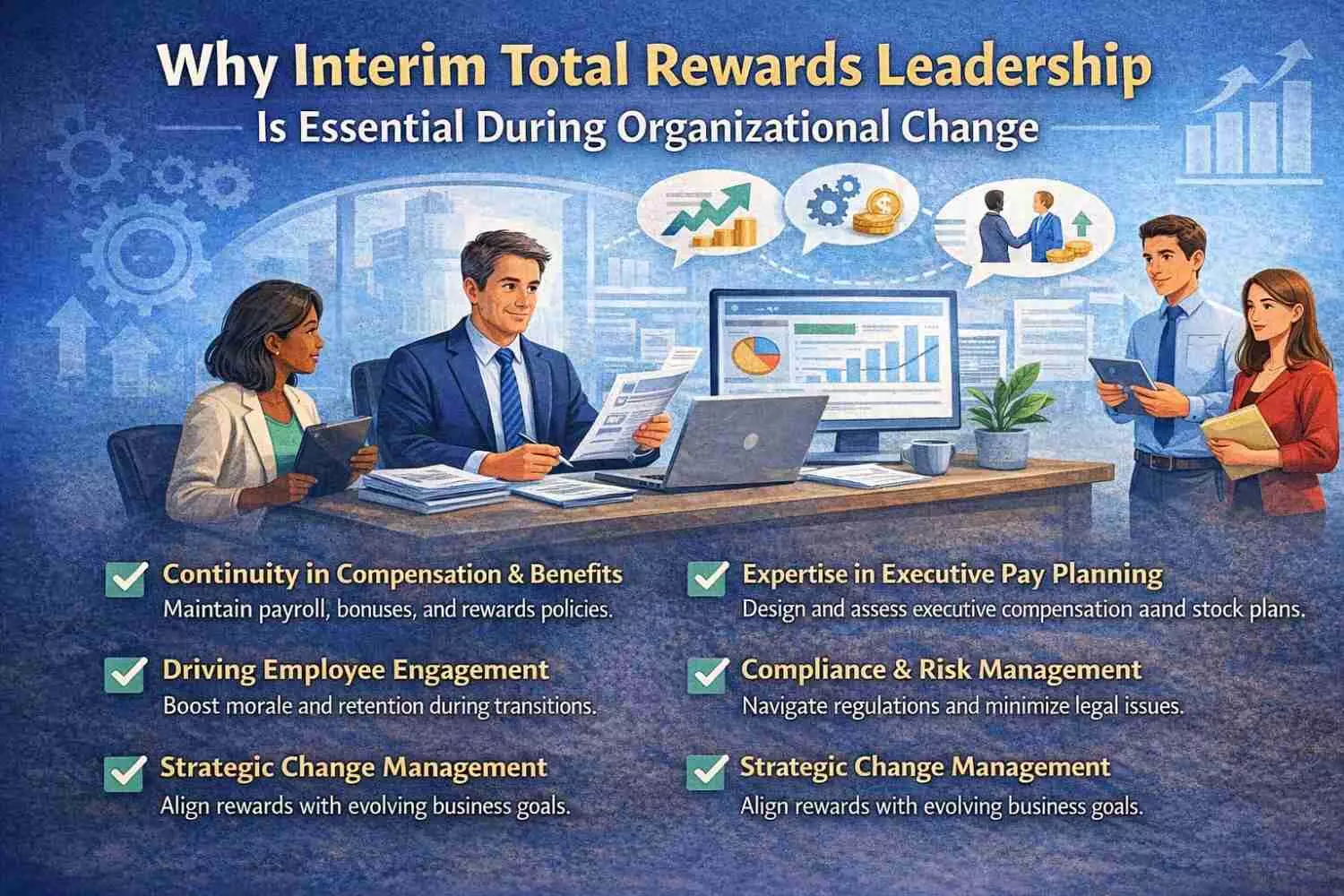
Change is inevitable in the fast world of business. Leadership shifts, mergers, acquisitions, rapid growth, downsizing, these changes, though necessary, bring the possibility of instability and uncertainty. During such periods, organizations need to protect their most valuable asset: their people. This is where interim total rewards leadership comes in as an intelligent, strategic solution.
Having an experienced interim professional on board provides continuity in key areas, such as compensation, benefits, and performance management. More significantly, firms that integrate total reward solutions for talent management into their transition strategy are much more likely to sustain employee morale, recruit new talent, and stay competitive.
Let's examine why an interim total rewards leader is more than a fill-in; they are a driver of organizational success.
What Does an Interim Total Rewards Leader Do?
Interim total rewards leaders are experienced professionals brought in on a short-term basis to manage and guide a company's compensation, benefits, and rewards strategy. These experts not only keep things running; they also frequently improve them.
Key Responsibilities
Design and study compensation systems.
Examine and rationalize reward schemes.
Comply with the law and regulations.
Good communication with the employees.
Strategically plan executive compensation and stock plans.
Develop evidence-based reports and insights.
Since internal politics or legacy concerns do not constrain them, interim leaders can move swiftly and objectively, delivering immediate value to organizations.
Why Transitions Require Expert Reward Strategy
In times of change, the lack of strategic leadership in total rewards will result in setbacks. Past-due deadlines, stagnant salary bands, compliance missteps, and communication failures are just the tip of the iceberg. An interim leader sidesteps these mistakes by bringing stability and a vision-driven plan.
Key Benefits of Interim Total Rewards Leadership
Continuity of business operations: Payroll, bonuses, and benefits are managed with ease.
Reduced risk: Ensures regulatory and legal compliance throughout transitions.
Strategic perspective: Offers new, objective insights into current reward systems.
Improved communication: Facilitates effective change management across departments.
When Should You Consider Hiring an Interim Total Rewards Leader?
Not all situations need an interim leader, but most transitional times do. Typical scenarios include:
Scenario
| Interim Leader’s Role
| Outcome |
Executive departure | Maintain strategy, guide new leadership
| Smooth change of leadership |
Merger or acquisition
| Standardize the pay structure, merge benefits
| Reduced worker confusion and discontent |
Company restructure | Revamp the reward structure to comply with the new org chart
| Efficient use of resources and improved morale |
Rapid expansion
| Implement a scalable compensation plan
| Supports recruitment and retention goals |
IPO preparation
| Develop design executive and equity compensation plans
| Guarantees compliance and readiness |
Commonly Used Tools
HR analytics platforms.
Internal equity review models.
Compensation benchmarking tools to render the market competitive.
Employee satisfaction and engagement surveys.
Scenario planning and forecasting models.
These tools enable leaders to make data-driven decisions that balance both short-term and long-term objectives.
Real-Life Advantages of Interim Total Rewards Leadership
Let's examine how organizations benefit from interim leadership during a transitional year.
Immediate Gains
No interruption to mission-critical HR operations.
Rapid onboarding with low ramp-up.
Compliance, equity, and strategy expertise on demand.
Long-Term Organizational Benefits
Improved employee experience.
Simplified compensation systems.
Updated HR tools and methods.
Strategic perspective transferred to fixed leadership.
By the time the interim leader passes the role, the department is not only operating, it's optimized.
How Interim Leaders Integrate With Your Team
One of the prevailing myths is that interim professionals work alone. Not so: in fact, they often become deeply embedded in your HR and leadership teams.
How They Collaborate
Collaborate with CHROs, CFOs, and CEOs.
Oversee internal HR personnel and vendors.
Chair reward committees and task forces.
Act as advisors during board meetings.
They are seen as members of the team, even if only temporarily, bringing fresh insights without disrupting culture.
Why Communication is Crucial During Change
In times of transition, employees seek clarity and reassurance. Timely, transparent communication regarding compensation and benefits can be the difference between retention and turnover.
A Strong Communication Plan for Employee Benefits Should:
Clarify why and how benefits can be altered.
Describe adjustment timelines.
Include FAQs and contact points.
Emphasize company values and support.
Interim leaders also develop or refine plans, such as an employee benefits communication plan, to keep employees informed and engaged, ensuring trust is maintained during times of uncertainty.
Trends Driving Demand for Interim Total Rewards Leaders
With changing expectations in the workforce and compliance becoming increasingly complex, demand for interim professionals is on the rise. Below are some trends that drive this need:
Expanded hybrid and remote working arrangements.
Demand from employees for flexible and inclusive benefits.
Surge in lifestyle and mental well-being perks.
Worldwide workforce growth and regulatory sophistication.
Navigating these changes requires both vision and precision, exactly what an interim leader offers.
Key Takeaways
Engaging total rewards interim leadership is a forward-thinking move, not a backward-thinking one. Particularly in times of change, it keeps your people strategy in place, your operations compliant, and your culture resilient.
Summary of Benefits
Strategic compensation and benefits alignment.
Leadership and organizational continuity through change.
Pay and incentive structures aligned with the market.
Increased employee morale and transparency.
Future growth frameworks that are scalable.
Final Thoughts
Engaging interim total rewards leadership in a year of transition is not just a temporary solution; it's a strategic investment in the strength and long-term vitality of your organization. These experienced leaders provide continuity, fresh skills, and develop scalable reward systems that are greater than a tour of duty. By being consistent in compensation, benefits, and communication approaches, with the help of professionals like Northcove Consulting throughout the entire change life cycle, you can retain employee trust, sustain operational excellence, and set your company up for long-term success.
Frequently Asked Questions
How long do interim total rewards leaders typically stay?
Most assignments last between 3 and 12 months, based on the scale of the transition or strategic initiative.
Are interim leaders more expensive than permanent hires?
They will cost more on an hourly or monthly basis, but there is no long-term overhead such as benefits, severance, or equity grants, so they are economical for short-term requirements.
Can an interim leader manage a full HR team?
Yes. The majority of interim managers are experienced executives who can oversee departments, guide HR managers, and report directly to the C-suite or board.
What industries benefit most from interim rewards professionals?
Regulated or rapidly evolving industries, such as finance, technology, health, and manufacturing, greatly benefit from the use of interim management during times of transition.
How do they support recruitment and retention during periods of transition?
By implementing total reward solutions to manage talent and developing a comprehensive communication plan for employee benefits, they support both hiring new employees and the retention of existing ones.





