

Interstellar Comet 3I/Atlas Baffles Scientists as Its ‘Flipped’ Anti-Tail Defies Standard Physics
Interstellar comet 3I/Atlas stuns scientists as its anti-tail mysteriously ‘flips’, prompting Avi Loeb to question conventional comet physics and composition.
Hubble captures the unusual ‘flipped’ anti-tail of interstellar comet 3I/Atlas during its approach toward Earth.
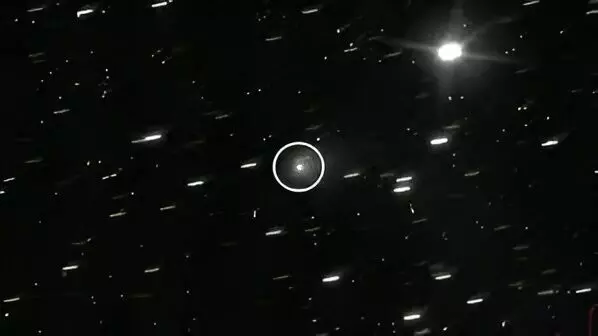
Interstellar comet 3I/Atlas is under intense scientific scrutiny after the astronomers had observed its anti-tail flipping orientation—an unusual and uncharacteristic behavior for comets. The object will pass near earth at a distance of 167 million miles (270 million km) on December 19, which is the day of its closest approach to earth, and will be visible for several months before departing the solar system forever.
According to NASA, major observatories and spacecraft continue to track the rare visitor. But its recent behavior has amplified debate within the scientific community.
Avi Loeb Challenges Conventional Explanations
In a new analysis published on Medium, Harvard astrophysicist Avi Loeb argues that the flipped anti-tail suggests 3I/Atlas may contain material unlike anything found in typical solar-system comets. Loeb says the comet exhibits 13 anomalies, with the most striking being the reversal of its anti-tail’s direction before and after perihelion, as captured in Hubble Space Telescope images.
He emphasizes that the reversal is not a perspective trick:
“The orientation of the anti-tail flipped relative to the direction of motion at perihelion and is definitely not a matter of perspective.”
Loeb also criticizes what he describes as a “lack of curiosity” among comet specialists, noting that only two interstellar objects—1I/ʻOumuamua and 2I/Borisov—have been studied previously. With so little data, he argues, dismissing unconventional possibilities is premature.
Why the Anti-Tail Behavior Defies Known Physics
A comet’s dust tail normally points away from the Sun due to radiation pressure. But Loeb says this mechanism cannot explain 3I/Atlas’s drastic tail flip.
In his research papers, he proposes two possibilities:
The anti-tail may consist of evaporating ice fragments that disappear before sunlight can redirect them.
Alternatively, it could contain large, heavy debris unaffected by solar radiation or solar wind.
These scenarios, he says, point to an object with unusual structure or composition.
Criticism and Scientific Debate
Loeb’s interpretations have stirred controversy. Astronomer Chris Lintott previously called broad alternative explanations “nonsense on stilts,” arguing the scientific process requires stronger evidence.
Loeb counters that scientists are dismissing anomalies too quickly. He has authored 11 papers on 3I/Atlas so far and claims early suggestions—including a discussion about potential technological origins—were removed during peer review at Lintott’s request. He later co-authored a separate study exploring technological possibilities more formally.
As 3I/Atlas continues its journey through the inner solar system, astronomers worldwide are watching closely—hoping the mysterious interstellar comet will offer new insights into objects that wander between the stars.





