

Dubai's AC Units Fail at Nearly Three Times the Global Average - Engineers Explain Why
Extreme climate conditions and maintenance challenges push Dubai’s cooling systems beyond global reliability standards
Engineers reveal that Dubai’s harsh climate, continuous usage, and maintenance gaps contribute to air conditioning units failing at nearly three times the global average, raising concerns about durability and efficiency.
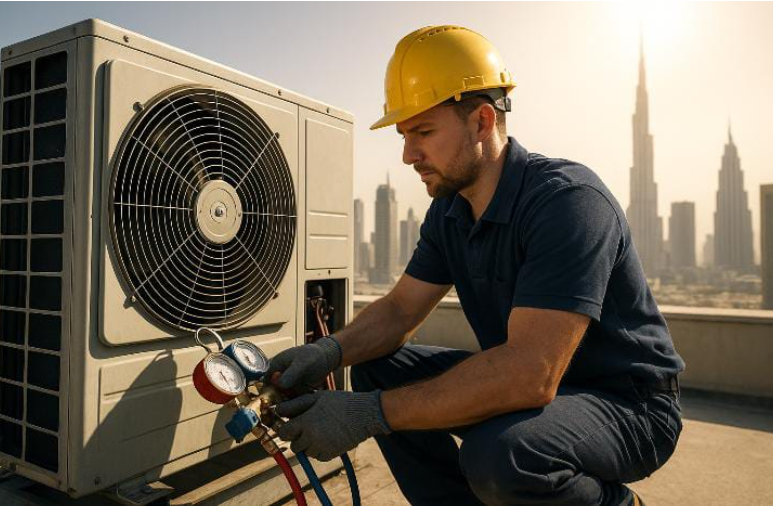
Dubai, UAE - An air conditioning unit installed in London, Sydney, or Houston will typically run for 15 to 20 years before it needs a major overhaul. That same unit, installed in a Dubai villa, is unlikely to make it past seven.
European Technical reviewed more than 12,000 residential AC service calls across Dubai in 2025 and found a statistic that caught even their own engineers off guard: 38 per cent of units brought in for major repair were less than four years old. Not ten. Not eight. Four.
"We're not talking about cheap units either," said Khalid Nasser, senior HVAC engineer at European Technical. "People spend AED 8,000 on a quality split system, expect it to last a decade, and three summers later they're looking at a compressor replacement that costs nearly as much as the original unit."
The three things that destroy AC systems in Dubai
Compressor burnout tops the list at 24 per cent of all major repairs. Refrigerant leaks from vibration fatigue account for 19 per cent. Condenser coil corrosion, caused by a combination of airborne salt and fine desert sand, makes up another 17 per cent.
That last one deserves a closer look. Outdoor condenser units in Dubai take a beating that manufacturers in Japan or South Korea never designed for. Desert sand grinds down aluminium fins like fine-grit sandpaper. Meanwhile, coastal humidity carries salt particles several kilometres inland. The two forces work together, eating through protective coatings and opening micro-leaks that bleed refrigerant slowly over months.
This is exactly why AC gas refill in DAMAC Hills and neighbouring villa communities ranks among the most frequent call-out types across the industry. The homeowner notices the AC blowing warm air in July and calls for help. By that point, the compressor has been overworking for weeks, pulling excess electricity and running hot. One problem becomes three.
What a failing AC costs you on your DEWA bill
A neglected unit draws 30 to 40 per cent more electricity than a well-maintained one. The Dubai Electricity and Water Authority has published data confirming this range. For a three-bedroom villa with five split units, that translates to AED 400 to 600 extra per month during peak summer.
DEWA's 2025 tariff structure makes this worse than it sounds. Residential rates increase in tiers as consumption rises. An inefficient AC system does not just use more power. It pushes the entire household into a higher billing bracket, so every kilowatt costs more.
Nasser puts it bluntly: "Spend AED 600 on a proper service twice a year, or spend AED 2,000 to 3,000 more on electricity and then another AED 5,000 when the compressor gives out in August. Homeowners make this choice every year, and too many of them choose wrong."
Villa communities with ageing systems are getting hit hardest
The pattern is most visible in Arabian Ranches and The Springs, where many AC installations are 10 to 15 years old. European Technical's emergency callout rate in these communities runs nearly double that of newer developments like Dubai Hills or Tilal Al Ghaf.
Compressor replacements account for most of the high-cost repairs in these areas. But the underlying issue is simpler and more preventable than a dead compressor.
"I walk into villas in The Springs with original units from 2007 or 2008 that have never had a chemical clean," Nasser said. "Fifteen years of accumulated dust inside the evaporator coil. The system is pushing air through what is essentially a clogged filter. It runs at maybe 60 per cent capacity, the owner cranks the thermostat lower, and the compressor works even harder to compensate. It is a slow death."
What actually helps (and what is probably already overdue)
Two full service visits per year is the baseline recommendation across the UAE HVAC industry. One before summer starts, one mid-season. A proper service covers chemical coil cleaning, refrigerant pressure testing, electrical terminal inspection, drain line flushing, and thermostat calibration.
For any unit older than five years, annual thermal imaging of electrical connections and compressor housing can catch early-stage problems before they become emergency breakdowns. Waterfront properties face an additional layer of risk. AC maintenance providers in Dubai Marina report that salt-air exposure accelerates condenser corrosion by roughly 30 per cent compared with inland communities. If you live near the coast, the service schedule should be tighter, not looser.
Dubai's Net Zero 2050 strategy has pushed inverter-technology AC units into the mainstream. These systems modulate compressor speed to match actual cooling demand instead of cycling on and off at full power. They last longer, use about 30 per cent less electricity, and handle Dubai's sustained heat loads with less mechanical stress. The upfront cost is higher. The five-year cost of ownership is not.
European Technical is a Dubai-based home maintenance company providing AC, plumbing, electrical, painting, and general maintenance services across Dubai and Abu Dhabi. Licensed by Dubai Municipality, the company serves residential and commercial clients with same-day emergency response. For more information, visit europeantechnical.ae or call 800 031 10015.





