

Drones powering a new farm revolution
How Thanos Technologies is transforming agriculture with rugged, high-performance drone solutions
Prathyush Akepati and Pradeep Palelli with the agricultural drone
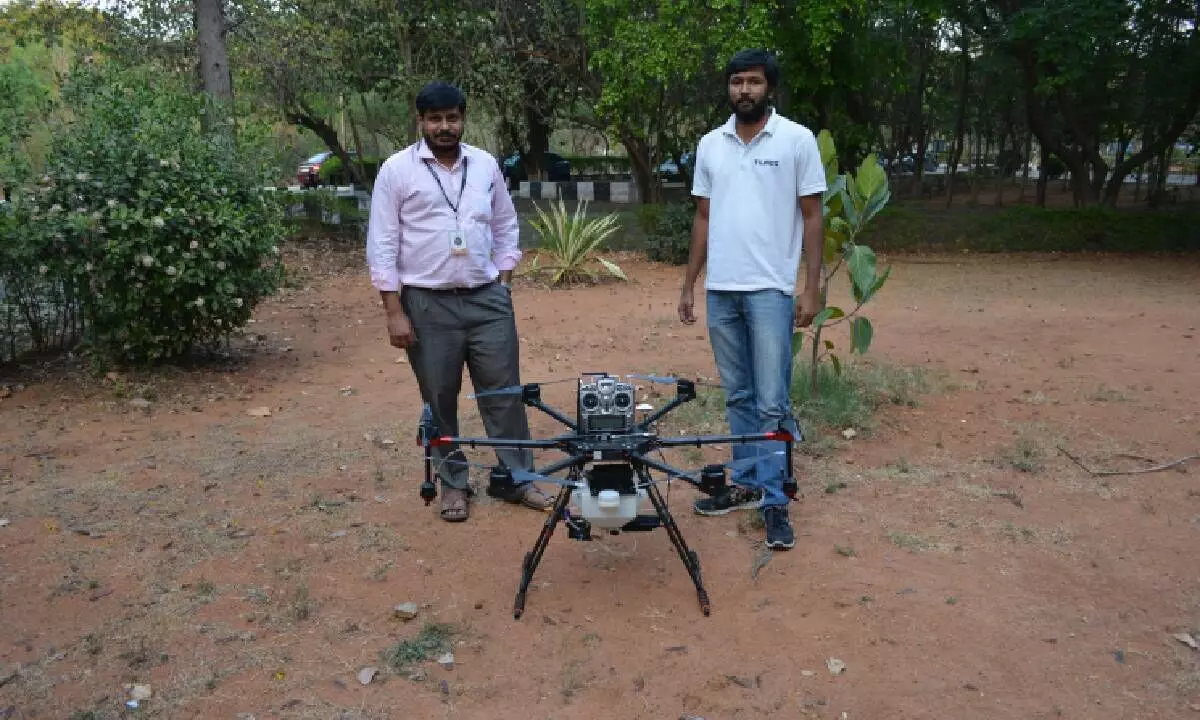
Hyderabad: In India’s fast-evolving agri-tech landscape, Thanos Technologies, co-founded by Pradeep Palelli and Pratyush Akepati, is carving out a distinct identity by going beyond drone assembly to deliver meaningful on-ground impact. Founded to solve critical agricultural challenges, the company has developed rugged, high-performance drones that address labour shortages, improve spraying efficiency, and enhance farmer safety.
From early experimentation to scaling operations across nine states, Thanos Technologies is emerging as a key player in driving drone adoption in agriculture. It is also expanding into defence and autonomous systems. In this interview with Bizz Buzz, co-founder Pradeep Palelli speaks about the company’s journey, regulatory hurdles, and the larger vision of putting “a drone in every village.”
What inspired you to start Thanos Technologies, and how did the idea evolve?
Around 2015-16, drones in India were largely used for photography, surveying, and mapping. We wanted to solve a serious, large-scale problem. After exploring multiple ideas, we focused on agricultural spraying, where labour shortages, inefficient manual methods, wastage of agrochemicals, and health risks were significant. Our mission became clear: strengthen farmers, increase productivity, and optimise resources.
What were the biggest uncertainties in the early days, and how did you validate your business model?
The initial challenges included raising capital, conducting proof-of-concepts, building a team, and navigating regulatory uncertainty. Until 2021, there were no clear commercial drone regulations, so we relied on custom drone orders for defence and private R&D. Our model could have evolved either as a product company or a service provider. Once regulations were formalised, we got certified and began production in late 2022.
The name “Thanos” symbolises strength. How does that reflect your vision?
Our drones are designed Palelli to be rugged and reliable. But strength also reflects the solutions we provide, boosting productivity and reducing inefficiencies for farmers. The long-term impact we aim for extends beyond agriculture into other sectors.
Why agriculture, despite having capabilities across sectors?
While our core strength is drone design, we focus on solving high-impact problems. Agricultural spraying presented immediate, large-scale challenges. Given limited resources in the early days, we chose to stay focused rather than spread ourselves thin.
What differentiates Thanos from other drone companies?
Many players assemble drones using imported kits, offering little differentiation. At Thanos, we design and manufacture drones in-house, which gives us control over quality, components, and future upgrades. This also enables us to continuously improve our products.
What were the key engineering breakthroughs in the SYENA series?
The SYENA H10 was built from the ground up. We incorporated larger motors for efficiency and longevity, and in-house lithium-ion batteries designed for long life and low maintenance. The heavier and larger design was intentional to ensure durability in Indian field conditions. Extensive trials confirmed improvements in performance, coverage, and reliability.
How do your drones address labour shortages and safety concerns?
Our drones operate autonomously and can spray 6–8 acres per hour, about ten times more efficient than manual methods. This ensures uniform spraying, reduces agrochemical wastage, and eliminates direct exposure of farmers and operators to harmful chemicals.
How important is diversification beyond agriculture?
Diversification is important but must be strategic. We are expanding into defence and unmanned surface vehicles (USVs), but only in areas aligned with our core capabilities in design and engineering.
What role do AI and data analytics play?
Our drones are multi-application platforms. AI and analytics will enhance precision spraying, crop monitoring, and automation. This will help farmers make data-driven decisions while reducing manual effort.
What are the key barriers to adoption in agriculture?
Major challenges include high upfront costs, slow financing, delays in subsidy implementation, and the presence of non-certified drones. Strict enforcement of certification norms and faster subsidy execution are critical for scaling adoption.
Which model works best—ownership or services?
Drones should be owned by farmers, FPOs, SHGs, or commercial operators. Individual ownership alone is not viable for continuous utilisation. The Village Level Entrepreneur (VLE) model is key to achieving the vision of “a drone in every village”.
How have regulations influenced growth?
The 2021 regulations enabled certified manufacturing and market expansion. However, non-certified drones still dominate, posing safety risks and affecting legitimate businesses. This also impacts investor confidence and slows innovation.
What policy changes would accelerate adoption?
Strict enforcement against non-certified drones, timely subsidy disbursement, and faster loan approvals under schemes like the Agriculture Infrastructure Fund would significantly boost adoption.
What is your current scale of operations?
We operate in nine states with a team of around 50 people and a 10,000 sq. ft. facility in Hyderabad. Our production capacity is 3,000 drones per year, and we have achieved 50–70 per cent annual revenue growth while remaining bootstrapped. We are now looking at expansion into Africa and the US.
Can drones help reduce rural-to-urban migration?
Yes. Drones create income opportunities and enable entrepreneurship in villages, helping people build livelihoods locally and reducing migration pressures.
Where do you see Thanos in the next decade?
We aim to deploy over 10,000 drones across sectors, expand internationally through partnerships, increase vertical integration in components and software, and develop autonomous systems across air, land, and water.
Is fully autonomous precision agriculture achievable in India?
Automation will play a major role in tasks like spraying and monitoring, but human expertise will remain essential for decision-making and system design.
How has your innovation philosophy evolved?
The principle remains the same: strength through innovation. Early breakthroughs like in-house battery development set us apart. Today, we continue to explore new materials, software, and designs to maintain leadership and deliver long-term impact.
Your advice to young agri-tech entrepreneurs?
Focus on solving real problems at scale. Build practical solutions, keep learning, and adapt quickly.





