

Apple debuts M5 Pro, M5 Max chips to power next-gen MacBook Pro
Apple unveils M5 Pro and M5 Max chips with new Fusion Architecture, offering 18-core CPUs, up to 40-core GPUs and major AI performance gains.
Apple debuts M5 Pro, M5 Max chips to power next-gen MacBook Pro
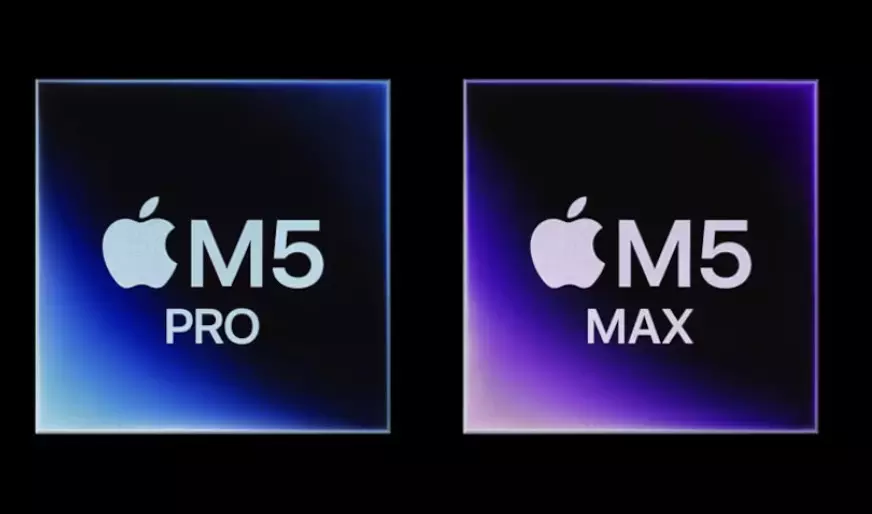
Apple has introduced its next-generation M5 Pro and M5 Max chips, featuring a new Fusion Architecture that combines two dies into a single high-performance system-on-a-chip, delivering major gains in CPU, GPU and AI performance for the latest MacBook Pro lineup.
Apple on Tuesday expanded its Apple Silicon roadmap with the launch of the M5 Pro and M5 Max, the newest additions to its M-series family. The chips power the updated MacBook Pro models and are engineered around what Apple calls its new “Fusion Architecture.”
The Fusion Architecture merges two silicon dies into a single high-performance system on a chip (SoC). The unified design integrates an advanced CPU, scalable next-generation GPU, Media Engine, unified memory controller, Neural Engine, and Thunderbolt 5 connectivity into one tightly integrated platform.
Major CPU upgrade
Both the M5 Pro and M5 Max feature an 18-core CPU, marking a significant jump from the 14-core configuration in M4 Pro and 16-core setup in M4 Max. The CPU includes six “super cores” — Apple’s highest-performance cores — alongside 12 newly designed performance cores.
Apple claims the new CPU architecture delivers up to 30% faster performance for professional workloads, targeting tasks such as large-scale data modeling, software compilation, advanced video production, and scientific simulations.
GPU and AI gains
The GPU architecture builds on the base M5 platform, scaling up to 40 cores in higher configurations. Each GPU core includes a Neural Accelerator, enhancing AI-related performance. According to Apple, the M5 Pro and M5 Max deliver over four times the peak GPU compute for AI tasks compared to the previous generation.
Overall graphics performance is said to be up to 20% faster, while ray-tracing workloads improve by as much as 35%, making the chips more capable for 3D rendering, real-time effects, and high-end creative workflows.
Unified memory and bandwidth
Memory capacity and bandwidth also receive substantial upgrades.
M5 Pro supports up to 64GB of unified memory, up from 48GB in M4 Pro, with bandwidth reaching 307GB/s.
M5 Max continues to support up to 128GB of unified memory, with memory bandwidth increasing to 614GB/s, designed for data-intensive and AI-heavy applications.
The expanded unified memory system enables seamless data sharing between CPU, GPU, and Neural Engine, reducing latency and boosting overall efficiency for demanding tasks.
Target audience
Apple says the M5 Pro is aimed at professionals such as post-production sound designers, developers, engineers, and STEM students who need balanced CPU and GPU performance.
The M5 Max is targeted at 3D animators, AI researchers, app developers, and other power users who require maximum GPU compute performance and high memory bandwidth for advanced machine learning, rendering, and simulation workloads.
Availability
The new MacBook Pro models powered by M5 Pro and M5 Max will be available for pre-order starting Wednesday, with retail availability beginning March 11.
With the introduction of Fusion Architecture and stronger AI acceleration, Apple continues to position its in-house silicon as a key competitive advantage in professional computing and next-generation AI workloads.





