

AudioConvert: redefining productivity with an AI-powered audio to text converter
image for illustrative purpose
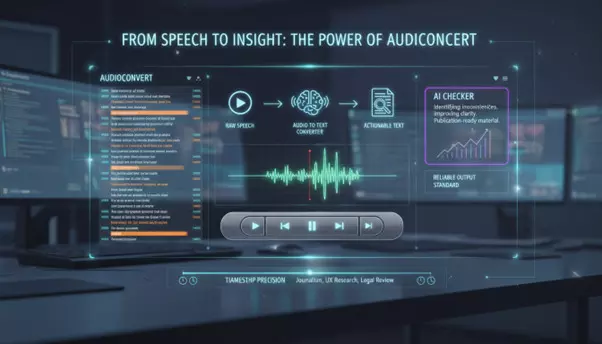
Modern workflows rely heavily on recorded conversations—meetings, interviews, research sessions, content drafts, team discussions. Yet these recordings rarely translate into actionable knowledge unless processed efficiently. AudioConvert approaches this challenge with an AI-driven engine that converts audio and video files into structured text designed for fast retrieval and deeper analysis. For teams handling high information volume, this shift influences not only operations but the velocity of decision-making itself.
The following exploration looks at AudioConvert through the lens of practical performance, workflow adaptability, and the broader implications of automated transcription on how individuals and organizations process spoken content.
The expanding need for rapid transcription in modern work environments
How an audio to text converter reshapes the path from raw speech to actionable text
The rise of distributed teams, creator-led publishing, and research-heavy industries has created a surge in recorded material. An audio to text converter addresses the central bottleneck: the gap between capturing a conversation and extracting what matters. AudioConvert focuses on producing clean transcripts that eliminate the need for repeated playback, reducing manual review time while improving accuracy.
In practical use, this changes how users approach complex audio. Rather than navigating full recordings, they interact with a text interface that supports scanning, searching, quoting, and contextual interpretation. The transcript becomes a tool for thinking rather than a mechanical record. This shift allows users to move from reviewing content to acting on it significantly faster.
Enhancing transcript clarity with an ai checker
Even strong AI transcription benefits from a final layer of refinement when the text will be shared externally. Integrating an ai checker strengthens the editorial pipeline by identifying inconsistencies and improving clarity without manual line-by-line editing. For users who generate interviews, podcasts, training modules, or case studies, this collaboration between transcription and AI-driven language checking helps produce polished, publication-ready material with minimal effort.
The end result is a more reliable output standard that scales well as content volume increases.
Why timestamp precision affects usability
One overlooked strength of AudioConvert lies in its time-aligned structure. Each line includes second-level timestamps that bridge the transcript and the original recording. This detail becomes essential when confirming tone, validating quotes, or reviewing specific interactions. Fields such as journalism, UX research, legal review, and academic analysis depend on accuracy, and precise timestamps reduce ambiguity across all these contexts.
The combination of clarity and verifiability supports more confident analysis and reduces the risk of misinterpretation.
Where AudioConvert fits into real-world professional workflows
Research-heavy environments that rely on accurate capture
Researchers who conduct long-form interviews or multi-session studies often face massive transcription workloads. AudioConvert transforms these hours into well-organized text that can be coded, segmented, and analyzed. This reduces the cognitive load of navigating raw recordings and increases the time available for synthesis and interpretation.
This is especially important in qualitative fields, where patterns emerge only after examining large text sets. With AudioConvert, insights become accessible earlier in the process, enabling stronger conclusions and faster reporting.
Content creators managing high-volume production
Creators who speak ideas aloud—podcasters, YouTubers, educators, consultants—benefit from a system that turns spoken drafts into structured text. AudioConvert helps convert recordings into working material for scripts, captions, social posts, or newsletters. Many creators operate across multiple platforms, and transcripts reduce the friction of repurposing content quickly.
Efficiency becomes a competitive advantage, especially for creators producing weekly or daily content cycles.
Remote teams that depend on transparency and searchable communication
Remote collaboration often leads to information fragmentation. AudioConvert helps teams generate written references for key meetings and discussions, providing searchable text that improves communication continuity. This archive serves as a shared knowledge system, reducing repeated explanations and supporting objective recall of decisions.
With timestamps, teams can cross-reference specific moments without revisiting full recordings, enabling smoother onboarding and more consistent alignment.
The foundations of AudioConvert’s design philosophy
Prioritizing a frictionless user experience
Many advanced tools demand attention and configuration before delivering results. AudioConvert takes a more streamlined approach: upload, transcribe, export. The interface remains intentionally minimal so users can focus on the content rather than the tool. This simplicity supports users who need efficiency without sacrificing control.
By removing unnecessary complexity, the tool becomes easier to integrate into daily workflows.
Maintaining stable performance across diverse recording conditions
Recordings vary widely in quality—mobile voice notes, online calls, studio sessions, field interviews. AudioConvert’s AI models are trained across a range of environments, enabling reliable performance even when audio is imperfect. Consistency is critical when teams depend on predictable outputs; fluctuations in accuracy create delays and uncertainty.
AudioConvert’s stability ensures that the tool remains trustworthy across changing contexts and project demands.
Output formats designed for flexible workflows
Once the transcript is generated, users often move it into writing apps, research tools, CRM systems, or content editors. AudioConvert supports this with export formats that maintain structural clarity while remaining easy to manipulate. The output adapts to both simple tasks—like reviewing a meeting—and complex ones, such as building a multi-chapter report or content strategy draft.
This flexibility keeps transcripts valuable across different stages of a project.
Turning transcripts into strategic assets
From text to structured insights
A transcript is more than a record; it is the foundation for insight extraction. Once speech becomes text, users categorize topics, highlight evidence, trace argument flows, and identify decision patterns. The transcript becomes a tool for strategic thinking rather than a passive document.
Teams working in consulting, research, or product strategy benefit greatly from this transformation. It shortens the path from conversation to outcome.
Accelerating internal training and knowledge transfer
Organizations that rely on workshops, onboarding sessions, or technical briefings often struggle to maintain consistent documentation. Converting video training into text allows teams to create reference guides, revise materials, and ensure standardized knowledge across departments.
AudioConvert supports the creation of internal libraries that remain accessible long after the original session has ended.
Improving accessibility and strengthening content discoverability
Text-based content is inherently more discoverable, both internally and on public channels. Transcripts help audiences who prefer reading or cannot access audio. They also enable SEO-driven distribution when creators repurpose transcript sections into articles, summaries, or metadata-rich posts.
AudioConvert provides clean, ready-to-edit text that minimizes formatting overhead in these scenarios.
Why AudioConvert is a reliable choice for long-term professional use
Built for durability and steady performance
Tools that succeed in long-term use share a common trait: they stay reliable under pressure. AudioConvert’s balance of speed, clarity, and structural precision supports repeated use without requiring constant adjustments.
This makes it particularly suitable for teams with recurring transcription needs.
Scales naturally with content-heavy workflows
As organizations produce more recordings, transcription moves from a convenience to an essential function. AudioConvert scales with this shift by delivering consistent results whether users handle a few files or a continuous flow of content. This adaptability supports both individual professionals and large teams.
A practical recommendation for users seeking clarity and speed
Professionals who need dependable transcripts—analysts, creators, researchers, educators, remote teams—benefit from a tool that minimizes manual effort while maintaining high-quality outputs. AudioConvert fits these requirements with a workflow built around clarity, reliability, and real-world usability.
Its value emerges not from complexity, but from the precision with which it turns spoken content into working material that accelerates thought, collaboration, and execution.





