

Are TCS and Infosys repeating IBM’s past mistakes in the age of AI?
AI disrupts IT services, TCS and Infosys risk repeating IBM’s 1990s mistake: prioritising payouts over reinvention while their core business model faces automation.
TCS and Infosys repeating IBM’s past mistakes in the age of AI
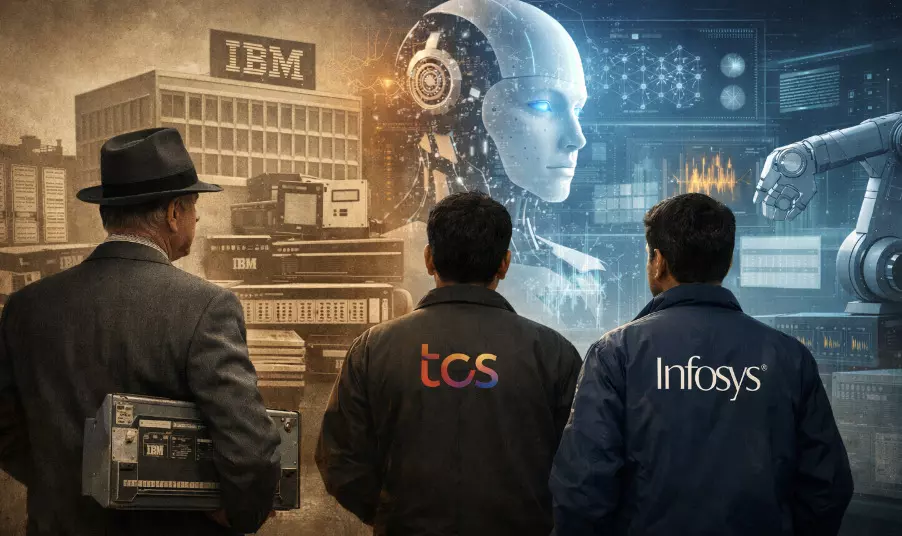
As AI reshapes the technology landscape, Indian IT majors TCS and Infosys are returning billions to shareholders instead of aggressively reinventing themselves. The strategy echoes IBM’s early 1990s playbook, when financial discipline overshadowed structural transformation — with painful consequences.
India’s IT heavyweights, Tata Consultancy Services (TCS) and Infosys, are widely admired for their scale, profitability, and shareholder-friendly policies. But beneath the surface of strong dividends and buybacks, a deeper structural question is emerging: are these companies preparing for the AI era — or managing decline the way IBM once did?
To understand the concern, it helps to revisit a defining moment in global technology history.
In 1990, IBM was the most valuable technology company in the world, generating more than $60 billion in revenue and employing nearly half a million people. It was a symbol of corporate strength and technological dominance. But within three years, that dominance collapsed. Between 1990 and 1993, IBM recorded nearly $16 billion in cumulative losses. Its market value fell by 70%, and the company went from industry titan to a firm fighting for survival.
John Akers, IBM’s CEO at the time, was forced out in 1993. He wasn’t necessarily incompetent; he was a product of the system that had made IBM successful. The problem was that the system itself had become outdated. IBM continued optimising an old model even as computing shifted from mainframes to distributed systems. Financial discipline and internal efficiency could not compensate for a fundamental shift in technology.
Lou Gerstner, the outsider brought in to rescue IBM, later recognised that the company’s crisis was not just operational — it was structural. IBM had to rethink what business it was in.
Fast forward to 2026, and Indian IT services firms face their own turning point. For decades, their growth has been built on a labour-intensive model: adding engineers, executing large transformation projects, and managing global technology operations. This model delivered predictable revenue and strong margins.
Artificial intelligence, however, threatens to change that foundation. AI tools can automate coding, testing, support, and even elements of consulting. Tasks that once required thousands of billable hours can increasingly be done with fewer people and smarter software. This raises uncomfortable questions about future growth, pricing power, and workforce models.
Yet, instead of aggressively pivoting their business mix toward AI-native platforms, products, and intellectual property, many large IT firms appear focused on capital returns. Large dividends and share buybacks signal confidence, but they can also signal limited high-growth reinvestment opportunities.
The parallel with IBM is not exact, but it is instructive. IBM’s leadership once prioritised efficiency and financial metrics while underestimating how deeply technology shifts would reshape its core business. By the time the scale of change became undeniable, the company was already in crisis.
TCS and Infosys are not in distress today. But the lesson from IBM is clear: when the technological ground is shifting, protecting the old model, however profitable can be riskier than it appears.





