

3I/ATLAS: Comet, cosmic visitor or something else? Perhaps will never know!
Image: USA Herald
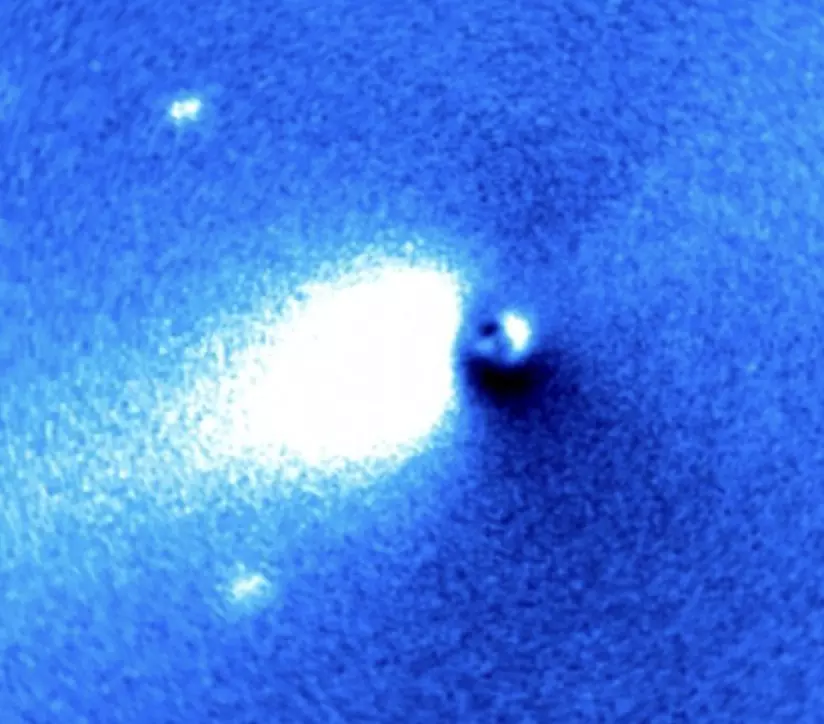
How science, speculation and public intrigue collided over the interstellar object that captivated the world
In mid-2025, astronomers around the globe were alerted to a strange new visitor speeding through our solar system. Detected on 1 July 2025 by the ATLAS sky survey telescope in Chile, the object was soon designated 3I/ATLAS, the third confirmed interstellar visitor ever observed, following ‘Oumuamua in 2017 and 2I/Borisov in 2019.
What made this object especially intriguing was its origin from outside our solar system, confirmed by its highly hyperbolic orbit meaning it wasn’t gravitationally bound to the Sun and was simply passing through at high speed.
But beyond that basic classification lay a simmering mixture of mainstream science and far-fetched speculation: Was 3I/ATLAS merely an unusually behaved comet, or could it possibly be evidence of something far more exotic — even alien technology?
The Scientific Baseline: A Natural Comet
From the outset, the consensus among professional astronomers was that 3I/ATLAS was a natural comet — an icy relic from another star system. Detailed observations from NASA-funded instruments, including the Hubble Space Telescope, the James Webb Space Telescope (JWST), and multiple ground-based observatories, showed that the object had all the traditional hallmarks of a comet:
Icy nucleus with a coma; the hazy cloud of gas and dust that surrounds a comet as sunlit ice sublimates.
Hyperbolic trajectory; unambiguously indicating an origin beyond the solar system.
Typical chemical signatures associated with volatile materials, such as carbon dioxide and other gases commonly seen in cometary activity.
NASA officials and collaborating scientists repeatedly emphasized that no signals or other evidence pointed to any technosignatures, the hypothetical markers that might indicate artificial, engineered origin. “There’s nothing about this object that suggests it’s anything other than a comet,” said Nicola Fox, associate administrator of NASA’s Science Mission Directorate.
Radio telescopes also detected emissions from hydroxyl radicals (OH) in the coma — a classic sign of water outgassing due to solar heating, further confirming its classification as a comet.
Astronomers have also used the object to probe the chemistry of distant stars’ planetary systems, noting unusual abundances of certain molecules, such as methanol and hydrogen cyanide — possibly linked to primordial chemistry in the regions where the comet formed.
The Other Side of the Debate: Speculation and Controversy
Despite the strong scientific consensus, a minority of voices and much of the public refused to let the mystery go. The most prominent proponent of alternative theories was Harvard astrophysicist Avi Loeb, who has long argued that scientists should seriously consider non-natural explanations for unusual interstellar objects.
Loeb and collaborators have suggested that the object’s high velocity and some perceived irregularities might be consistent with an artificial structure — perhaps an alien probe or technology designed for long-distance interstellar travel. They pointed to:
Unusual brightness and motion patterns that didn’t neatly align with textbook comet behavior.
Speculation that the jets of material ejected from the object might operate like propulsion thrusters, hinting at engineered mechanisms.
Critics of this idea argued that the lack of detected signals wasn’t evidence of absence. If an intelligent source wasn’t pointing a beacon at Earth or didn’t transmit at radio frequencies detectable in a brief observation window, we simply wouldn’t see it — leaving open the possibility, however remote, that the object could be artificial.
This line of reasoning gained traction in fringe communities online, where enthusiasts pushed narratives ranging from mysterious Fibonacci-patterned radio pulses to highly speculative claims of exotic gas emissions that could only be engineered. Scientists have firmly rejected these claims, noting that there’s no verified evidence of alien communication or technology linked to 3I/ATLAS.
Misinformation and Public Perception
The surge of speculation wasn’t solely academic. Social platforms and community forums hosted a thriving undercurrent of dramatic claims about hidden signals, anomalous compositions, and conspiracies around scientific silence. Much of this circulated without peer-reviewed evidence and was actively debunked by professional astronomers.
Scientists and science communicators have emphasized that, while 3I/ATLAS is extraordinarily valuable for understanding interstellar chemistry and the physics of cometary bodies, *there is currently no scientific basis for labeling it alien technology. Their measured statements grounded in observation and analysis, stand in contrast to the sensationalism that often dominates public narratives.
What It Ultimately Tells Us
As 3I/ATLAS continues its journey out of the solar system, scientific instruments have pushed the limits of what we can learn from a fleeting cosmic visit. They’ve unveiled rare chemistry, ancient origins possibly older than our own Sun, and physics that expands our understanding of cometary behavior.
Yet in the absence of concrete evidence for intelligent design, the object remains best understood as a natural interstellar comet — one that exemplifies how little we still know about the diversity of matter in the galaxy. Some experts suggest that only with far more advanced instrumentation and prolonged observation campaigns could we ever hope to decisively rule out any non-natural origin, but such technology remains out of reach at present.
In the end, the story of 3I/ATLAS reflects a broader truth about science and exploration: rare phenomena push us to question assumptions, challenge old models, and refine our understanding of the universe — even as they resist simple explanations.
Whether 3I/ATLAS becomes remembered as a comet, a curiosity, or the stuff of science fiction debate, one thing is clear: the mystery it stirred in 2025 will continue to inspire inquiry, scientific and public alike, for years to come.





