

Why Arab world’s outreach to India reshaping geopolitics, global trade geometry
As global fault lines deepen, Arab world’s outreach to Bharat is no longer about energy alone. It is about finding a partner that can anchor growth, capital, stability in an increasingly fragmented global economy
Why Arab world’s outreach to India reshaping geopolitics, global trade geometry
Breaking the Post-WW- II Trade Order
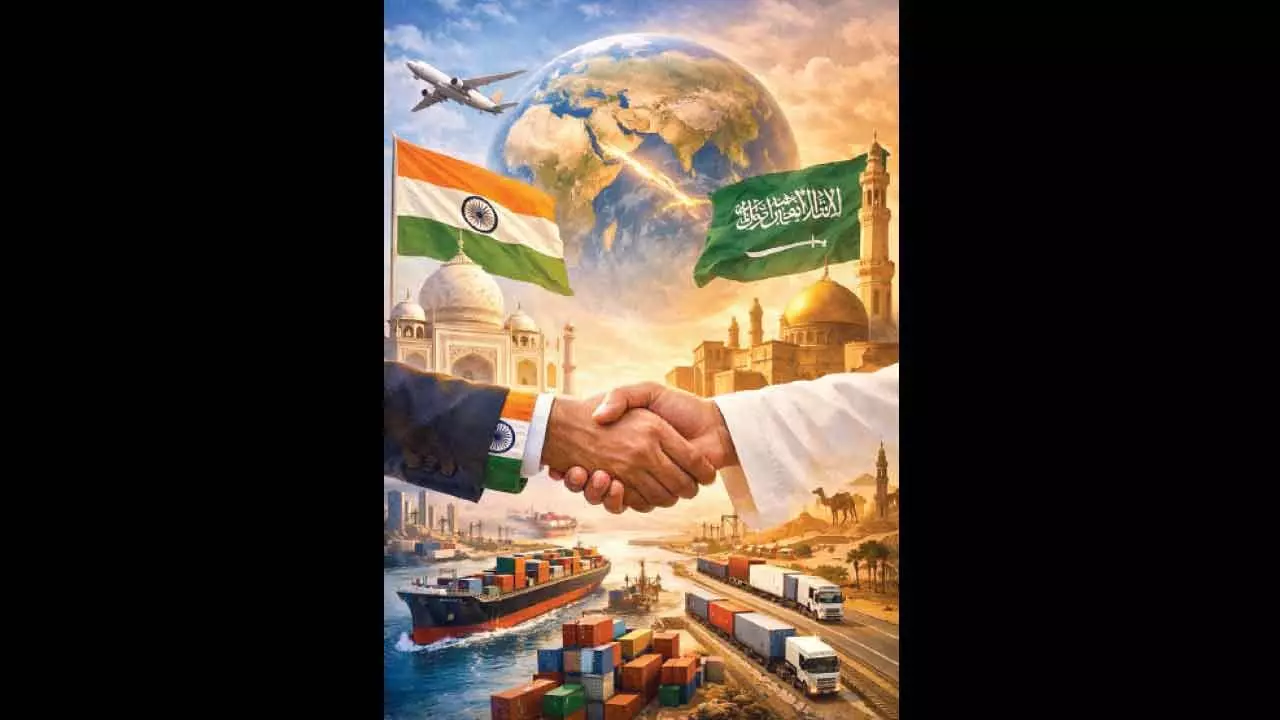
The assembly of all 22 members of the Arab League in New Delhi for the Bharat–Arab engagement was not a ceremonial exercise in diplomacy. It was a strategic signal, one that followed close on the heels of India’s landmark trade breakthrough with the European Union.
Together, these moves suggest something larger at play: New Delhi is no longer content operating within the trade and geopolitical architecture shaped by the post–World War II Western order.
For decades, global trade flows, security guarantees, and political legitimacy were mediated through a narrow set of Western institutions and alliances.
That order is now fraying. Supply chains are fragmenting, conflicts are regionalising, and capital is searching for safety without strings. In this moment of churn, Bharat has chosen strategic silence over ideological grandstanding, and that restraint has become its most potent tool.
By bringing the Arab world to the table in New Delhi with a clear emphasis on trade, energy, and strategic cooperation, Bharat signalled its willingness to shape an alternative axis of growth, one that does not reject the West but no longer depends on it for validation.
Bharat as a predictable partner in an unpredictable world
What distinguishes Bharat today is not just economic scale, but credibility. India has emerged as a dependable partner—commercially, diplomatically, and strategically. Its economy offers stability and growth; its diplomacy is non-interventionist but firm; and its military posture is defensive, restrained, yet decisive when required.
This balance matters. Global investors and governments alike are wary of partners who are either too aggressive to trust or too pliable to respect. India occupies the rare middle ground: capable without being coercive, assertive without being destabilising.
Recent years have clearly demonstrated this posture. Bharat has maintained energy and trade ties across rival blocs, kept shipping lanes in the Indian Ocean secure, and absorbed global shocks, from pandemics to wars, without exporting instability. This combination of economic resilience, geopolitical weight, and credible defence capacity makes India a “predictable partner” in the truest sense: a rarity in today’s fractured geopolitical order.
Nowhere is this clearer than in Bharat’s role in the India–Middle East–Europe Economic Corridor (IMEC). An emerging trans-regional trade corridor linking India, West Asia, and Europe. These routes are not just about moving goods faster; they are about reducing dependence on conflict-prone chokepoints and offering an alternative to routes dominated by any single power.
For Arab states looking to diversify their economic and strategic bets, India provides depth, economic, political, and military support without ideological baggage.
From trading partner to Value-Chain ally
The most consequential shift in India–Arab relations lies in how trade itself is being reimagined. Bharat is no longer pitching itself as a low-cost manufacturing base or a passive consumer of hydrocarbons. Instead, it is positioning itself as a value-chain partner.
For the Arab world, this distinction matters. The Gulf’s economic priorities have evolved rapidly. Sovereign visions now emphasise industrial diversification, advanced manufacturing, food security, digital infrastructure, and defence self-reliance. What these economies need is not another supplier of finished goods, but a partner that can co-create value across the production chain.
Bharat fits this requirement uniquely. In automobiles and auto components, Indian firms already operate at global quality benchmarks while retaining cost efficiency. In electronics, India is moving up the stack, from assembly to design, testing, and component ecosystems. In defence manufacturing, joint production and technology partnerships are replacing buyer-seller models.
Food security and agri-trade offer another compelling example. India is no longer just an importer of fertilisers or a buyer of food commodities. It is a supplier of grains, processed foods, agri-technology, and supply-chain management solutions—critical for water-scarce Middle Eastern nations. As a value-chain partner, Bharat can help stabilise food supply while generating annual export revenues of billions of dollars.
Critically, this approach also helps Arab states reduce over-dependence on China-centric supply chains. India does not present itself as a replacement factory; it offers diversification with value addition.
Capital Flows: When diplomacy turns into investment
Diplomacy ultimately proves its worth when it moves capital. Here, the shift is already visible. Gulf sovereign wealth funds increasingly view Bharat as a destination where capital is not only secure but productive.
Investments are flowing into Indian ports, logistics platforms, fintech ecosystems, data centres, and renewable energy projects. These are not speculative bets; they are long-term plays aligned with India’s growth trajectory and the Gulf’s need for steady, inflation-resistant returns.
In an era of global fragmentation, where emerging markets are often penalised for political risk, India stands out as a safer bet. Its regulatory institutions function, contracts are largely honoured, and policy continuity is no longer hostage to electoral cycles. For a Gulf capital seeking scale without volatility, Bharat offers something rare: growth with governance.
This influx of patient capital does more than fund infrastructure. It binds India and the Arab world into a shared economic future, where stability on one side directly benefits the other.
Security Cooperation: The invisible hand of trade
Trade does not thrive in a vacuum. It needs security, especially in regions where energy routes, ports, and shipping lanes are vulnerable to disruption. The Arab world understands this reality acutely.
India’s unequivocal stance on zero tolerance toward terrorism, reaffirmed through joint declarations with Gulf partners, functions as an economic stabiliser as much as a political one. Investor confidence depends on predictable risk environments. When security cooperation improves, insurance costs fall, freight premiums stabilise, and long-term contracts become viable.
As a dominant naval power in the Indian Ocean, Bharat plays a quiet but critical role in safeguarding maritime routes that underpin global commerce. Protection of shipping lanes, ports, and energy assets is not framed as power projection by New Delhi, but as a shared responsibility. For Gulf economies dependent on uninterrupted trade flows, this assurance is invaluable.
A new geometry of growth
Bharat’s deepening engagement with the Arab world is not a rejection of existing global systems, but a recalibration. It reflects a world where power is more distributed, alliances more fluid, and economic logic more decisive than ideology.
By positioning itself as a value-chain partner, a safe investment destination, and a stabilising security actor, India is offering the Arab world something the old order increasingly cannot: partnership without prescription.
In doing so, Bharat is also reshaping its own destiny—moving from the periphery of global decision-making to its centre. Beyond barrels and borders, this relationship is about building a new geometry of growth, one where India and the Arab world anchor stability in a world that is rapidly losing it.
(The author is Founder of My Startup TV)





