

When regime change becomes a precedent: The Pandora’s Box world cannot ignore
It is about precedent and how precedent could influence thinking of other major powers, especially Bharat
When regime change becomes a precedent: The Pandora’s Box world cannot ignore
The recent US regime-change operation in Venezuela could reshape global thinking on security and power—not through international law or morality, but through precedent. For nations like Bharat, facing threats on multiple fronts, this moment matters and could influence its future security doctrine
The recent regime change operation in Venezuela, carried out by the United States, could quietly alter the global security conversation. Not because it was the first such action in history, but because of how openly it was justified, as a matter of national security, executed with patience, intelligence, and precision.
The conversation is not about whether the operation was legal under international law. Nor is it about moral judgment. It is about precedent and how that precedent could influence the thinking of other major powers, especially Bharat, at a time when the global order is already under strain. In geopolitics, what matters is not just what is done, but what others believe they can now do because of it.
From exception to template
For decades, regime change was framed as an extraordinary act, controversial, risky, and often hidden behind humanitarian language or multilateral cover. The ongoing US action, in Venezuela, stripped away much of that caution. The message was simple: We waited.
We gathered intelligence. We acted when our security demanded it. That framing is powerful precisely because it is easy to replicate. It does not depend on global approval. It does not rely on international consensus. It rests on one claim alone — national interest. Once such logic is normalised, it stops being an exception and starts becoming a template.
Why precedent matters more than Intent
The United States may argue that its action was unique and context-specific. But history shows that precedents are rarely controlled by those who create them.
Nations do not study intent; they study justification. If one powerful nation can argue that removing a hostile leadership is an act of defence, others will ask why the same logic should not apply to their own security threats. This is where New Delhi comes into play.
Bharat’s reality: Security on two fronts
India’s security challenges are not theoretical. They are immediate, geographic, and persistent.
The Western front
On its western border, Bharat faces Pakistan — a neighbour that has repeatedly used proxy warfare, cross-border terrorism, militant groups, and deniability as tools of state policy. India’s response has evolved over time. It moved from years of strategic restraint after major terror attacks, to diplomatic isolation, and then to targeted, intelligence-driven military strikes.
Operations such as Sindoor sent a clear message, not just to the Pakistani establishment but also to global powers, that the old doctrine had ended. The message was unmistakable: Bharat would act decisively, and international pressure would no longer be a limiting factor.
Yet, despite this shift, New Delhi stopped short of pursuing regime change through military action, even though the core issue remains unresolved; a hostile establishment whose survival strategy is tied to destabilising Bharat.
In this context, the US action introduces a new argument into the equation: if a leadership structure consistently enables threats, removing that structure can be framed as self-defence rather than aggression. This is not an argument Bharat has made publicly. But it now exists in global discourse, whether New Delhi chooses to use it or not.
The Eastern front
On the eastern side, Bharat’s concerns are newer but no less sensitive, especially after Dr Muhammad Yunus was installed as Chief Adviser of Bangladesh’s interim government on 8 August 2024.
India–Bangladesh relations have long been considered a regional success story. However, under the current caretaker regime, concerns have grown in Bharat’s strategic circles and among the public.
These include rising instability along the border, space being created for forces hostile to India’s territorial integrity, rhetoric that weakens long-standing security understandings, and a growing number of inhuman incidents of minorities, particularly the Bangladeshi Hindu community.
In such a scenario, an uncomfortable question inevitably arises, even if quietly: when instability next door begins to directly threaten national unity, where does non-interference end and self-preservation begin? The US action does not answer this question. But it lowers the psychological barrier to asking it.
Bharat’s strategic language is changing
Indian leadership has been clear that the world is entering a more interest-driven, transactional phase. External Affairs Minister S. Jaishankar has noted that the world is moving toward a multipolar order and that every nation must protect its interests.
He has also pointed out that there cannot be one set of rules for some countries and another for the rest. These are not calls for aggression. They reflect a growing realism in New Delhi that Bharat will not allow selectively applied norms to constrain its core security interests.
Prime Minister Narendra Modi has echoed this thinking, stressing that while India seeks peace, it will respond decisively when provoked. When such statements are read alongside emerging global precedents, the strategic implications are hard to ignore.
Russia and China are reading the same signals
India is not alone in reassessing the landscape. For Russia, the precedent reinforces a long-held argument that security threats near its borders justify decisive action. A US-led regime change makes it easier for Moscow to rationalise its own moves, including actions aimed at leadership outcomes in Ukraine.
For China, the implications are even deeper. Beijing has always framed Taiwan as a core issue tied to national survival. When regime change is normalised as a security response, it strengthens the belief that force can be justified by narrative rather than consensus.
From rules to reasoning
The most dangerous shift is not military — it is intellectual. The old question was: Is regime change allowed? The new question is: Can we justify it convincingly enough? Once justification replaces legality as the main test, instability becomes built into the system. One country’s security logic becomes another country’s threat.
Bharat at a strategic crossroads
As a rising power, Bharat benefits from stability, predictability, and respect for sovereignty. But as a nation facing real and persistent threats, it cannot ignore evolving global norms, especially when those norms are being rewritten by the most powerful players. The US operation may not force New Delhi to act. But it has expanded the range of arguments that can be made, at home and abroad. That alone makes this moment significant.
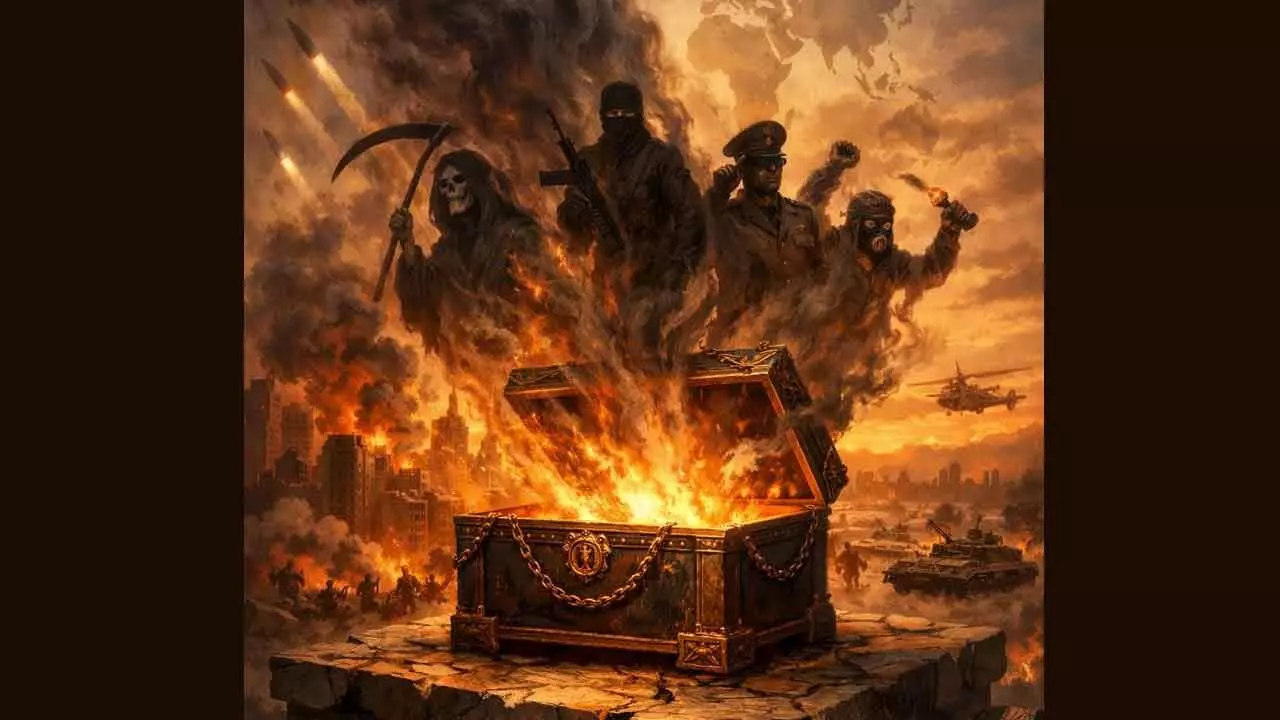
A Pandora’s Box that will cot close easily
Pandora’s box, once opened, rarely shuts cleanly. If regime change becomes a widely accepted security tool, borders become more fragile, leadership transitions turn into strategic objectives, and regional tensions risk becoming global flashpoints. The world may not descend into immediate chaos. But it will become a place where force is justified more quickly, and restraint is questioned more often.
For Bharat and for the world, the challenge is no longer whether this precedent exists. It does now!
The real question is how and when will responsible nations choose to use the new doctrine?
(The author is Founder of My Startup TV)





