

Trump-ed up war: Vishwaguru must show spine
In an increasingly competitive geopolitical landscape, India must strengthen its independent diplomatic voice and the Non-Aligned Movement — maintaining strategic autonomy while engaging with all sides — may yet find renewed relevance in the emerging multipolar order
Trump-ed up war: Vishwaguru must show spine
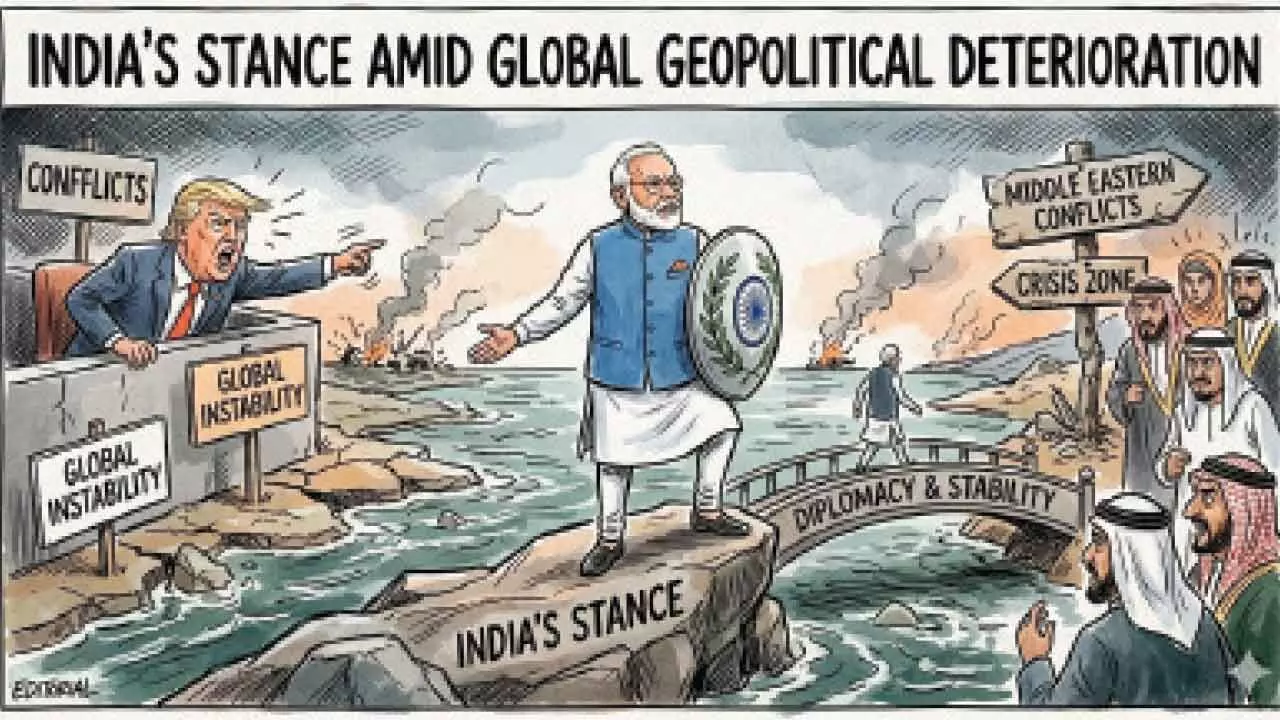
The war raging between the United States, Israel and Iran is no longer a distant geopolitical confrontation. It is already reshaping the strategic landscape of West Asia and sending tremors through global politics and energy markets. Missiles streak across Israeli skies, drones strike installations across the Gulf, and oil prices climb nervously as the world braces for a deeper regional crisis.
What may have begun as a display of strategic bravado now risks becoming a conflict whose consequences stretch far beyond the battlefield.
The pattern, however, is not new. Whether under Republican or Democratic presidents, the United States has repeatedly entered wars with enormous confidence in its military superiority, only to discover that power does not automatically translate into lasting victory. The Korean War of 1950–1953 ended not with triumph but with an uneasy armistice that still divides the peninsula. Vietnam proved even more humiliating. The war, stretching from the mid-1950s to 1975 and marked by large-scale US involvement between 1965 and 1973, ended with American withdrawal and the fall of Saigon. Images of helicopters evacuating desperate personnel from rooftops became enduring symbols of strategic failure.
Afghanistan provided a more recent reminder. After nearly two decades of military intervention beginning in 2001, the United States withdrew in 2021 in a chaotic exit that stunned the world. Billions of dollars worth of armoured vehicles and weapons were abandoned, much of which fell into the hands of the Taliban — the very force American troops had fought for years. Some of those vehicles are now being openly used by the Taliban regime that replaced the government Washington once supported.
It was a stark illustration of how ambitious military strategies can collapse when political realities prove more complex than anticipated.
These memories loom over the present confrontation with Iran. This is not a minor adversary that can be subdued quickly. Iran is a large and resilient nation that has spent decades preparing for such a confrontation. Rather than matching the United States and Israel weapon for weapon, it has built an arsenal designed to offset technological superiority. Long-range missiles, inexpensive drones and a network of regional alliances have created an asymmetric deterrence that is already complicating military calculations.
The battlefield itself reflects a transformation in modern warfare. Iranian missiles and drones have managed to strike targets despite sophisticated defence systems. The cost imbalance is striking. Interception systems costing millions of dollars can be challenged by drones that cost a fraction of that amount. Military superiority is no longer measured only by aircraft carriers or advanced fighter jets. The ability to disrupt technologically superior forces using inexpensive systems is becoming a defining feature of contemporary conflict.
The war has also shattered the illusion that the Gulf region remains insulated from large-scale confrontation. Countries such as the United Arab Emirates, Kuwait and Saudi Arabia long projected themselves as islands of stability even as turmoil consumed other parts of West Asia. Iranian retaliation has exposed how fragile that perception really is. Strategic installations, energy infrastructure and military facilities across the Gulf suddenly appear within range of missiles and drone strikes. In an era of precision weapons and remote warfare, geography offers diminishing protection.
The consequences are already spreading far beyond the battlefield. Global energy markets are reacting nervously as fears grow about disruptions in the Strait of Hormuz, through which a substantial share of the world’s oil supply passes. Prices have begun to climb sharply, and analysts warn that sustained escalation could push crude oil beyond the $100-per-barrel mark. For energy-importing countries such as India, such a surge would translate quickly into inflationary pressure, economic strain and fiscal challenges.
Yet India’s response cannot be framed simply in economic terms. None of the countries directly involved in the conflict — the United States, Israel or Iran — are India’s enemies. New Delhi maintains important relationships with all three through strategic cooperation, energy trade, technology partnerships and diaspora links. That reality underscores the significance of balanced diplomacy guided by national interest rather than ideological alignment.
India has already had to recalibrate its energy strategy in recent years. Russian crude became an important source of supply after Western sanctions disrupted global oil flows following the Ukraine war. However, recent reporting by agencies such as Reuters and Bloomberg suggests that Russian oil is increasingly being sold closer to prevailing market prices rather than the steep discounts offered earlier. If the Iran conflict drives global prices higher, that cushion may shrink significantly.
Meanwhile, two major powers are watching the crisis from the gallery. Russia and China, both strategic competitors of the United States, could well be quiet beneficiaries of the turmoil. As Washington becomes entangled in another Middle Eastern confrontation, Moscow and Beijing can observe events without direct involvement. A prolonged conflict that drains American resources and attention may ultimately serve their broader geopolitical interests.
For the United States itself, deeper military involvement raises difficult domestic questions. The prospect of deploying American boots on the ground against Iran would inevitably provoke intense debate at home. The American public has grown wary of prolonged overseas wars, particularly those involving significant casualties. During the Vietnam War, massive protests erupted across universities and major cities as the death toll mounted, eventually forcing Washington to confront the limits of public support for distant conflicts.
Memories of Iraq and Afghanistan remain equally fresh. The United States toppled Saddam Hussein in Iraq and pursued regime change with overwhelming force, yet the long-term outcome left the region unstable and American credibility damaged. From Saigon to Kabul, Washington has repeatedly discovered that military power alone cannot impose political solutions in deeply complex societies.
For the rest of the world, including India, the conflict highlights the volatility of the global order and the importance of strategic autonomy. India has long maintained relationships with multiple global powers while avoiding rigid alliances. That approach becomes even more important as the world moves steadily toward a multipolar order shaped by competing geopolitical interests.
The crisis has also exposed ambiguities in India’s recent diplomatic messaging. The devastation in Gaza generated widespread humanitarian concern across the world. Many countries condemned the Hamas attacks while simultaneously expressing alarm at the scale of destruction inflicted on Palestinian civilians. India, however, appeared hesitant to articulate that humanitarian concern with the clarity many expected from a nation that historically supported the Palestinian cause.
A balanced stance was entirely possible — condemning the Hamas attack while highlighting the humanitarian catastrophe in Gaza and calling for restraint. Instead, strong political signalling of support for Israel created confusion about India’s diplomatic posture. Foreign policy driven by personalised political messaging rather than carefully calibrated institutional diplomacy can easily produce such contradictions.
In an increasingly competitive geopolitical landscape, India must strengthen its independent diplomatic voice. As we have long argued in these columns, the spirit that once animated the Non-Aligned Movement — maintaining strategic autonomy while engaging with all sides — may yet find renewed relevance in the emerging multipolar order.
History offers a consistent warning. Korea, Vietnam, Iraq and Afghanistan all demonstrated the limits of military force when confronted with complex political realities. Wars launched with confidence often end with messy exits — and a bloody nose for Uncle Sam.
(The columnist is a Mumbai-based author and independent media veteran, running websites and a youtube channel known for his thought-provoking messaging.)





