

SWACHH BHARAT’s FATAL BLIND SPOTS
A sweeping cleanliness drive collapses when toxic air, unsafe water and vanishing ecosystems are sidelined, turning sanitation into ceremony and allowing preventable illness, disasters and death to masquerade as development
SWACHH BHARAT’s FATAL BLIND SPOTS
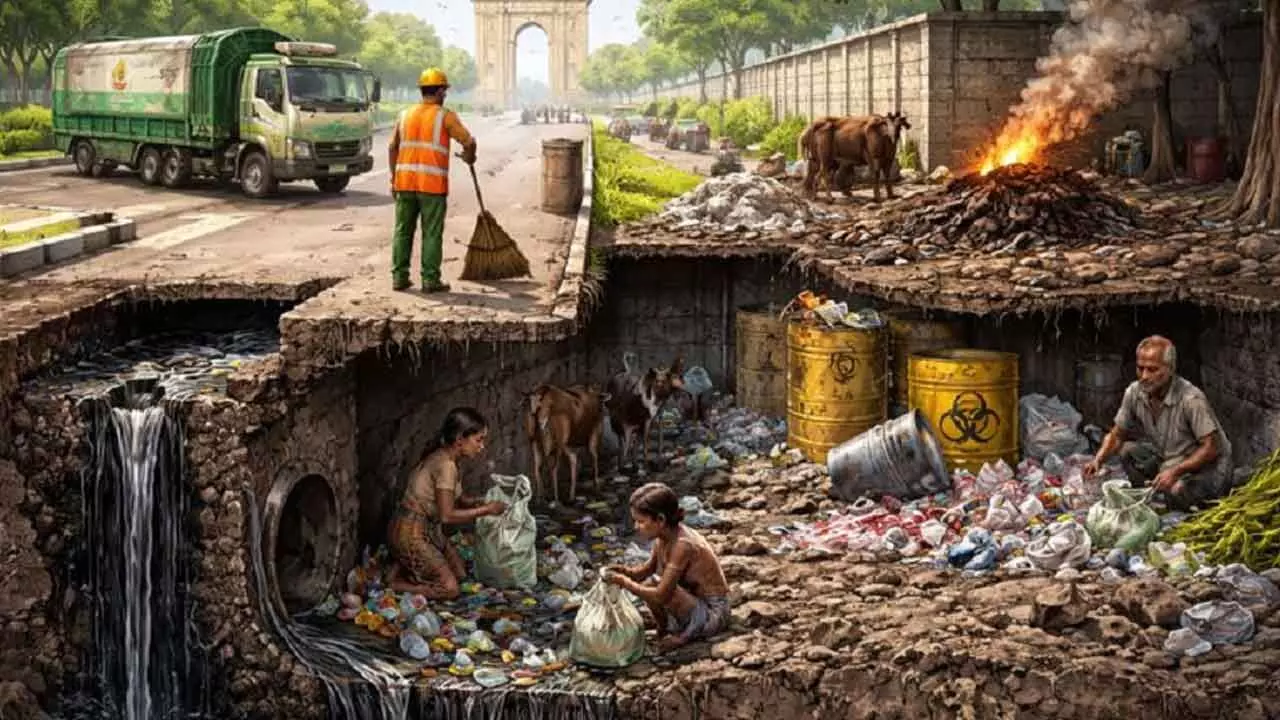
Prime Minister Narendra Modi called cleanliness a national duty tied to public health and dignity. That promise rings hollow when toxic air, unsafe water, collapsing hills and vanishing green cover are ignored, turning Swachh Bharat into ceremony while preventable disease, disasters and environmental decline quietly intensify across India
When Prime Minister Narendra Modi launched the Swachh Bharat campaign from the Red Fort, he spoke of cleanliness as a civilisational duty. It was not, he said, merely about sweeping streets or building toilets, but about protecting public health, dignity and the future of the nation. Cleanliness, he argued, was foundational to a strong and healthy India.
That vision remains compelling. But more than a decade on, Swachh Bharat is confronting a fundamental contradiction that threatens to hollow out its promise. The campaign has focused overwhelmingly on what can be seen, counted and showcased, while what sustains life itself—clean air and clean water—remains dangerously sidelined.
Without clean water and breathable air, cleanliness is reduced to ceremony, offering spectacle without public health protection—an atrocity of governance that normalises preventable harm.The warning signs are no longer abstract. They are immediate, lived and, in some cases, tragic.
Indore, repeatedly crowned India’s cleanest city, became a symbol of this contradiction when a water contamination episode triggered illness, deaths and fear among residents. Accolades did not protect households from unsafe water. Rankings did not translate into resilience. What the crisis exposed was not just an infrastructure failure, but a failure of definition. Clean streets and efficient waste collection could not compensate for weaknesses in water sourcing, treatment, monitoring and accountability.
Indore was not an outlier. It was a mirror
Clean water is not an accessory to sanitation; it is its foundation. Without safeguarding water sources, maintaining pipelines, ensuring treatment integrity and responding transparently to lapses, cleanliness becomes a surface-level exercise. The danger lies in mistaking appearance for assurance. When metrics reward what is visible and neglect what is vital, public health quietly erodes beneath the applause.
Air pollution tells an even more unforgiving story
In Delhi, breathing the air during peak pollution episodes is now routinely equated by scientists to smoking 20 to 30 cigarettes a day. In Navi Mumbai, hazardous air quality levels recently translated to inhaling the equivalent of seven to eight cigarettes daily, even for non-smokers. These are not rhetorical exaggerations. They are grounded in medical and epidemiological assessment.
Yet air pollution continues to be treated as episodic and seasonal—an inconvenience to be managed with emergency measures rather than as a chronic public health emergency demanding structural reform. Construction bans come and go. Advisories are issued. Masks are recommended. But the deeper drivers—unchecked construction dust, fossil fuel dependence, industrial emissions, vehicular congestion and the steady erosion of green buffers—remain inadequately addressed.
You can quit smoking
You cannot quit breathing
A cleanliness programme that hides behind political rhetoric and blame games, and fails to confront this reality, represents a form of institutional self-denial sustained by brute legislative majorities.The contradiction extends into flagship welfare programmes. The construction of millions of toilets under Swachh Bharat was a remarkable administrative effort, but in many parts of rural and peri-urban India, toilets were built without reliable water connections. In such cases, usage predictably declined. Toilets became unusable, abandoned or repurposed, even as official records continued to count them as successes.
Sanitation infrastructure without water is not sanitation. It is poor planning, elevated into policy.
The same pattern surfaced in the Ujjwala LPG scheme. Conceived to liberate women from smoke-filled kitchens and indoor air pollution, the programme delivered real initial gains through widespread connections. Over time, however, high refill costs and inconsistent supply pushed many households back to firewood and biomass. The health risks returned quietly, without ceremony or acknowledgment.
The intent was transformative. The follow-through was not.
These gaps between announcement and endurance are symptoms of a deeper malaise: environmental systems are treated as peripheral even as they determine the success or failure of social interventions.
As air quality deteriorates and water sources degrade, India’s green cover continues to vanish. Urban forests are cleared in the name of development. Mangroves are reclaimed. Wetlands are filled. Hill systems are drilled, blasted and destabilised. Trees are promised as compensation—often on paper, rarely in survival rates. Ecological costs are postponed until disaster forces recognition.
This is not a baseless or generalised political claim. The consequences of these sustained, anti-nature interventions are too stark to dismiss.
Landslides, floods and structural collapses are routinely described as “natural”.
They are not.
They are policy outcomes.
This reality is starkly illustrated by the government’s position on hill tunnelling. Through responses to Right to Information applications, it has emerged that tunnelling through hills for road projects does not require a separate environmental impact assessment under existing regulations. While highways attract scrutiny, the act of drilling and blasting through ecologically fragile hills does not automatically trigger environmental clearance.
In Navi Mumbai, the ₹2,100-crore Kharghar–Turbhe Link Road cuts twin tunnels through the already stressed Kharghar–Parsik hill range near Pandavkada. Forest land diversion has been approved. Environmental clearance specifically for hill tunnelling has not. Activists warn that such regulatory interpretations effectively throw hills open to unchecked exploitation, even allowing mining-like activity to masquerade as infrastructure development.
Blasting hills without environmental assessment is not a technical oversight. It is a calculated risk imposed on ecosystems and communities. Recent tunnel collapses and landslides across multiple states stand as grim reminders of what happens when geological and ecological safeguards are treated as inconveniences rather than necessities.
We worship nature
We dismantle it administratively
India prides itself on revering the five elements—earth, water, fire, air and space. Rivers are worshipped as goddesses. Mountains are sacred in scripture. Yet untreated sewage flows into waterways, forests are fragmented, and air grows toxic with alarming regularity. The Ganga and Yamuna action plans have consumed thousands of crores with limited outcomes, while most other rivers—from the northeast to central and southern India—remain outside the national conversation altogether.
Pollution does not disappear. It merely moves downstream.
The tragedy is not a lack of knowledge or capacity. It is the absence of accountability.
India does not lack solutions. It lacks integration.
Cleanliness cannot be compartmentalised into departments or reduced to scorecards. It must encompass air, water, land and ecosystems as a single, interlinked system. Toilets need water. Clean fuel needs affordability. Roads need environmental scrutiny. Development without safeguards is not progress; it is deferred damage.
Above all, accountability must travel upward—from the panchayat that approves quarrying to the municipality that permits reckless construction, from state governments that ignore pollution data to Parliament that dilutes environmental protections. Elected representatives are not insulated from polluted air or contaminated water. They breathe the same air. Their families face the same risks.
Public office does not confer ecological immunity.
Swachh Bharat was never meant to be cosmetic. It was meant to be civilisational. Until clean air and clean water are treated as non-negotiable pillars of the mission, cleanliness will remain superficial and public health will continue to erode quietly.
The choice before India is clear. We can keep sweeping what is visible, or confront what is killing us silently. A truly clean India begins not with a ceremonial broom, but with the courage, commitment and accountability to protect the air we breathe and the water that sustains life—at the very core of the constitutional right to live with dignity under Article 21.
(The columnist is a Mumbai-based author and independent media veteran, running websites and a youtube channel known for his thought-provoking messaging.)





