

Modi in Israel: Abandoning long-cherished Indian vision
The Modi regime has shunned its hesitation and displayed a resolve to join the Israel-US axis
Modi in Israel: Abandoning long-cherished Indian vision
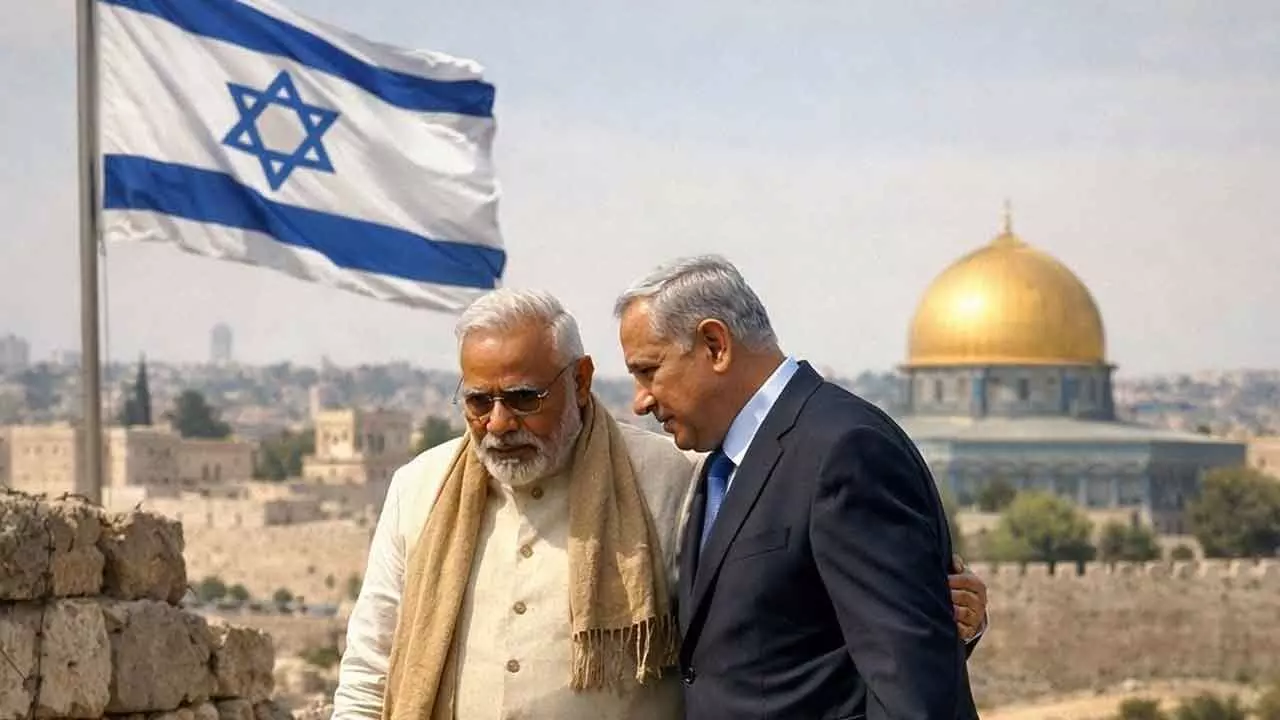
A feeling of unease and anguish is in India and abroad over Prime Minister Modi’s visit to Israel. People are citing the volatile situation in the Middle East, and the possible outbreak of Iran-US war, and questioning the rationale of an Indian Prime Minister making a stand-alone visit to a country that is being accused of genocide.
The Modi regime, too, has been critical of the episodes in Gaza, albeit in a low-pitched voice. It has surely been hesitant in supporting the Palestinian cause, but refrained from standing beside Israel. The Modi regime has abandoned its hesitation and displayed a resolve to join the Israel-US axis.
“We will also work closely in different formats such as the India–Middle East–Europe Economic Corridor and the I2U2 framework between India, Israel, the UAE and the US. Defence and Security is another important pillar of our partnership.
In November last year, we signed an MOU on Defence Cooperation. In today’s uncertain world, a strong defence partnership between trusted partners like India and Israel is of vital importance,” he told the Israeli parliament, the Knesset.
The declaration should be read with his assertion, “I also carry with me the deepest condolences of the people of India for every life lost and for every family whose world was shattered in the barbaric terrorist attack by Hamas on "October 7”.
We feel your pain. We share your grief. India stands with Israel, firmly, with full conviction, in this moment, and beyond.”
The assertion may not attract the desired attention, as it is carefully wrapped in pity and compassion. However, it only criminalises the Palestinian cause. It decontextualises the persecutions of the Palestinian people.
Any student of Middle East politics can tell you that Hamas is a creation of Israel, as the Taliban is the creation of the USA. The outfit was promoted to divide the Palestinian struggle led by the great leader Yasir Arafat. Hamas marginalised the Palestine Liberation Organization.
Prime Minister Modi’s drawing a parallel between terror attacks on India and those of Hamas should also be seen in the same context to delegitimise a struggle that has a history of more than a century. Modi has also thrown away the legacy of Indian support for the people of Palestine.
The long history of Indian support needs reiteration. Way back in 1921, Mahatma Gandhi had pledged that the Khilafat movement would restore Palestine to its people.
The British had captured the territory and created a Mandate. Gandhi remained consistent and, in 1931, criticized Zionism. He praised Jews as a community and acknowledged their communitarian unity. He also thanked his Jew friends who helped him in South Africa.
However, he made it clear that their ambition to occupy Jerusalem is misarticulated. He advised the community of a spiritual takeover of Jerusalem, as the Holy Land was a feeling and should remain in the heart of every Jew. He abhorred any attempt to physically occupy the Holy Land.
Gandhi Ji also articulated his political views on the Palestine issue in 1938. He supported Jews against Nazi operations, but opposed their attempt to occupy Palestine. “My sympathies are all with the Jews. They have been the untouchables of Christianity.
The tyrants of old never went so mad as Hitler. If ever there could be a justifiable war in the name of humanity, it would be against Germany to prevent the wanton persecution of a whole race. But I do not believe in any war.
Besides, my sympathy for the Jews does not blind me to the requirements to Justice. It is wrong and inhuman to impose the Jews on the Arabs. What is going on in Palestine today cannot be justified by any moral code of conduct. The mandates have no sanction but that of the last war.
The nobler course would be to insist on a just treatment of the Jews wherever they were born and bred. Those born and bred in France are French precisely as Christians born in France are French. Every country is their home, including Palestine, not by aggression but by loving service,” Gandhi wrote.
Gandhi was clear in his views that Jews need support against Nazi oppressions, but it does not mean that they should be supported for their occupation of Palestine.
Gandhi’s framework remained the core of India’s policy on the Palestinian issue. It supported Palestine without indulging in hate-mongering against the Jews. However, India has supported the two-nation formula and stood firmly in favor of an independent Palestinian state.
It never surrendered to the US pressure. India’s stance on the Palestinian issue has been the core feature of its independent foreign policy. A close look reveals that allegations of Rahul Gandhi that Prime Minister Modi has surrendered before the US are not without basis.
The optics, the Prime Minister has tried to create only confirm it. He has visited the country at a time when Israel did not have support among countries that have traditionally been supporting it.
Take a look at his assertions:
“ In India, there is great admiration for Israel’s resolve, courage, and achievements. Long before we related to each other as modern States, we were linked by ties that go back more than two thousand years. The Book of Esther refers to India as Hodu.
The Talmud records trade with India in ancient times.” “ Jewish merchants travelled across sea routes that connected the Mediterranean with the Indian Ocean. They came seeking opportunity and dignity. And, in India, they became one of us.”
“ Jewish communities have lived in India without fear of persecution or discrimination. They have preserved their faith and participated fully in society. That record is a source of pride for us.”
And also, “After all, I was born on the same day that India formally recognised Israel – September 17, 1950!” Do these words make any sense in diplomacy? These words are to deflect us from his abandoning the national vision shaped by Gandhi.
(The author is a senior journalist. He has experience of working with leading newspapers and electronic media including Deccan Herald, Sunday Guardian, Navbharat Times and Dainik Bhaskar. He writes on politics, society, environment and economy)





