

LEST WE FORGET, OR LET’S JUST FORGET!
When pre-poll benefits become predictable, voters are conditioned to expect largesse at election time rather than accountability through the term... Citizenry loses its legitimacy
LEST WE FORGET, OR LET’S JUST FORGET!
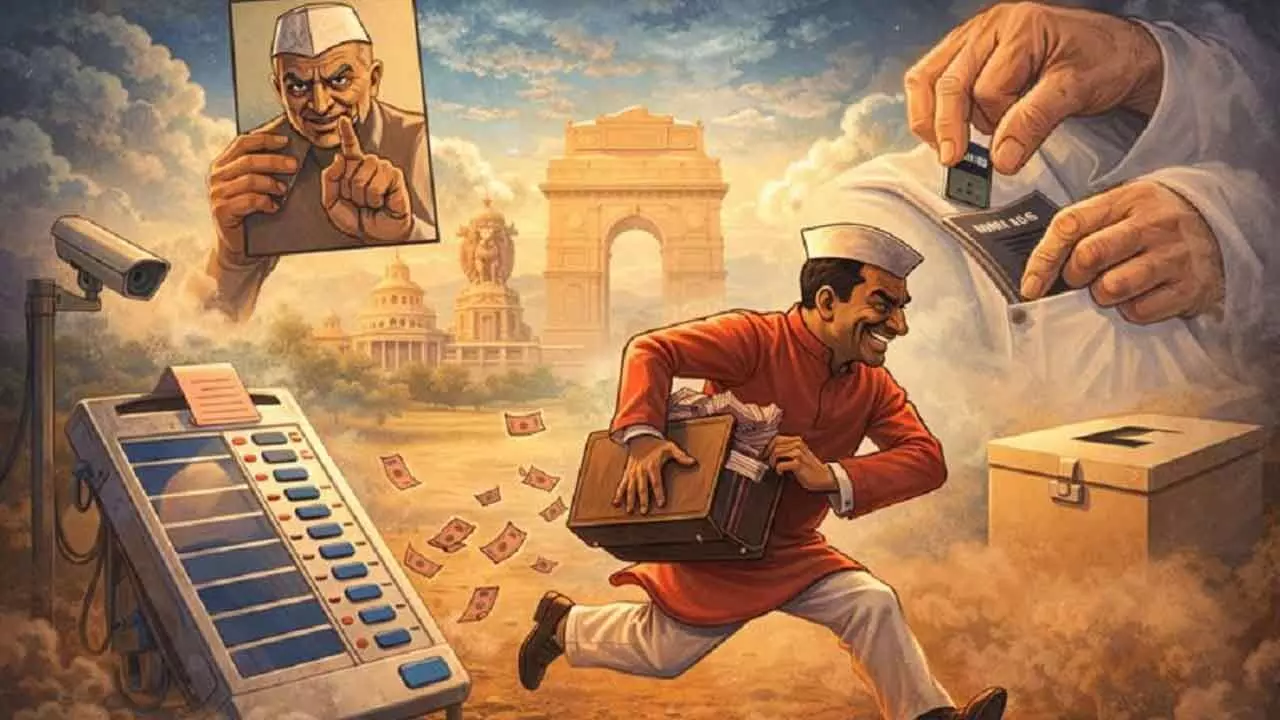
The much-publicised “Vote Chor” campaign by the Congress, launched nationally in April, struggled to gain traction beyond social media. It lacked grassroots translation. Anger did not convert into organisation. Seat arithmetic was debated endlessly. Strategy was not. Old rivalries prevailed over collective purpose
As 2025 recedes into the rear-view mirror, the official mood is upbeat. Relentlessly. Growth numbers are cited. India’s global stature is invoked. Rankings are flashed. The future, we are told, belongs to a confident nation led by decisive governance.
Optimism, however, earns credibility only when it survives scrutiny. A year worth celebrating is also a year worth interrogating. And 2025 demands a hard, unsentimental political audit.
The upbeat narrative leans heavily on headline indicators and international comparisons, often citing India’s position in global economic tables as external validation. Yet a closer look reveals how fragile such claims can be. This became evident after India received a “C” grade for its national accounts under the International Monetary Fund’s Data Adequacy Framework. While the rating triggered political sparring at home, a crucial clarification from the IMF went largely unnoticed: the framework “is not an instrument for data validation.” It does not independently verify national statistics but merely assesses whether the data submitted are adequate for surveillance. Claims of global validation, therefore, rest on a shaky foundation.
This was also the year of last-minute generosity. In the run-up to key Assembly and parliamentary contests between February and May, welfare announcements came thick and fast—cash transfers recalibrated, free schemes expanded, delivery timelines hurried. What stood out was timing. Policies appeared less as instruments of governance and more as tools of mobilisation, blurring the line between entitlement and inducement.
The Election Commission of India had opportunities to intervene. It did not. Complaints over selective roll revisions, uneven enforcement of the Model Code of Conduct and the use of official platforms during campaigns were met with procedural responses rather than decisive action. Silence, at critical moments, spoke louder than rulings.
The opposition failed to capitalise. The Congress’s “Vote Chor” campaign struggled to gain traction beyond social media. Seat arithmetic was debated endlessly. Strategy was not. Old rivalries prevailed over collective purpose.
Money, meanwhile, flowed predictably, masking governance with pre-poll generosity. The expanding role of electoral trusts and opaque funding has enabled a politics where performance takes a back seat to timing. Maharashtra offered one example, Bihar another. There is little reason to believe this playbook will not be repeated in West Bengal and Assam. Govern quietly, campaign loudly, distribute generously—just in time.
Such politics is not about welfare as a principle; it is about welfare as leverage. When pre-poll benefits become predictable, voters are conditioned to expect largesse at election time rather than accountability through the term. Governance is reduced to optics. Delivery is deferred. The social contract is weakened.
Ironically, this is not a critique unfamiliar to the ruling leadership itself. Earlier warnings against “revdi culture” now appear conveniently forgotten. When electoral largesse becomes the norm and institutional scrutiny is muted, politics and principle drift apart. Governance gives way to expediency—facilitating crony capitalism on the one hand and unquestioned price hikes on the other. The larger question is whether anyone still cares.
Foreign policy, too, showed strain. Not in rhetoric, but in outcomes. By mid-2025, India’s neighbourhood diplomacy appeared brittle—Nepal uneasy, Bangladesh in turmoil, Sri Lanka cautious, the Maldives distant. Engagement was episodic. Strategic depth thinned into diplomatic management. Any RIC bonhomie will face sterner tests—Trump’s tariff wars on one side and China’s assertive posture along the Line of Actual Control, including claims over Arunachal Pradesh. Oscillation will not do.
The weakness was laid bare after the April 22 Pahalgam terror attack. Several countries condemned the assault. But India could not secure explicit international attribution to Pakistan, despite sustained diplomatic outreach. Condemnation without naming the source offered moral comfort, but little deterrence.
Worse, the narrative slipped. Islamabad repositioned itself diplomatically, warming ties with Washington as Donald Trump returned to the White House. The latest is that Trump will give bullet train engines to Pakistan. Optics mattered, and India found itself watching from the sidelines—an outcome hard to square with its diplomatic ambitions amid Trump’s oscillating foreign-policy posture.
Security failures closer home raised harder questions. Tourist inflows to Pahalgam had been passively allowed through the early spring without apparently any security checks. During a Rajya Sabha debate, Congress president Mallikarjun Kharge claimed the Prime Minister had cancelled a scheduled visit to Jammu and Kashmir days before the attack after intelligence inputs were received, and questioned why similar caution was not extended to civilian safety. When the attack occurred, condolences followed swiftly. Accountability was absent and it continues to be.
Inside Parliament, democratic stress became routine. Question Hour was curtailed. Key legislation was pushed through with limited discussion. Committees were bypassed. Numbers replaced nuance. Speed displaced deliberation.
The Information Technology Bill briefly exposed the fault lines. Introduced in August and withdrawn by September after widespread pushback, it showed that public resistance still works—sometimes. Environmental movements offered another reminder. Mining controversies in the Aravalli range reignited concerns over ecological destruction. Citizen pressure endured.
In Navi Mumbai, protests over deteriorating air quality forced administrative response after years of data without delivery. Students and first-time voters mobilised not around ideology, but habitability. AQI numbers became political. Public voice is rising. Not uniformly. But undeniably.
This contradiction defines 2025. A year where power spoke confidently, bordering on overconfidence, but listened selectively. Where institutions functioned but flinched. Where opposition existed but fragmented. And where citizens—especially the young—began pushing back, not out of ideology, but impatience.
Optimism remains possible. Renewal is plausible. But only if memory is preserved. Only if critique is not dismissed as cynicism. Only if imbalance is recognised before it hardens into habit.
So, lest we forget. Or perhaps, let’s just forget—if forgetting is more convenient. And if it can create hope.
Democracies decay quietly when excess becomes routine, silence and sycophancy are rewarded, and imbalance feels normal. Public apathy follows—the fatal “kee farak penda”.
(The columnist is a Mumbai-based author and independent media veteran, running websites and a youtube channel known for his thought-provoking messaging.)
BREAKING! Hope for the Hills!
Amid the despair and disturbing reports of relentless environmental destruction through 2025, one piece of late-year news offers cautious hope. The Supreme Court of India has agreed to review its earlier judgment on the Aravalli Hills—an order that had narrowly defined the range for mining and opened up any hill below 100 metres to excavation.
That ruling set a dangerous precedent. Had it stood, it could have exposed nearly 90 per cent of the Aravalli system—stretching from Delhi to Gujarat—to mining and real-estate exploitation, effectively sounding the death knell for one of India’s most fragile ecological barriers.
Environmental groups, including NatConnect Foundation, had warned that such an interpretation would leave hills across the country vulnerable. Appeals were made to the President of India and the Prime Minister to intervene.
The Ministry of Environment, Forest and Climate Change has since conveyed that no fresh mining licences will be issued without a thorough review. The larger question remains: should existing licences also be scrapped, and all hills treated as strict no-development zones?
Perhaps 2026 will offer the environment a new lease of life.





