

If India can stop this war, what are we waiting for?
War is not delivering stability to any actor. Israel remains under threat, Iran widens the battlefield, and the United States risks deeper entanglement. The Gulf countries find themselves exposed to risks they did not choose. For India, the implications are immediate
If India can stop this war, what are we waiting for?
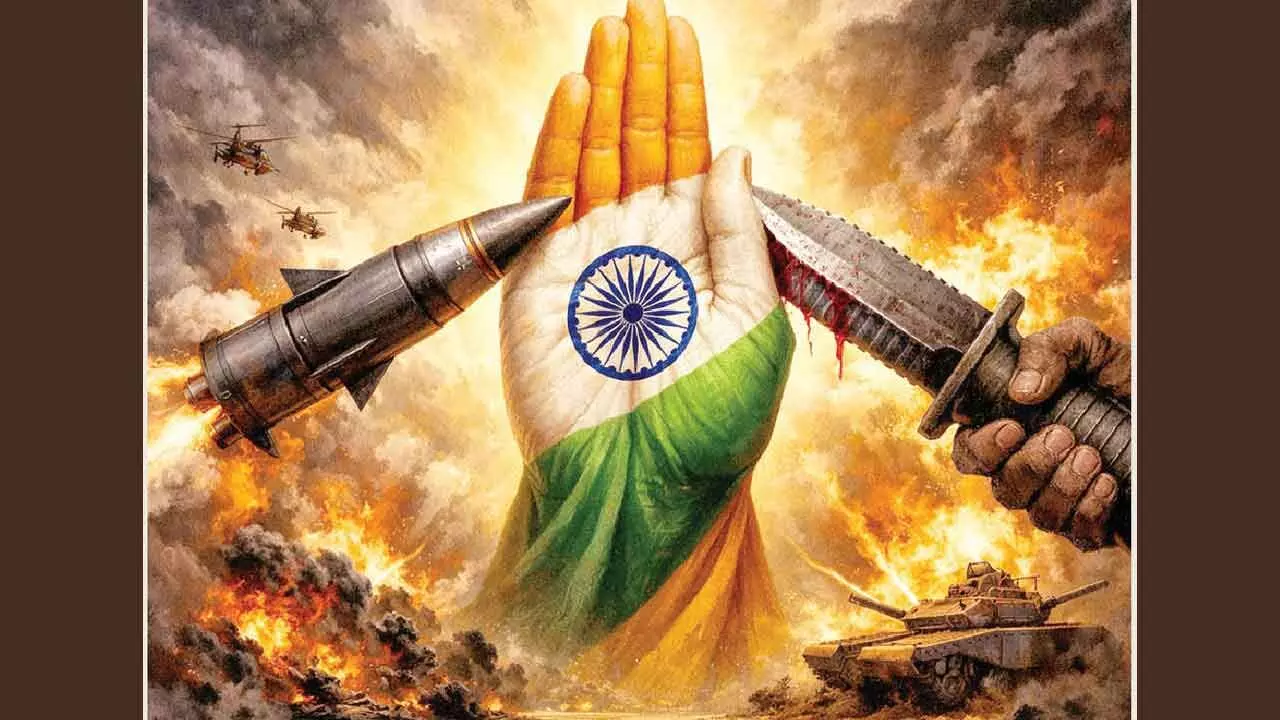
As the United States and Israel escalate their war against Iran, pushing the region towards instability, a striking question has begun to surface back home.
RSS chief Mohan Bhagwat recently suggested that India has the moral authority—and perhaps the capacity—to help stop such conflicts.
It is a bold assertion. It is also an unsettling one.
Because it leads to an unavoidable question:
If India can help de-escalate this war—even marginally—what exactly is it waiting for?
Bhagwat is not a peripheral voice. As RSS chief, his words carry political weight—particularly with a BJP government in power—and cannot be dismissed as mere commentary.
This is no longer a conflict that can be analysed from a distance or explained through familiar geopolitical frames. The United States and Israel are engaged in sustained military action against Iran, targeting strategic and energy infrastructure with increasing intensity. What began as calibrated strikes has evolved into a confrontation that now stretches across borders, airspace, and supply chains.
Iran is responding across multiple fronts—targeting Israeli territory, signalling intent across the Gulf, and placing critical energy routes under pressure. U.S. military assets remain on alert, while countries such as Qatar, Bahrain and the United Arab Emirates find themselves pulled into the arc of a conflict they neither initiated nor control.
At the centre lies the Strait of Hormuz, through which a significant share of global oil flows. Any disruption here would have immediate and far-reaching consequences for economies across the world. This is no longer a regional war. It is a strategic faultline with global consequences.
What makes this conflict particularly dangerous is not just its scale, but its direction. Even the most informed assessments now acknowledge there is no clear pathway to resolution.
A ceasefire appears distant, regime change unlikely, and the most plausible outcome may simply be a prolonged phase of instability with shifting fronts.
This is not a war moving toward closure. It is a conflict settling into uncertainty—one that risks expanding rather than ending.
What makes this drift even more difficult to arrest is the nature of the leadership driving it.
In the United States, President Donald Trump has approached the crisis with a mix of assertion and spectacle—projecting control even as the conflict expands unpredictably. Declarations of strength sit alongside actions that deepen engagement.
When confronted with difficult questions, the response has often been to deflect—dismissing sections of the media as partisan rather than addressing the substance of concern. This tendency adds another layer of uncertainty to an already volatile situation.
In Israel, Prime Minister Benjamin Netanyahu operates under equally powerful compulsions. Political survival, coalition pressures, and domestic expectations create conditions where military assertiveness becomes politically reinforcing. Escalation is not merely strategic—it is also political.
This convergence produces a dangerous equilibrium. When leadership becomes invested in narratives of strength, stepping back appears as weakness, while continuing becomes easier to justify. That is how wars drift—not toward resolution, but toward extension. The global response reflects that drift. There are calls for restraint, expressions of concern, and calibrated statements—but little evidence of coordinated effort to arrest the slide.
This is not merely a failure of diplomacy. It is a failure of intent.
Because this war is not spiralling because it cannot be stopped. It is spiralling because those who can influence it are choosing not to. And that brings the focus back to India.
India is not without options. It maintains strategic engagement with the United States, strong ties with Israel, and working channels with Iran. It is viewed across the Global South as a country capable of articulating positions not aligned to any single bloc.
Few countries can engage all sides without immediate distrust.
Which is why Bhagwat’s remark cannot be dismissed as rhetorical flourish. It is a challenge to India’s own ambition of being a shaping power. The current response has been careful and measured. India has called for dialogue, emphasised humanitarian concerns, and safeguarded its immediate interests—energy supplies, trade routes, and the safety of its citizens.
These are necessary actions.
But they are not sufficient.
Because the problem is not that India lacks influence. It is that it is choosing not to use it.
War is not delivering stability to any actor. Israel remains under threat, Iran widens the battlefield, and the United States risks deeper entanglement. The Gulf countries find themselves exposed to risks they did not choose. For India, the implications are immediate.
There is no officially declared LPG crisis. Yet the signals are unmistakable: price volatility, supply anxiety, and dependence on a region sliding into instability.
This is how distant wars become domestic concerns.
India has the ability to communicate with Washington beyond alignment, engage Israel without hostility, and speak to Iran without distrust. Diplomacy does not require posturing—it requires intent.
What prevents India from telling the United States that this conflict is drifting beyond control? What prevents it from telling Israel that the line between security and destabilisation is eroding? What prevents it from telling both that escalation now carries consequences far beyond the battlefield?
This is not about choosing sides. It is about refusing to remain irrelevant.
In a war where everyone is escalating, restraint without influence is not diplomacy—it is irrelevance. There is a visible vacuum in global leadership. Power centres are either participants or constrained. Multilateral institutions function, but struggle to shape outcomes.
This is precisely the space India once occupied.
The Non-Aligned Movement was about independence—the ability to engage competing powers while retaining credibility to mediate. That logic is relevant again. A fractured world needs voices that can convene, not just comment. It needs coalitions that can exert pressure through credibility and intent.
India can initiate such efforts—engaging middle powers, activating platforms like the Commonwealth, and building groupings for de-escalation.
None of this guarantees success. But the absence of effort guarantees irrelevance.
The idea of India as a Vishwaguru suggests moral clarity in times of crisis. But a Vishwaguru that speaks softly in the face of war risks sounding distant—and distance is interpreted as hesitation. India is no longer a bystander by circumstance. It is a bystander by choice.
And that choice will shape how it is perceived.
Because history does not remember those who watched carefully. It remembers those who acted.
This war is expanding, intensifying, and redrawing the boundaries of risk.
If India believes it can play even a limited role in slowing that trajectory, this is the moment to act. Because the question that began this debate still hangs in the air.
And as this article reaches you, I sincerely hope the world has not woken up to a nuclear explosion.
(The columnist is a Mumbai-based author and independent media veteran, running websites and a youtube channel known for his thought-provoking messaging.)





