

General Naravane’s book: Can PM Modi evade answers to Rahul Gandhi’s questions?
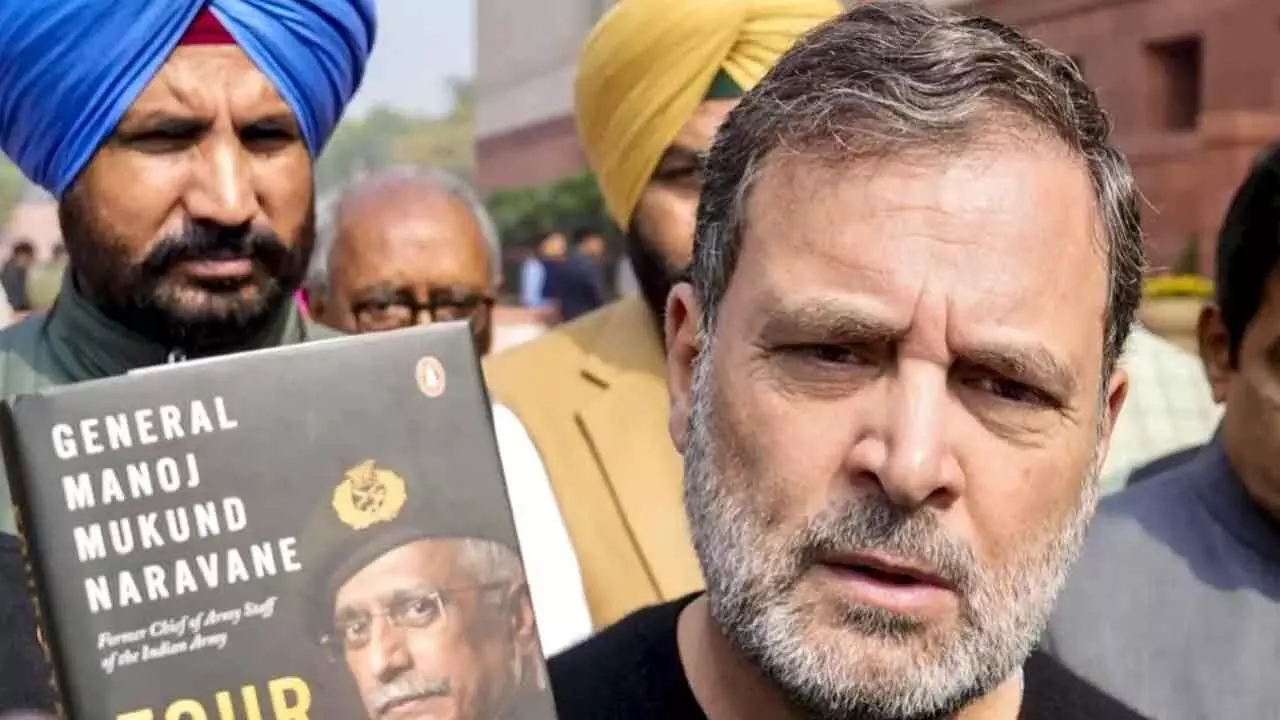
Rahul’s insistence on reading memoir of General Naravane in Parliament must not be dismissed as a routine attempt by Opposition
General Naravane’s book: Can PM Modi evade answers to Rahul Gandhi’s questions?
Can a nation afford to live in a world of make-believe and survive? It cannot. But Prime Minister Narendra Modi wants India to continue with it. No one would believe the make-believe he has offered to the nation. His manipulations in the electoral field, toppling opposition-led governments or breaking parties in the provinces, only prove his political guile.
The imagining of a better India in 2047, by no means, is a goal; it is a part of the post-truth sponsored by the BJP and the RSS. It is only an extension of propaganda on Amrut-Kal (Golden Era) run by the Modi regime.
Thanks to the long-dead tradition of survey and research, we lack data on socio-economic indices to substantiate the alarm about the collapse of the Indian economy and India’s doomed future. The recent happenings in politics do point to the danger we are facing on the fronts of the economy and security. They have only exposed us to reality.
Leader of the Opposition, Rahul Gandhi’s insistence on reading the memoir of General Manoj Naravane in Parliament must not be dismissed as a routine attempt by the opposition party. The story in the memoir, Four Stars of Destiny, speaks volumes about the hopeless situation at the top level of leadership in the country.
The issue of permission to publish the book is another aspect that requires attention. It points to the character of the current regime. On the one hand, it suppresses freedom of expression; on the other, it deprives the country of a debate on national security.
Rahul Gandhi and other opposition leaders have been accusing the government of failing to confront China during the standoff in the Galwan River Valley in Ladakh in the summer of 2020. They blame the government for giving away the Indian territory to China. Narvane’s memoir substantiates the allegation.
He, Gandhi says, has written how the leadership left the General to decide the course of action against the advancing Chinese Army. Gandhi accuses Prime Minister Modi of evading a decision on a vital security concern.
The event that followed the proceedings in Parliament turned out to be more embarrassing for the Prime Minister. He decided not to address the Lok Sabha to make the customary reply on the motion of thanks for the President’s speech.
The excuse for the decision came from the Speaker of the Lok Sabha. He said that he advised the Prime Minister not to come to the House to address it as he had information of a protest by the opposition members in an “unprecedented manner”.
The statement raises many questions. It only proves that the Prime Minister has a deep sense of distrust for the opposition. This also raises doubts about his reverence for Parliament and the Constitution. There is no precedent of a Prime Minister not replying to a debate on the motion of thanks to the President.
No one knows the move was deliberate. But it is sure that it does not depart from his political style of not giving any value to Parliamentary values and protocol. Not long ago, the opposition parties had to bring a No-Confidence motion against his government to extract a statement on Manipur violence.
The move to escape the reply must be considered a planned departure from the parliamentary norms and traditions, and a further step towards demeaning the opposition. The exercise is part of the dirty tricks against the opposition by branding them as irresponsible. The aim is to win the people’s sympathy.
Instead of responding to the opposition’s allegations that the government did not confront China at the border, the Prime Minister continued to malign the opposition. His speech in the Rajya Sabha is full of anti-opposition rhetoric.
He says that his opposition hates him because he decisively acted against Pakistan and the decision to repeal Article 370 of the Indian Constitution. Does the assertion have any substance? How can he accuse the Congress of being unpatriotic? Only lies can prove his point; history cannot.
A rereading of history informs us that the First Prime Minister of India collaborated with the Lion of Kashmir, Sheikh Abdullah to outwit Jinnah and the Muslims League in winning away the people of the state to the Union of India.
The RSS and the Hindu Mahasabha sided with the Maharaja Hari Singh, who wanted to keep his state independent. We must remember that when Pakistan-supported militia invaded Kashmir, Sheikh and his volunteers fought against it along with the Indian Army.
Article 370 was a pledge to acknowledge the Kashmiri identity. The identity played a significant role in upholding the secular character of the Union of India. It was a declaration of India’s adherence to the principles of federalism and democracy. Was it a small achievement that a state with an 80 per cent Muslim population joined India and refused to accept the partition of the country based on religion?
The communal propaganda might have influenced a large section of the people in India to support the BJP’s stand; a proper reading will surely lead them to the right approach towards Kashmir and other issues concerning the minority of the country.
The Prime Minister also talked of so-called infiltrators. The SIR in Bihar has proved how fallacious it has been to allege that infiltrators have become voters in states. Do people not understand that the cry against infiltrators is to target the minority population?
We have heard how Himanta Biswa Sarma appeals to the majority to harass the minority population. Does he not deserve prosecution? Instead of taking action against such people, the Prime Minister is trying to evade the opposition’s allegations by indirectly endorsing anti-minority views.
Rahul Gandhi’s allegation of not providing leadership during the standoff at Galwan Valley is a serious one. The government cannot escape an answer by making a counter-allegation and reinforcing anti-minority bias. The act will further expose the weakness.
(The author is a senior journalist. He has experience of working with leading newspapers and electronic media including Deccan Herald, Sunday Guardian, Navbharat Times and Dainik Bhaskar. He writes on politics, society, environment and economy)





