

GDP--GRAND DATA POLIT(R)ICKS
Economists flag inconsistencies as triumphal narratives overshadow real concerns about transparency, credibility and the true health of India’s economy and its GDP
GDP--GRAND DATA POLIT(R)ICKS
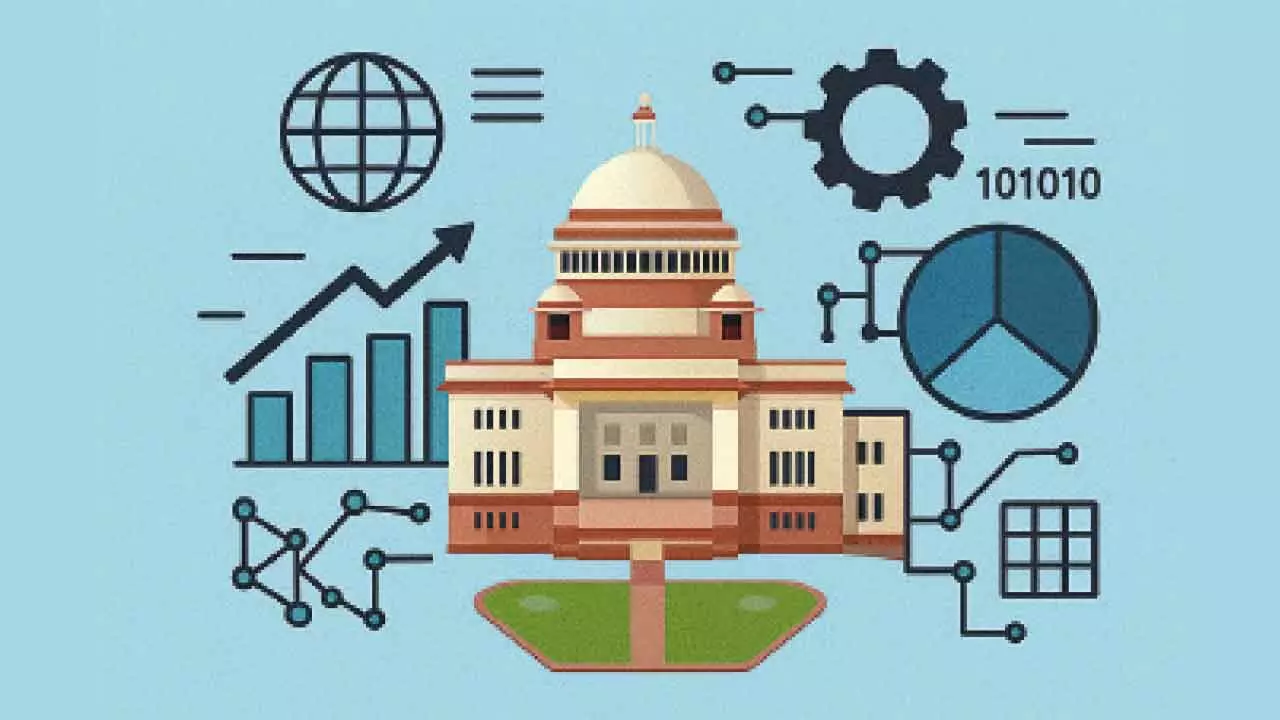
Everyone wants India to progress—no one benefits from joblessness, rising prices or widening inequality. But real advancement requires the government to confront complexity, institutions to act independently, and the media to question power rather than echo it
For several years in this column space, we have expressed concern about the way India’s economic data is accepted at face value by global institutions. The International Monetary Fund (IMF) and the World Bank usually rely on official submissions rather than conducting any independent cross-verification of large economies.
This is not an accusation of wrongdoing but a factual critique of an institutional practice: when global praise is built entirely on a government’s own numbers, without an independent audit, the praise raises questions.
Recently, I wrote to the IMF’s media division asking how they reconcile their upbeat assessments with the absence of independent validation. Their reply is awaited. But the Fund’s latest statement, with pointed queries about how India’s GDP is being calculated, indirectly validates the doubts repeatedly raised in these columns.
This is not to belittle India’s progress. The country has advanced in several sectors, and its global stature is undeniable. The point is simply this: economic projections and public claims must be transparent, realistic and open to scrutiny.
Take the issue of per-capita GDP. We hear constantly that India is now the fourth-largest economy. But what does this mean when nearly 60 per cent of our population continues to receive free foodgrains funded by taxpayers? High GDP with low per-capita income is not evidence of broad prosperity; it is evidence of uneven growth.
There is an even deeper structural problem. India has not conducted a nationwide census since 2011. Without updated demographic data, no country can generate accurate estimates of employment, migration, household incomes or consumption. We do not know how many people live in rural or urban India with certainty.
We do not have a precise count of unemployed youth. We cannot map the scale of internal migration. The functioning of the informal sector—which employs a significant majority—cannot be measured accurately without updated baselines.
When the basic population denominator is outdated by a decade and a half, any economic claim carries a built-in uncertainty.
The IMF’s latest remarks, delivered with diplomatic restraint, nevertheless highlighted important discrepancies. The Fund acknowledged India’s strong headline growth, but it also sought clarity on the methodology behind the GDP estimates, particularly how the informal economy—shrunk, altered and reconfigured after the pandemic—was being captured. It raised concerns about persistent youth unemployment, the slow revival of private investment and the pressures of fiscal consolidation. It stressed the need for improved transparency and stronger statistical systems.
For an institution that typically avoids commenting on sovereign data structures, these comments carried weight. Delivered on an authentic global platform, the observations are inevitably embarrassing for a nation that has been projecting itself as a Vishwaguru and claiming unshakeable economic ascendancy.
Naturally, the opposition responded quickly. Several leaders argued that the government has been packaging numbers rather than presenting a complete picture.
The opposition was quick to seize on the IMF’s remarks, with senior Congress leaders such as P Chidambaram, Mallikarjun Kharge and Shashi Tharoor arguing that the government’s headline-driven narrative ignores weak consumption, stubborn unemployment and the widening gap between official claims and ground realities.
Independent economists reinforced these concerns. Dr Pronab Sen, former Chief Statistician of India, has pointed out that domestic consumption remains weaker than headline growth suggests. Nobel laureate Dr Abhijit Banerjee has observed that rising GDP without rising real household incomes does not signal a healthy recovery—an argument reiterated often in these columns.
Prof. Arun Kumar, economist and author known for his research on the black economy, maintains that India’s statistical framework systematically undercounts informal-sector activity, thereby overstating growth. Development economist Prof. Jean Drèze has warned that welfare indicators—nutrition, health and income distribution—paint a more sobering picture than aggregate national output.
Former RBI Governor Dr. Raghuram Rajan has insisted that the private sector’s hesitation to invest signals deeper concerns about demand and confidence. Dr Rathin Roy, economist and former member of the Prime Minister’s Economic Advisory Council, has argued that India risks misreading its medium-term growth potential and overlooking significant structural vulnerabilities.
The ruling party’s leaders, spokespersons and their online amplification networks reacted with predictable defensiveness. IT-cell-aligned accounts circulated colourful charts celebrating India’s achievements, accused critics of undermining the nation and framed every analytical question as political hostility.
Instead of addressing substantive issues—data transparency, methodological clarity, demographic uncertainty—the pushback concentrated on optics. The aim seemed less about informing citizens and more about maintaining narrative dominance.
All the while, the reality requiring attention remains unchanged—and largely unaddressed.
Graduates continue to struggle to find work; multiple surveys show that nearly half of degree-holders face underemployment or unemployment.
Agriculture, the livelihood source for millions, is burdened by stagnant incomes, rising input costs and unpredictable weather shocks for which the system remains unprepared. Rural purchasing power stays weak, and rural demand—once a dependable engine of growth—has not fully recovered.
The much-propagated infrastructure boom has delivered only temporary, localised gains, with little evidence of broader socio-economic transformation. Small and medium enterprises, crucial for job creation, face difficulties accessing credit and navigating volatile markets. Urban inflation may appear moderate on paper, but essential goods remain expensive for families with limited incomes. Fuel continues to be costly.
The deeper concern is the steady stream of workers migrating from economically weaker states to distant metros. From Bihar to Mumbai, from Uttar Pradesh to Chennai, the flow continues because local employment ecosystems remain thin.
A country aspiring to become a global economic power cannot build itself on such lopsided geography of opportunity. Prosperity must be distributed, not concentrated in a few urban clusters.
Education and skill development form another critical piece of the puzzle. India’s schooling pipeline produces millions of young people who are not prepared for the job market. Skill-training programmes remain fragmented, inconsistent and misaligned with industry needs.
Without a strong foundation of human capital, India risks having a young population that cannot translate its demographic dividend into economic advantage.
Industry participation in academia is almost unheard of, and the government has not taken proactive steps to bridge this gap. There is also no progress report on the Centres of Excellence—another pet project of the Prime Minister.
I say this with authority because my inquiry under the RTI Act regarding the status of these Centres is still shuttling from one desk to another at the Union Higher Education Ministry. Apart from the PM, the minister too had spoken eloquently about these “game-changing” Centres of Excellence.
None of these issues can be solved by silencing dissent or attacking critics. They require honest assessment, inclusive policymaking and robust public debate. Everyone wants India to succeed—no one gains from unemployment, price pressures or persistent inequality.
But genuine progress demands that the government acknowledge complexities, that institutions maintain independence and that the media fulfil its role as a watchdog rather than as an amplifier of official messaging.
The promise of India’s future is enormous but fulfilling that promise requires a commitment to truth. A nation of 1.4 billion deserves accurate numbers, credible communication and confidence that the story told about its economy reflects the reality experienced by its people.
If India embraces transparency over theatrics, honesty over spin and inclusion over hostility, its growth story will strengthen—not weaken.
And when that happens, we won’t need grand announcements or orchestrated praise. The numbers will speak for themselves, and the world will listen—not because we ask them to, but because the truth carries its own authority and credibility. Satyameva Jayate.
(The columnist is a Mumbai-based author and independent media veteran, running websites and a youtube channel known for his thought-provoking messaging)





