

Exit of Hiren Joshi - Decoding Modi’s world of opacity
The BJP-dominated cabinet is going to introduce symbols of authoritarianism, such as the bulldozer
Exit of Hiren Joshi - Decoding Modi’s world of opacity
The absence of an articulation required for a healthy democracy is not an accident. Instead, it is the result of the fortification of all that could kill the idea of freedom and plurality. We should not make the mistake of imagining an anti-democratic regime or a majoritarian state as a goal in itself. It is a means to perpetuate inequality and exploitation
The news business has entered a domain where it has lost its charm. The surprise element is gone, and predicting political developments requires no skill. Even people are aware of how the judiciary will proceed in cases that involve high institutions. People have internalised the dictum that the boss is always right. In recent weeks, this loss of insight among the intelligentsia has been too glaring to ignore.
From the Bihar assembly elections to the ouster of Hiren Joshi from the Prime Minister’s Office, we see a pattern. No matter what happens to the media or academia, no one speaks against the regime. Instead, everyone has to rationalise every single event.
We saw how people who had been discussing significant anomalies in the voter list began discussing the INDIA alliance's failure to mobilise the people. The atrocious exercise of Special Intensive Revision took a backseat in the discourse, and a prominent journalist and a famous political analyst were found to be endorsing the victory that even surprised the victors.
Their lack of commitment towards fighting authoritarianism only added to the misery of the people who have been struggling to survive amidst a dismal situation. Thanks to these irresponsible rationalisations, like people of Uttar Pradesh, Biharis have to face the kind of saffronisation the state has evaded so far.
The BJP-dominated cabinet is going to introduce symbols of authoritarianism, such as the bulldozer. It has also launched a scheme to promote Sanatan Dharma. It entails Satyanarayan Katha on every full moon and Bhagwati Pooja on every new moon. All the registered temples and mutts have been ordered to implement the scheme.
The government will appoint district coordinators to supervise the scheme. The program aligns with those being implemented in neighbouring Uttar Pradesh under the leadership of Yogi Adityanath. Apart from standing against the Constitution, which calls on the state to adopt neutrality in the spheres of religion and culture, the scheme shows a callous disregard for the problems the state is facing.
Can a state that competes with Sub-Saharan nations in human development indicators afford such extravagance? Should a state where people die of diseases that spread from the lack of basic knowledge of health and hygiene promote superstitions in the name of fostering tradition and religion? The state has a huge gender gap in education and is struggling to reduce its Infant Mortality Rate and improve maternal health.
Nitish Kumar has been ruling the state for two decades, and only he should be held accountable for the state of affairs in Bihar. Is it fair on the part of the journalists and analysts to criticise the opposition parties for not being able to mobilise people against the government? Shouldn't they articulate the roles of the media, the Election Commission, money power, and the government machinery in delivering a favorable poll verdict?
The absence of an articulation required for a healthy democracy is not an accident. Instead, it is the result of the fortification of all that could kill the idea of freedom and plurality. We should not make the mistake of imagining an anti-democratic regime or a majoritarian state as a goal in itself. It is a means to perpetuate inequality and exploitation.
The life of an average Sanatani in the plains of the Ganga is no little better than that in Sub-Saharan regions. Is it a matter of concern for the promoters of Sanatan Dharma? The prevailing pro-democratic articulation has not only failed to confront the consolidation of evil ideas, but also to inspire a revolt against the regime that seeks to promote all sorts of inequality and inhumanity. There is a lethargy among poets, artists, and academicians, or they fear persecution. This is why we see rationalizing theories.
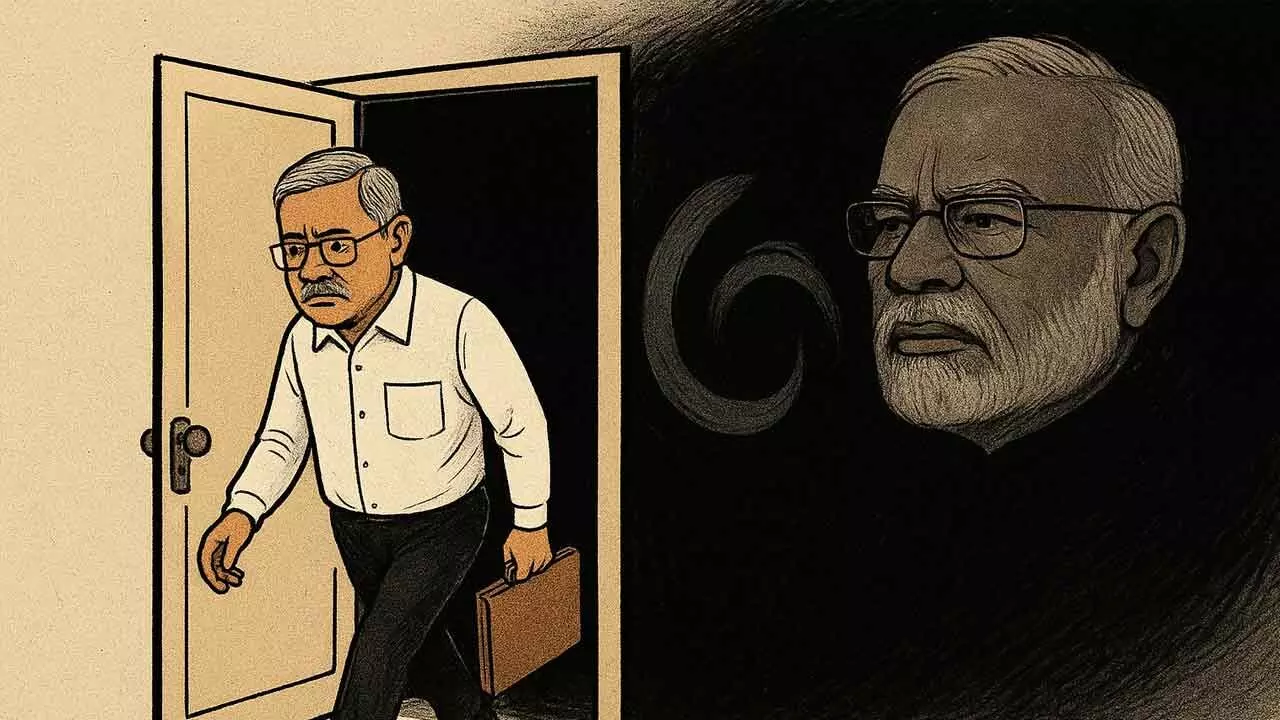
We see the same pattern in the story of the exit of Hiren Joshi from the Prime Minister’s Office. The man who has been overseeing the project to position Narendra Modi as a global leader and is involved in transforming the Indian media into a servile propaganda organ vanishes suddenly. Obviously, it upsets analysts and people in both so-called and alternative media.
However, most of them failed to decode the incident and decipher the underlying message. The response to the incident only reinforces the view that there is a tendency to escape from reality. Those who ousted Joshi have successfully spread the narrative that he was caught engaging in corruption, which led to his exit.
Does it point to any wrongdoing on the part of the prime minister? What else could a responsible leader do? The same kind of narrative was built around the exit of then-Vice President Jagdeep Dhankhar. He was accused of destabilising the Modi government. Does it make any sense? What was the man, who had the image of a person more loyal than the king, to gain by crossing over to the other side?
His image went from loyal to betrayer. It only subsidised the image of the Prime Minister. The same thing happened in the case of Hiren Joshi. He is being portrayed as a corrupt guy, and the Prime Minister as a justice-giver. This is part of the same act of rationalising the rulers, but in a different way.
Should we not see into the opacity and authoritarian style in such decisions? We did not have any information on why or when the decision was taken. The same thing had happened to Dhankhar. The latest victim is Navneet Sehgal, the Chairman of Prasar Bharati. We did not know about the resignation. We only know about its acceptance. In the case of Joshi, nothing is known, resignation or acceptance.
Any struggle for a better democracy will only require a better understanding of the character of the regime. The rationalising project only helps the regime to hide its authoritarianism. Accusing Dhankhad or Joshi of betrayal or corruption is atrocious. They are the victims of the opaque, authoritarian system they have helped build.
(The author is a senior journalist. He has experience of working with leading newspapers and electronic media including Deccan Herald, Sunday Guardian, Navbharat Times and Dainik Bhaskar. He writes on politics, society, environment and economy)





