

DUMP TRUMP, EMBRACE THE WORLD
The inconsistency in the American position becomes glaring when China enters the frame. Beijing buys far more Russian oil than India. Yet Trump’s posture towards China has always oscillated between confrontation and accommodation
DUMP TRUMP, EMBRACE THE WORLD
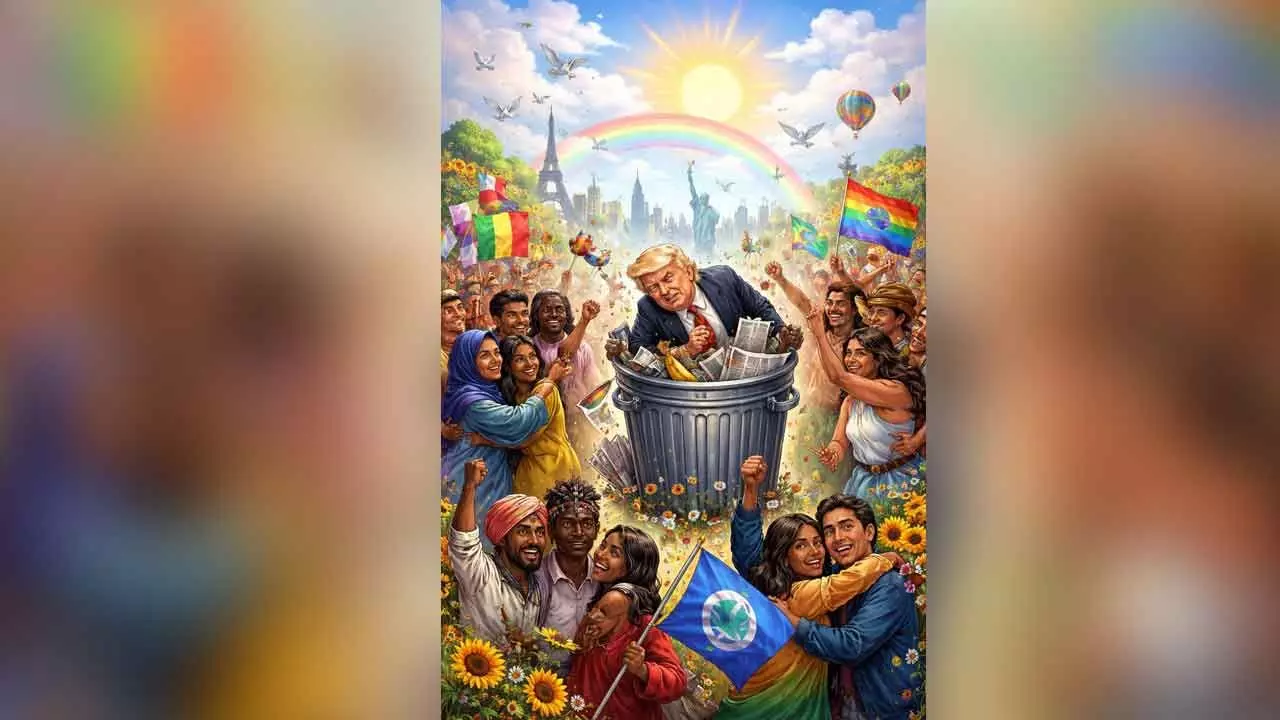
Donald Trump has never been predictable. What is becoming increasingly evident, however, is that he is also an undependable friend—particularly for India. While repeatedly referring to Prime Minister Narendra Modi as “my friend,” Trump has made a habit of publicly needling, pressuring, taunting and, at times, even insulting India. Praise and provocation arrive together. Friendship is proclaimed, then tested. Often in public.
Trump has taken credit—by his own telling, more than 50 times—for what he claims was his role in facilitating a ceasefire between India and Pakistan during Operation Sindoor, allegedly by holding a tariff dagger over both countries. The ceasefire did happen. But the tariff threats against India did not end. They lingered. Then resurfaced.
That contradiction defines Trump’s diplomacy. Claim credit. Apply pressure anyway. Friendship, in this worldview, is not a relationship but a lever—pulled when useful, discarded when inconvenient.
What makes this behaviour more galling is the memory it collides with. The slogan “Ab ki baar, Trump sarkar” first surfaced during the 2016 US presidential campaign in a Republican Hindu Coalition video featuring Trump himself. But it was at the 2019 Howdy Modi rally in Houston that Prime Minister Narendra Modi publicly echoed the sentiment—an unusual and overly enthusiastic gesture that went well beyond normal diplomatic signalling. With hindsight, it stands out as a rare misjudgment, one that underestimated Trump’s transactional instincts and volatility.
From public prayers and political cheerleading to the Namaste Trump extravaganza in Ahmedabad—where Modi described Trump as India’s closest friend in Washington—the over-enthusiasm has aged poorly, now serving as easy ammunition for the opposition.
Far from proving a dependable partner, Trump has behaved like a fair-weather ally—warm in words, transactional in action, and quick to turn punitive when expectations are not met. A friend does not publicly threaten tariffs or demand phone calls as proof of loyalty, nor does he repeatedly claim credit for de-escalation only to continue economic pressure regardless. Even outside government, opposition leaders have periodically cautioned against reading too much into Trump’s theatrics, underscoring that unease about his reliability cuts across party lines.
The latest flashpoint is India’s purchase of Russian oil. Trump is unhappy. Washington disapproves. But India’s position is neither new nor ambiguous. Energy security for a country of 1.4 billion people is not a favour to be granted by another power. It is a sovereign necessity. India bought Russian oil to stabilise prices, cushion inflation and protect growth. That was governance, not ideology.
The inconsistency in the American position becomes glaring when China enters the frame. Beijing buys far more Russian oil than India. Yet Trump’s posture towards China has always oscillated between confrontation and accommodation. The reason is simple. China is economically formidable and resists coercion. India, by contrast, is expected to bend.
Trump’s own record with China exposes this double standard. Despite incendiary rhetoric, he travelled to Beijing in 2017, lavished praise on President Xi Jinping, and presided over business agreements running into tens of billions of dollars. In 2020, he signed the Phase One Trade Agreement with China, easing tariff pressures in return for purchase commitments. He even intervened to lift US sanctions on Chinese telecom firm ZTE after Xi appealed to him, citing American jobs and suppliers. Principles for others. Pragmatism for himself. India will do no less for its own interests.
Trump’s foreign policy, in fact, operates less on the logic of alliances and more on the mechanics of a ledger. Strategic partnership is a commodity to be repriced in real time. The current trade standoff with India illustrates this clearly. Repeated tariff threats, selective duties, and now the spectre of a proposed Senate bill advocating punitive levies of up to 500 per cent under the Sanctioning Russia framework have shown that proclaimed “friendship” offers no insulation. India is to be squeezed for market access—particularly in agriculture and dairy—while being penalised for exercising energy sovereignty.
This worldview is not confined to India alone. Trump’s recent remarks about acquiring Greenland point to the same instinct applied globally. The interest is strategic—Arctic shipping lanes, rare earth minerals and military positioning as ice melts—but the language is revealing. Sovereign territory is spoken of as an asset to be bought, pressured for, or taken if leverage permits. It is power without diplomatic restraint. In Indian terms, it is plain dadagiri—the belief that strength confers entitlement. That entitlement is then enforced through transaction: pressure applied, concessions priced, loyalty monetised.
That same instinct now shapes Washington’s engagement with New Delhi. The transactional nature of this relationship was laid bare when US Commerce Secretary Howard Lutnick suggested that a deal collapsed simply because a sufficiently “close” phone call was not made—a claim the Ministry of External Affairs has since dismissed as inaccurate, noting that the two leaders have spoken eight times in the past year alone.
India’s response has been measured. Commerce Minister Piyush Goyal has been clear: national interest stands above everything else. Trade negotiations are not conducted through personal summons or public pressure.
Instead, India has widened its options. Trade agreements with the UAE and Australia are operational. A landmark deal with the UK has followed. Talks with others continue. This is not anti-American behaviour. It is pro-India strategy.
For years, we have argued in this column for a “US-plus” foreign policy, much as the world adopted a “China-plus” approach after Covid-19. No serious nation places all its eggs in one basket—least of all the American basket. Eggs kept in a single, volatile basket are neither protected nor productive—they get crushed.
History reinforces this instinct. American power has often come with an imperial reflex. Korea. Vietnam. Iraq—invaded on claims of weapons of mass destruction that were never found. Regions destabilised. Closer home, the US has repeatedly armed and supported Pakistan despite knowing its hostility towards India. This is lived experience.
India has faced such pressure before. In 1971, when the US deployed the Seventh Fleet to intimidate New Delhi, Prime Minister Indira Gandhi did not flinch. Bangladesh was born. The lesson endured.
Against this backdrop, Modi’s response to Trump’s provocations has largely been restraint. Often, just silence. Strategic silence.
Ignoring provocation is not weakness. It is diplomacy at a higher level. India has focused instead on strengthening ties with Russia, managing a complex relationship with China, and expanding its global economic footprint. On external affairs, political differences blur; national interest sharpens.
India’s China policy reflects this realism. Galwan and border tensions underscore mistrust. Yet absolutes are a luxury geopolitics does not permit. A calibrated reopening of Chinese investments under scrutiny is not reconciliation. It is risk management.
There is also a larger shift underway. Trump remains wedded to a petro-dollar worldview. China is racing ahead in electric vehicles and clean-tech. As EV adoption expands and renewables scale up, oil dependence will decline. Initiatives like the International Solar Alliance—ironically one Trump abandoned—represent the future.
The latest flourish—the talk of a Senate proposal advocating punitive tariffs of up to 500 per cent on countries such as China, India and Brazil—should be read as political signalling, not executable policy. Such measures would spike inflation and hurt American consumers first. History suggests restraint will prevail. Threats travel faster than tariffs.
This moment calls for rethinking global alignments. Instead of rigid binaries, nations should cultivate multiple economic and strategic blocs—EU-style, BRICS, RIC or new formations. Engage with all. Depend on none.
The arc from “Ab ki baar, Trump sarkar” to today reminds us that diplomacy anchored in interests endures, while personality-driven promises do not—a distinction India itself has sometimes muddied through avoidable shifts in tone under External Affairs Minister S. Jaishankar.
Strategic autonomy works best when it is not over-explained, over-defended, over-personalised—or over-TRUMPeted.
Good diplomacy does not require answering every provocation. Sometimes, ignoring the noise is the message. India has learned—sometimes the hard way—that restraint outlasts rhetoric, diversification outperforms dependence, and national interest must always trump performative friendship.
For those who once believed in slogans, the lesson is now unmistakable. Nations, like democracies, are safest when they rely on institutions and interests—not on personalities. Until then, India should continue its path—calm, firm and unwilling to be bullied.India is on a diplomatic course correction, moving like a submarine—silent, disciplined, targeted and determined.
(The columnist is a Mumbai-based author and independent media veteran, running websites and a youtube channel known for his thought-provoking messaging.)





