

Clashing with Shankaracharya: Is it an attempt to control religion?
The ideas associated with the tradition of Shankaracharya are retrogressive and atrocious, for they endorse untouchability and the loss of freedom to a large section of society
Clashing with Shankaracharya: Is it an attempt to control religion?
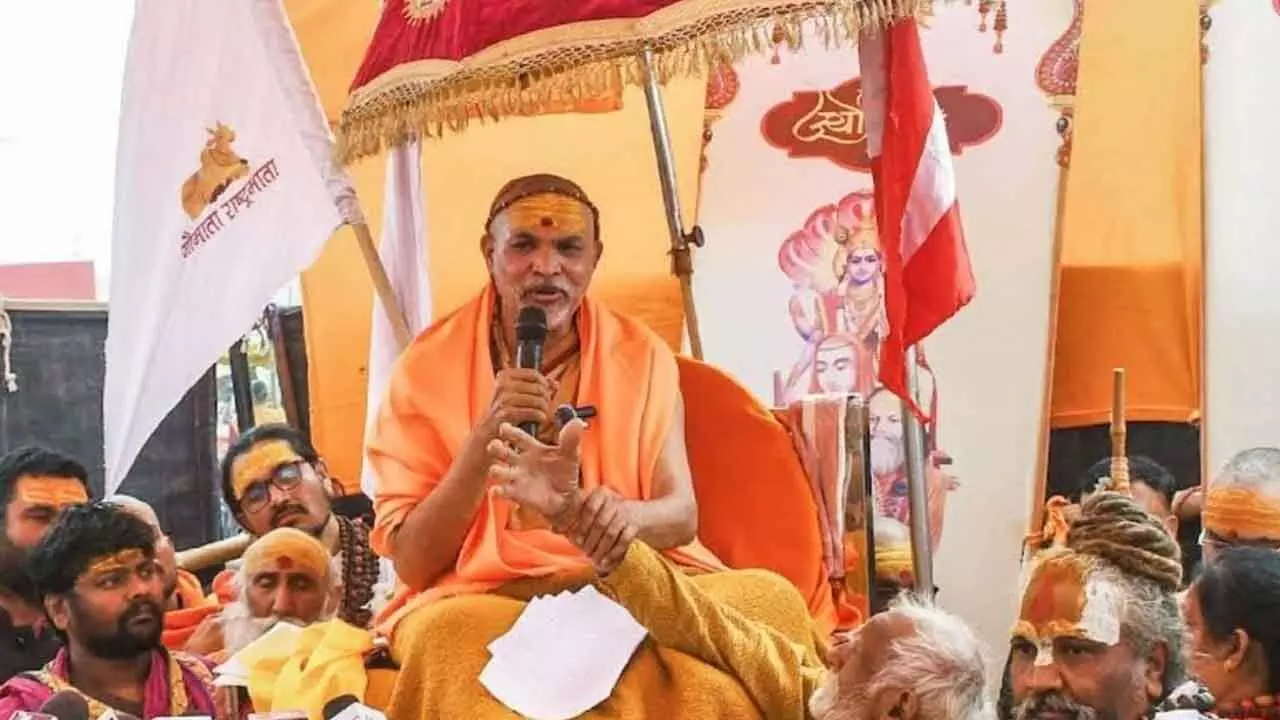
Undoubtedly, the tradition of Shankaracharya is a typical example of stagnation. Its support to the Chaturvarnya (System of four Varna) is an example. However, can we support the humiliation he had suffered at the hands of the Yogi Adityanath government? Some are amused at the insult and maltreatment of his young disciples for being a representative of a revivalist and obsolete belief system.
Others are happy over an all-out war between two groups of conservative forces, the RSS and the BJP, as one of the two parties. But a closer look reveals the weakness of both stances. The incident would neither weaken Hindutva nor destroy it. The incident should be seen as an attempt to control religion.
The ideas associated with the tradition of Shankaracharya are retrogressive and atrocious, for they endorse untouchability and the loss of freedom to a large section of society. However, we cannot ignore the contribution of the Vedanta to the development of Indian philosophy.
The philosophy of Advaita has its roots in the Upanishads. It has also drawn from the Shunyavad (the theory of emptiness) of the Buddhist philosopher Nagarjuna. Shankar’s philosophy influenced the Bhakti movement and the Indian renaissance of the nineteenth century.
Swami Vivekananda has been the most important promoter of Vedanta philosophy in the modern era. Acknowledging the influence of the philosophy on Vivekanand’s thought, Jawaharlal Nehru writes in his famous book, The Discovery of India, “He preached the monism of the Advaita philosophy of the Vedanta, and he was convinced that only this could be the future religion of thinking humanity, for the Vedanta was not only spiritual but rational and in harmony with scientific investigations of external nature.
We must not overlook the very nature of the theological conquest of the Aadi Shankaracharya. It involved debate and dialogue, and did not resort to violence.
Is it not exciting that a medieval belief system is immune to violent temptations that were very common in the contemporary world? Indeed, advocating preservation of the social order, Varna, Ashram and Sanskara played havoc with the lives of millions, and the institution of the Shankaracharya only helped establish an exploitative social order.
But we should not forget that the very philosophy inspired the protest against the social order it helped establish. The order did not remain unchallenged.
Successive generations of saints and philosophers who believed in the unity of God, and adhered to the philosophy of Advaita, opposed the social order supported by the institution of Shankaracharya. Kabir, Raidas and scores of others led the movement against the unjust social order.
It is also a mistake to assume that opposition to the Vedanta was limited to the Varna system only; people opposed the philosophy itself. The opposition largely came from the diverse forms of belief. The forms of worship prevalent among a large section of the society contradicted the philosophy of Advaita. People never accepted the core of Advaita that the world is an illusion (Maya).
The contribution of Advaita in inspiring the anti-colonial response in India is also invaluable. It starts with Raja Ram Mohan Roy. During the freedom struggle, the Bhagwad Gita, the most revered Hindu scripture that preaches Advaita, inspired many, including Tilak and Gandhi. However, Dr Baba Saheb Ambedkar considers its philosophy as a philosophical defence of the unjust Varna system. He also rejected the book for its endorsement of violence. Dr Ambedkar terms it a “counter-revolution” against Buddhism, the popular religion of the time.
The question is how to deal with these traditions in democratic India. Should they be crushed down in the manner the Uttar Pradesh government has done? Has the Uttar Pradesh police done the right thing by thrashing the innocent kids of Gurukul attached to the Shankar Math? Do we not have a proper mechanism to deal with these tricky situations?
We have a constitutional and ideological basis for respecting traditions. The ideology of the freedom struggle forms the core of it. Many leaders of the Congress party were believers and practised diverse religions. However, no one tried to impose it on fellow travelers.
The classic example is of how Mahatma Gandhi treated Khan Abdul Ghaffar Khan. Gandhi arranged non-vegetarian food for Ghaffar Khan at the Sevagram Ashram, where no non-vegetarian meal was available. Gandhi, in his prayer meetings, used to recite verses from the scriptures of different religions, including the holy Quran.
Once, a Hindu refugee opposed it. Gandhi stopped the prayers for days together and resumed them only after the person agreed to the recital, and himself requested the resumption.
Many may take the continuance of the institution of the Shankaracharya as a surrender to obsolete ancient ideas. But the real democratic spirit inspires us to allow freedom to propagate the belief. It is absurd to think that they should agree to modernity or perish.
The institution of Shankaracharya reminds us of different stages of the evolution of ideas. The philosophy of Vedanta presents before us a stream of Hindu thought. Its presence only strengthens the diversity within the Hindu way of thinking. We must not be afraid of being swamped by it or any other stream of thought. Thinking of a homogeneous social or political order is characteristic of authoritarianism.
Has the BJP any right to question the elevation of Swami Avimuktrehwranand to the position of Shankaracharya? It was done only to suppress the Swami’s opposition to political interference from the Modi regime in the affairs of religion.
People are smelling an ego-clash between Yogi Adityanath and Swami Avikuteshwaranand. This is not. It is an attempt to control religion through political tools. The RSS is trying to control religion without the rigour required to lead religious or philosophical discourse. The organisation is against diversities within the culture and society. It treats religion politically. Will it succeed? There is very little chance because India has always celebrated diversity.
(The author is a senior journalist. He has experience of working with leading newspapers and electronic media including Deccan Herald, Sunday Guardian, Navbharat Times and Dainik Bhaskar. He writes on politics, society, environment and economy)





