

CITU opposes new legislation on N-energy transformation
Finds fault at capping operator liability to Rs 3,900 crore in event of nuke disaster
CITU all India general secretary Tapan Sen and Andhra Pradesh general secretary Ch Narsinga Rao at the 18th National Conference of CITU in Visakhapatnam on Thursday
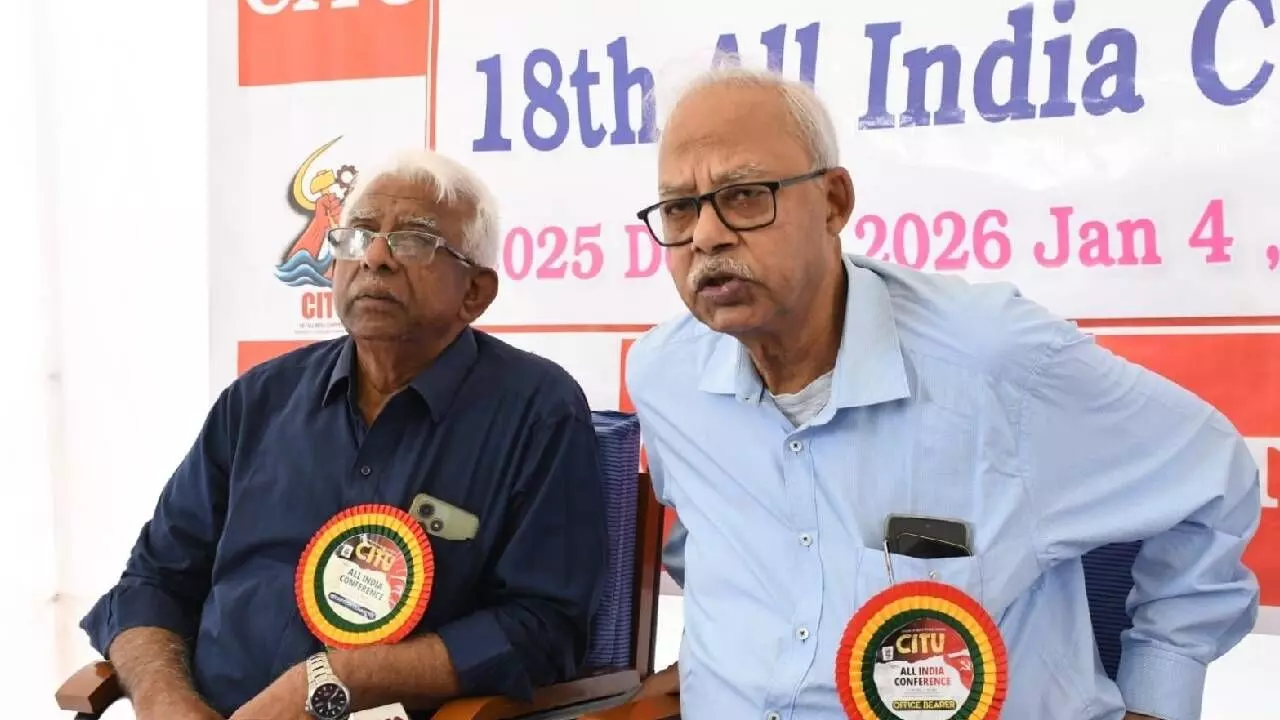
Visakhapatnam: The18th National Conference of the Centre of Indian Trade Unions (CITU) on Thursday adopted a resolution strongly criticising Sustainable Harnessing and Advancement of Nuclear Energy for Transforming India (SHANTI) Act, 2025, which it felt was rushed through Parliament, repealing the Atomic Energy Act, 1962 and the Civil Liability for Nuclear Damage Act, 2010.
The Act severely weakens the nuclear liability framework by retaining a capped operator liability of 300 million Special Drawing Rights (about Rs3,900 crore), an amount grossly inadequate in relation to potential nuclear disasters. The Fukushima disaster has already cost over $180 billion, while compensation for the Bhopal gas tragedy exceeded this cap decades ago. Any cap on nuclear liability is unjust; such a low cap is a betrayal of the people. "More dangerously, the Act removes the operator’s statutory right of recourse against equipment suppliers. Even when accidents arise from defective design or supplier negligence, multinational corporations will enjoy de facto immunity, while compensation burdens will fall on public funds and the people. Profits are privatised, while catastrophic risks are put over the shoulders of people," the resolution stated.
The conference asserted that the Act is a dangerous, anti-people and anti-sovereignty legislation that opens India’s most hazardous and strategic energy sector to private and foreign corporate interests. It dilutes safety, accountability, democratic oversight and workers’ rights. This conference demanded immediate repeal of the Act in its entirety. CITU general secretary Tapan Sen told the media that nuclear energy involves uniquely catastrophic and irreversible risks.
The resolution stated that since Independence, India’s nuclear programme was placed under strict public ownership, recognising its implications for national security, public safety and environmental protection. The Atomic Energy Act, 1962 embodied this principle by reserving all nuclear activities for the public sector and ensuring accountability to Parliament. "The SHANTI Act represents a fundamental rupture from this framework. Under the guise of “modernisation” and “clean energy transition”, it establishes a pro-corporate, over-centralised and opaque regime that prioritises commercial expansion over safety, sovereignty and public welfare," the resolution stated.
The conference noted with grave concern that the Act permits “any other company” or “any person expressly permitted by the Central Government” to obtain licences across the nuclear fuel cycle, including operation of nuclear facilities. This effectively opens the sector to private and potentially foreign entities. Granting profit-driven operators control over fissile materials and highly radioactive substances sharply increases systemic risk and exposes the country to catastrophic consequences from accidents, negligence or sabotage.
The conference viewed the SHANTI Act in the broader context of India’s deepening strategic and military alignment with imperialist powers, particularly the United States. The US National Defense Authorisation Act (NDAA) for Fiscal Year 2026 explicitly promotes nuclear and strategic energy cooperation with India as part of expanded defence integration, encouraging collaboration in civil nuclear technologies, supply chains and advanced reactors. The SHANTI Act must therefore be seen as a domestic legal restructuring aligned with these strategic–corporate partnerships, at the cost of sovereignty, democratic control and public safety.
The 18th National Conference of CITU rejected the SHANTI Act, 2025 as anti-people, anti-worker and anti-sovereign, opposed the opening of India’s nuclear sector to private and foreign corporate participation in any form, warned against aligning India’s nuclear energy framework with foreign defence and strategic agendas, including those embedded in recent US defence legislation and sought restoration and strengthening of the public-sector mandate of nuclear energy and the liability framework, including unlimited liability and operator recourse against suppliers.





