

Beyond optics, are we witnessing foundation of a new world order?
Official statement also noted that both leaders reaffirmed their commitment to strengthening special, privileged strategic partnership
Beyond optics, are we witnessing foundation of a new world order?
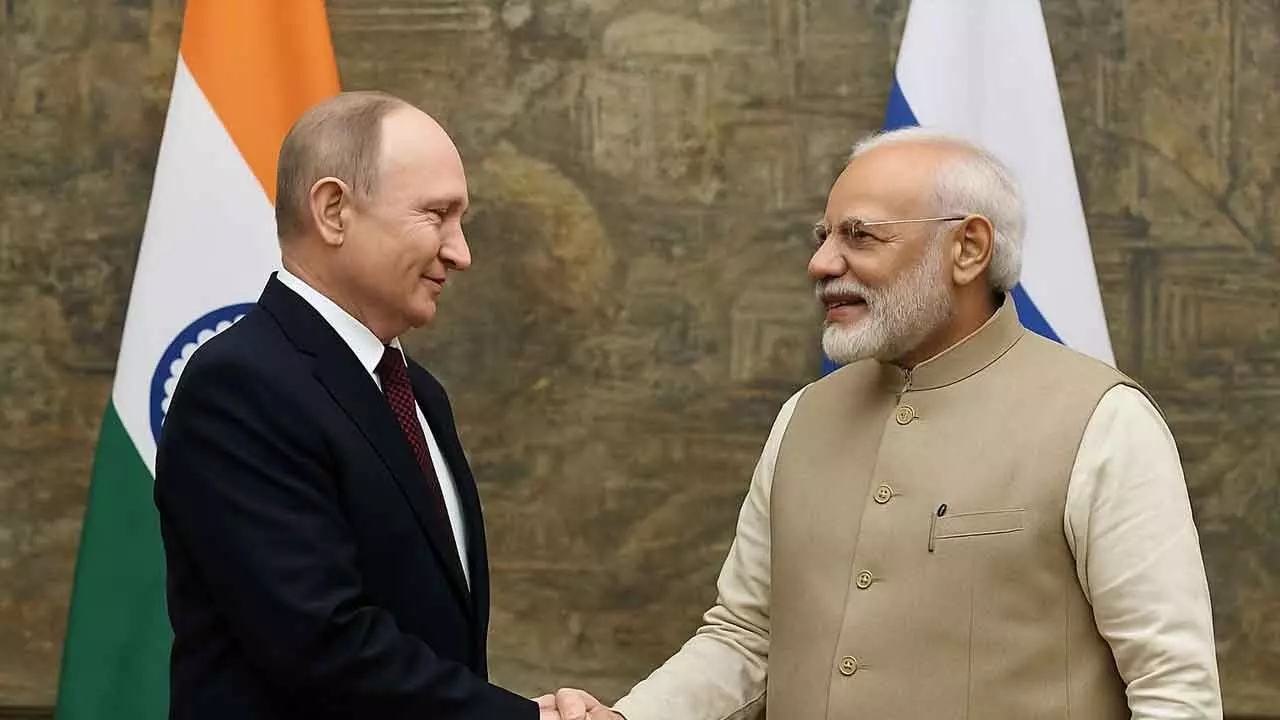
President Vladimir Putin's visit to Bharat is framed as the Strategic Economic Roadmap for 2030. Yet several US analysts believe something far more consequential may have begun in New Delhi — the quiet birth of a "new world economic order
When President Vladimir Putin arrived in New Delhi on 4–5 December 2025 for the 23rd India–Russia Annual Summit, global attention was focused on traditional themes; energy supplies, defence ties, and the West's discomfort at increasing Bharat–Russia convergence.
However, the signals emerging from the summit suggested a shift more profound and more structural. According to the Ministry of External Affairs (MEA), Prime Minister Narendra Modi and President Putin "discussed all aspects of relations which are deep-rooted and multifaceted."
The official statement also noted that both leaders reaffirmed their commitment to strengthening the Special and Privileged Strategic Partnership, signalling continuity despite global turbulence.
At the bilateral level, the two leaders oversaw the exchange of several agreements covering trade and commerce, maritime cooperation, migration and mobility, fertilisers, health, food safety, academic exchanges, media cooperation and people-to-people ties. But diplomatic observers noted that the scope, and timing, of these agreements signalled a deeper strategic recalibration.
A $100 Billion Target and a Broader Economic Framework
Among the most concrete outcomes was the joint commitment to scale bilateral trade to USD 100 billion by 2030. Though Russia's share of India's trade has historically depended on defence supplies and energy imports, the new roadmap aims to broaden and rebalance the economic relationship; including setting up joint-venture fertiliser projects, enhancing shipping collaboration, polar-route cooperation, and creating smoother pathways for Indian skilled workers to work in Russia.
This represents an important evolution: a partnership no longer defined solely by Soviet-era defence ties or opportunistic oil purchases but by a wider economic and socio-strategic architecture.
Energy Guarantees Amid Global Pressure
One of the defining moments of the summit was President Putin's firm assurance of "uninterrupted" fuel shipments to Bharat — a message widely interpreted as a commitment to insulating India from geopolitical volatility, particularly the pressures emanating from Washington.
MEA clarified, Indian energy imports — from Russia or anywhere else are guided by market logic, not political pressure. This was more than a defensive statement; it was an assertion of New Delhi's growing strategic autonomy.
US Analysts Break Silence: "A Strategic Deficit for Decades to Come”
Putin's visit also prompted unusually candid reactions from prominent US strategic analysts, reflecting growing unease in Washington over Bharat's evolving foreign policy.
Michael Rubin, a former Pentagon official and senior fellow at the American Enterprise Institute, delivered one of the most pointed critiques in an interview with ANI News. Rubin argued that President Trump's approach has "reversed U.S.–India ties" — a relationship painstakingly built over 25 years by successive administrations across both parties.
He added that Washington's pressure tactics reveal "a lack of understanding of Indian strategic culture," and risk leaving "America with a strategic deficit for decades to come."
Highlighting that the US–India partnership was never the achievement of "one party or one president," Rubin questioned whether a turbulent few months or even a few years of disruptive diplomacy, under Trump, is worth pushing India closer to Russia for an entire generation.
Adding balance to the debate, External Affairs Minister S. Jaishankar, speaking at the HT Leadership Summit shortly after Putin's visit, reminded that as Bharat rises in economic and geopolitical stature, its "key relationships must be in good repair" to optimise its position in a rapidly shifting global order.
The MEA echoed this view in its official statement, emphasising that India's strategic autonomy is non-negotiable and that no country has a veto over India's choices or partnerships.
However, it is also true that Rubin's comments capture a wider concern within the US foreign-policy establishment: that Washington's miscalculations may be accelerating geopolitical shifts it neither intended nor fully understands.
Another sharp assessment came from Larry C. Johnson, a former CIA officer, intelligence analyst, and State Department Office of Counter-Terrorism planner, who has also spent over two decades training the US military's Special Operations community.
Speaking on a YouTube programme titled The End of US Hegemony: Why India & Russia Just Defied Washington, Johnson argued that Washington’s entire approach toward India was built on "a fundamental miscalculation."
According to him, the US assumed that India's economy was heavily dependent on American markets and that sanctions or the threat of sanctions could coerce New Delhi into distancing itself from Moscow. In reality, he noted, Bharat's exports to the US account for upto 10% of its GDP — meaningful but not decisive. By contrast, cutting off affordable Russian oil and gas would inflict far greater economic harm on Bharat.
Johnson said this misunderstanding stems from a "lack of historical awareness" in Washington about the depth of India–Russia ties dating back to the Soviet era and shaped throughout the Cold War.
"Is Russia is now playing mediator between China and Bharat ?"
A more unexpected development, he added, has further complicated US calculations. Moscow can help stabilise the Modi–Xi dynamic, Johnson argued, it would reshape the Asian balance of power and accelerate what he describes as the emergence of a "new world economic order."
Johnson, who has worked across multiple US administrations since George H.W. Bush also revealed that Washington had spent decades painstakingly building a new nuclear strategic framework with Bharat — one he called "a strategic element of primary importance," crafted mainly by State Department diplomats with support from the Pentagon.
The objective, he said, was to draw India into a U.S.-led nuclear and strategic orbit. In his blunt assessment on recent developments under Trump, he said, "We’ve killed that. We’ve destroyed it." He argued that recent US policies have not only pushed Russia and China closer together, but have also drawn Bharat into this emerging alignment — an outcome directly opposite to Washington's long-term goals.
Johnson concluded with a stark warning; "we are witnessing the birth of a New World Economic Order. Its foundation rests on Russia, China and India — especially India and China, representing nearly three billion people in the global economy.
The United States is unprepared for this and still believes it can compel nations to obey its will." His remarks, like Rubin's, underscore a growing recognition within the American strategic community that global power is dispersing — and that Bharat's choices are shaping this transition in ways few in Washington fully anticipated.
(The author is Founder of My Startup TV)





