

Ten years on, Paris agreement drives action—but global efforts fall short
Climate ambition rises, but finance gaps and fossil fuel dependence persist
Ten years on, Paris agreement drives action—but global efforts fall short
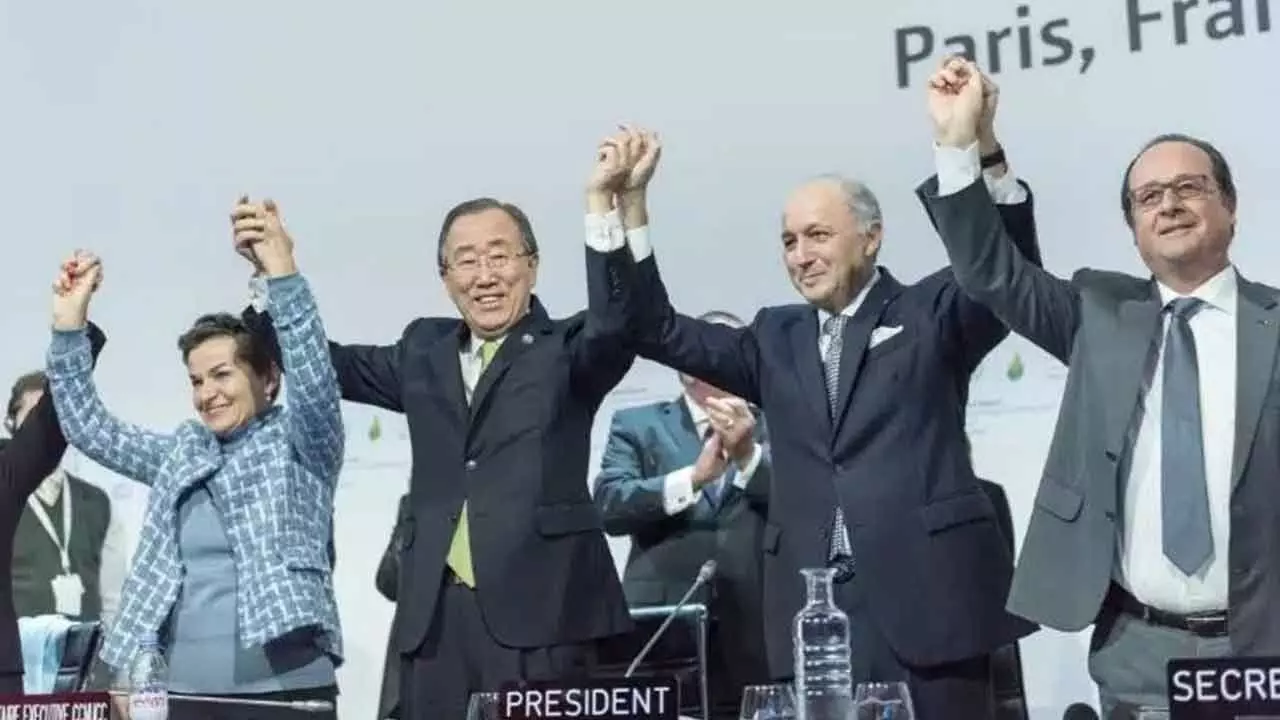

As the Paris Agreement marks its 10th anniversary on December 12, 2025, the landmark climate pact stands as a turning point in global climate governance, having strengthened policy frameworks, boosted participation and bent the warming trajectory downward from catastrophic projections. Yet, despite notable progress in adaptation, mitigation and climate finance mechanisms, the world remains off track to meet the 1.5°C goal. Persistent divisions over fossil fuel phase-out, inadequate climate finance for developing nations, and insufficient ambition in national commitments continue to hinder progress
December 12, 2025, marks the 10th Anniversary of the Paris Agreement on Climate, a milestone. This period of 10 years after the Paris Climate Agreement signed on 12th December 2015, has led to significant progress on the need to take up adaptation and mitigation measures by all the signatories to this agreement, more than 195 countries so as to restrict the temperature to a level of 1.5°C over pre industrial levels if not atleast to a level of 2.0°C level.
However, the efforts and actions taken so far have not led to significant reductions in the temperature levels, as the world is divided between phasing down or phasing out the use of fossil fuels to reduce greenhouse gas emissions, as there is no unanimity on this critical subject, and oil-producing countries may not like to restrict their main source of country income.
Their access to resources are being scarce, and also as these countries are already having debt being high debt, they are not able to have enough funds for mitigation measures. There is also increased use of fossil fuels amongst developing countries as they are in the development stage and their peak level of use to fossil fuels are still far away which enhances emissions levels even though some of them are spending on alternative energy projects like solar, wind, EVs rising but the the world is still off track to meet the 1.5°C goal, with emissions rising, which necessitates urgent and quick wholehearted action by all to bring the temperature level to the desired level as nations cannot afford losses and damages which will happen which will be impossible to bear for the future generations.
However, this Climate Agreement, signed at Paris in 2015, provided a global framework for global climate action, driving policy and investment. The Paris Agreement, adopted at the UN Framework Convention on Climate Change (UNFCCC) COP 21 in 2015, as per Mathias Cormann, OECD, the Agreement established a novel framework for international climate cooperation that encouraged countries to determine their own commitments to reduce greenhouse gas emissions.
As per " The Paris Agreement at Ten years " published by OECD, and as per Survey respondents clearly and consistently expressed the view that the Paris Agreement has contributed meaningfully to strengthening climate policy frameworks, driving higher ambition and promoting broader participation and accountability.
According to the United Nations Climate Change, the Paris Agreement on Climate Change is " delivering real progress, even if much remains to be done. According to scientific data, as reported on the UN Climate Change site, before this global climate cooperation, warming was likely to exceed 4°C above pre-industrial levels by 2100. With this agreement and various actions taken by member countries, we have been able to bend the curve downwards and take initial steps towards climate resilience.
However, there is a lot to be achieved, and further steps of enhanced National Determined Contributions ( NDCs) are needed. As of late 2025, over 100 countries have submitted New NDCs with targets for 2035.
These show a modest improvement in global emissions projections, but collectively they still fall short of the 1.5°C or 2.0°C warming limits set by the Paris Agreement. At the recently held COP 30, it was expected that all member countries would have submitted these New NDCs, but still, there are a few major economies, including China, India and the European Union have yet to officially submit their updated NDCs, even though due in February 10, 2025. Approximately 108 countries cover around 71% of global emissions.
Notable G20 members that have submitted include the United Kingdom, Canada, Japan, the United States, Australia, Brazil and others. India is likely to submit its new NDCs by the end of December 2025, with targets for 2035 as earlier announced.
However, there are still challenges remaining at this juncture of the Paris Agreement on Climate Change achieving 10 years. As earlier stated, no unanimity has been arrived at fossil fuels phase out, thereby slow fossil fuels phase out. There is a huge gap in funding requirements of the developing countries, leading massive climate finance shortfall.
There is also a huge ambition gap as NDCs are not aligned with 1 5°C. The need for multilateralism and global cooperation is very much needed to achieve the desired action plans. Due to current political tensions and major countries like the US withdrawing from the Paris Agreement, it is a temporary setback.
As per the Executive Summary of OECD paper The Paris Agreement at Ten years, several challenges emerge as the main barriers to achieving the goals of the Paris Agreement, namely the provision of necessary infrastructure for the transition to net-zero, the affordability of clean alternatives and the adoption of cleaner technologies, limiting public funds, mobilisation of private finance, etc.
Overall, the Paris Agreement on Climate Change signed in 2015 is a turning point and in these 10 years, it has helped in taking lot of adaptation measures and mitigation steps, the need to phase down or phase out use of fossil fuels have been felt, all efforts are being taken to provide enough public funds and private capital including multilateral lending to provide climate finance along with loss and damages fund being formalised. It is hoped that going forward, there will be enhanced action plans in this regard, and the global world can expect to substantially reduce the future climate risks to protect the prosperity of people.
(The author is former Chairman & Managing Director of Indian Overseas Bank)





