

Stop Weaponising Institutions: India Deserves Better Opposition
Politics in India has become a relentless cycle of manufactured outrage, where every institution—from the Election Commission to the judiciary—is dragged into partisan battles
Stop Weaponising Institutions: India Deserves Better Opposition

In a healthy democracy, politics is meant to resolve conflicts, not manufacture them. Yet today, it increasingly behaves like a machine that drags every institution into its orbit—smearing, polarising, and weaponising even those bodies meant to stand above partisan combat. Whether it is the Election Commission of India or the judiciary, institutions that were once regarded as the steel frame of neutrality are now routinely pulled into political crossfire.
What remains baffling is the opposition’s persistent belief that Indian voters can be taken for granted. They refuse to accept that the vote chori narrative has become an endlessly recycled melodrama—a tired, over-chewed myth of stolen mandates that has turned into a never-ending circus.
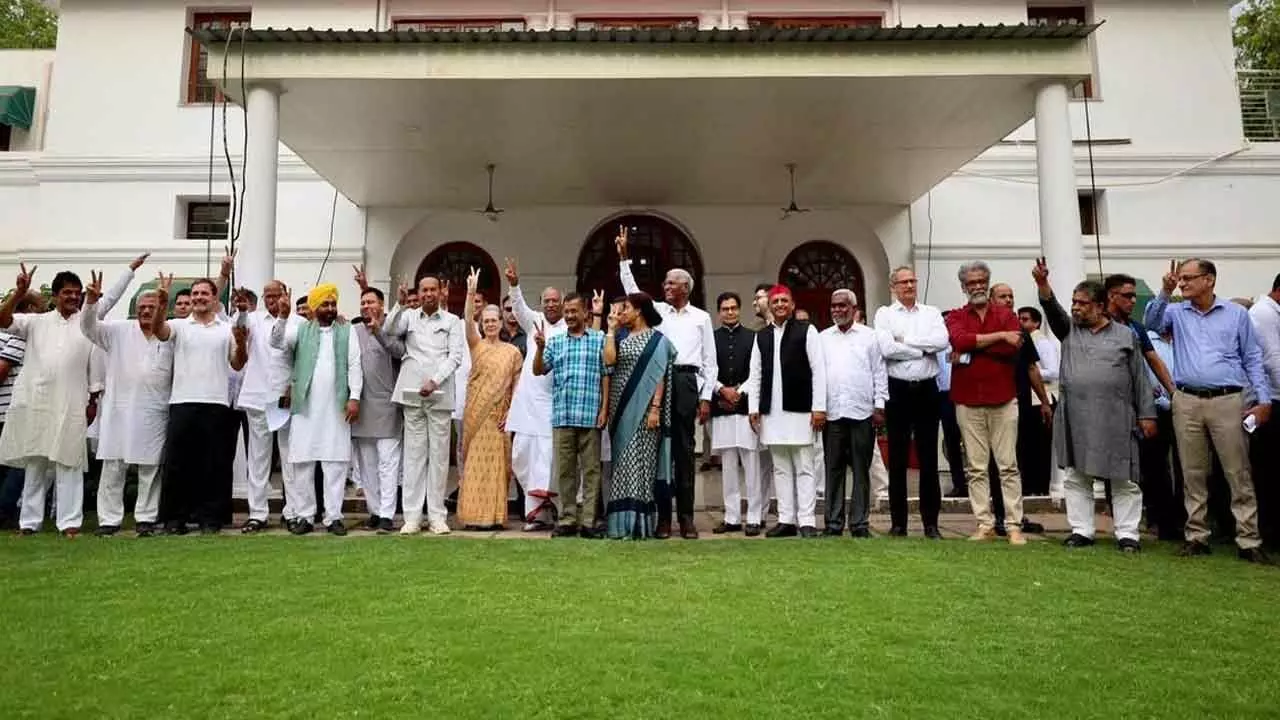
They created chaos over the issue, but when the time came for a serious debate in Parliament, none of them, including the Leader of the Opposition, managed to put the government on the defensive. The INDIA bloc still depends heavily on rhetoric rather than rigorous research or coherent strategy. India needs a strong opposition—leaders with vision, conviction, and political stamina, not those clinging to dynastic entitlement or part-time politics.
The real casualty of this attitude is public faith. When political parties question the Election Commission only when they lose, or attack judges the moment a verdict inconveniences them, the message is clear: institutions deserve respect only when they serve partisan interests.
This opportunistic cynicism corrodes the democratic spine. It signals to citizens that nothing is independent, nothing is sacred, and everything is fair game. Democracy weakens not when institutions make mistakes, but when they are deliberately delegitimised. Politics must step back. Institutions must be allowed to breathe.
Without this, democracy risks suffocating under the weight of its own manufactured controversies. Every administrative decision is now framed as an assault on someone’s identity, someone’s sentiment, someone’s narrative of victimhood.
A striking example is the confrontation between the Tamil Nadu government and Justice G.R. Swaminathan of the Madras High Court. What began as a dispute over the lighting of the Karthigai Deepam lamp atop the Thirupparankundram hill has escalated into a national debate on judicial independence. This is no longer about a lamp, a temple, or communal sensitivities. It is now about whether political power is being used to discipline a judge for an inconvenient verdict.
At the heart of the controversy lies a straightforward judicial directive. Justice Swaminathan held that lighting the lamp at the ancient Deepathoon did not infringe upon the adjacent dargah’s rights or threaten communal harmony. He allowed the ritual with strict conditions—only ten devotees, escorted under CISF protection. A division bench later upheld his ruling, calling the state’s non-compliance “wilful.”
This incident cannot be separated from the ideological climate surrounding it. DMK leaders have openly expressed contempt for Sanatan Dharma. In 2023, Udhayanidhi Stalin likened it to diseases such as dengue, malaria, or even coronavirus—arguing it should be “eradicated.”
Against this backdrop, the Tamil Nadu government’s aggressive posture seems less like administrative disagreement and more like political hostility towards Hindu traditions. It is therefore unsurprising that the government and its ideological allies moved beyond criticism.
Over 120 MPs—mostly from the DMK-led INDIA bloc—submitted an impeachment motion against Justice Swaminathan. They accused him of ideological bias and disturbing communal harmony. While impeachment is a constitutional tool, invoking it over the content of a judicial order is extraordinarily rare and widely viewed as improper.
This is what has triggered charges of intimidation. Impeachment is the judiciary’s nuclear weapon—meant only for cases of gross misconduct, corruption, or moral turpitude. Deploying it immediately after a judicial order, especially one upheld by a larger bench, creates the unmistakable impression of retaliation.
It looks far more like a political cover-up than a constitutional correction—an attempt to mask the state government’s failure to implement the court’s order and respect the sentiments of Hindu devotees.
This is certainly not an example of secularism. Secularism does not require disrespecting Hindu traditions for narrow vote-bank politics, especially with the 2026 Tamil Nadu elections approaching.
The Congress, which linked even the discussion on Vande Mataram in Parliament to the West Bengal elections, has chosen silence on this incident—revealing the selective outrage that has become its trademark. Sanatan baiters would now also be upset that UNESCO has given World Heritage event. Deepavali which is soul of our civilisation.
Meanwhile, the ASI has now been forced to intervene to survey the Madurai Murugan temple property, amid allegations of encroachment on the land where the Karthigai lamp is traditionally lit. The fact that Hindu rituals, festivals, and institutions are repeatedly dragged into controversy, mocked, or controlled by state mechanisms is becoming an unfortunate pattern. It is telling that only Hindu temples are placed under endowment control, while others enjoy autonomy.
The sequence of events—non-compliance, public attacks, and the impeachment threat—creates the impression of a systemic attempt to punish a judge rather than challenge his judgment on legal grounds. The larger, more troubling message is that courts may adjudicate freely only so long as their orders align with the preferences of the ruling establishment.
The real danger here is the chilling effect. If judges begin to fear political retribution, particularly in cases involving religious identity or executive authority, they may resort to self-censorship. That weakens the judiciary’s fundamental role as a check on the executive.
This episode exposes a larger trend: the weaponisation of constitutional mechanisms to discipline judicial voices. Whether the impeachment motion succeeds or not, the signal is unmistakable—and deeply worrying. A democracy cannot afford a judiciary that feels threatened for doing its job.
Ironically, the opposition that routinely claims the government and RSS have “captured all institutions” is now turning its ire on the Supreme Court. The recent controversy over Chief Justice of India Surya Kant’s remarks—questioning whether undocumented Rohingya immigrants should automatically receive refugee protections and rhetorically referring to them as “intruders”—must be read in this context.
The case concerned allegations of custodial disappearances of Rohingya individuals. Petitioners argued they were refugees protected under international principles and constitutional guarantees. The CJI raised a foundational question: Who had granted them the legal status they claimed? And should the court be expected to “roll out a red carpet” for those who entered India without authorisation?
This routine judicial query triggered an unusually sharp political reaction—fuelled partly by the upcoming West Bengal elections. Some retired judges and senior lawyers criticised the remarks as insensitive; others, including 44 retired judges, defended the CJI and condemned what they called a “motivated campaign” to delegitimise the judiciary.
What both these episodes reveal is a deeper malaise: a political ecosystem that has lost the discipline to differentiate disagreement from delegitimisation. Institutions are not arenas for partisan theatrics; they are the guardrails that prevent democracy from collapsing into disorder. When political actors attack these guardrails simply because outcomes do not suit their electoral arithmetic, they do not weaken the ruling party—they weaken India.
If the opposition truly wishes to rebuild credibility, it must rise above reflexive outrage and rediscover the seriousness required of a democratic alternative. India deserves an opposition that strengthens institutions, not one that threatens them; that debates with rigour, not noise; and that respects the judiciary, not intimidates it. Democracies do not fall in a day—they erode when politics forgets its limits. It is time those limits were remembered.
(The author is former Chief Editor of The Hans India)





