

From a $4 trn economy to Viksit Bharat: India’s defining journey to 2047
Strong growth, bold reforms and private sector participation set the stage, but execu-tion will decide the outcome
From a $4 trn economy to Viksit Bharat: India’s defining journey to 2047
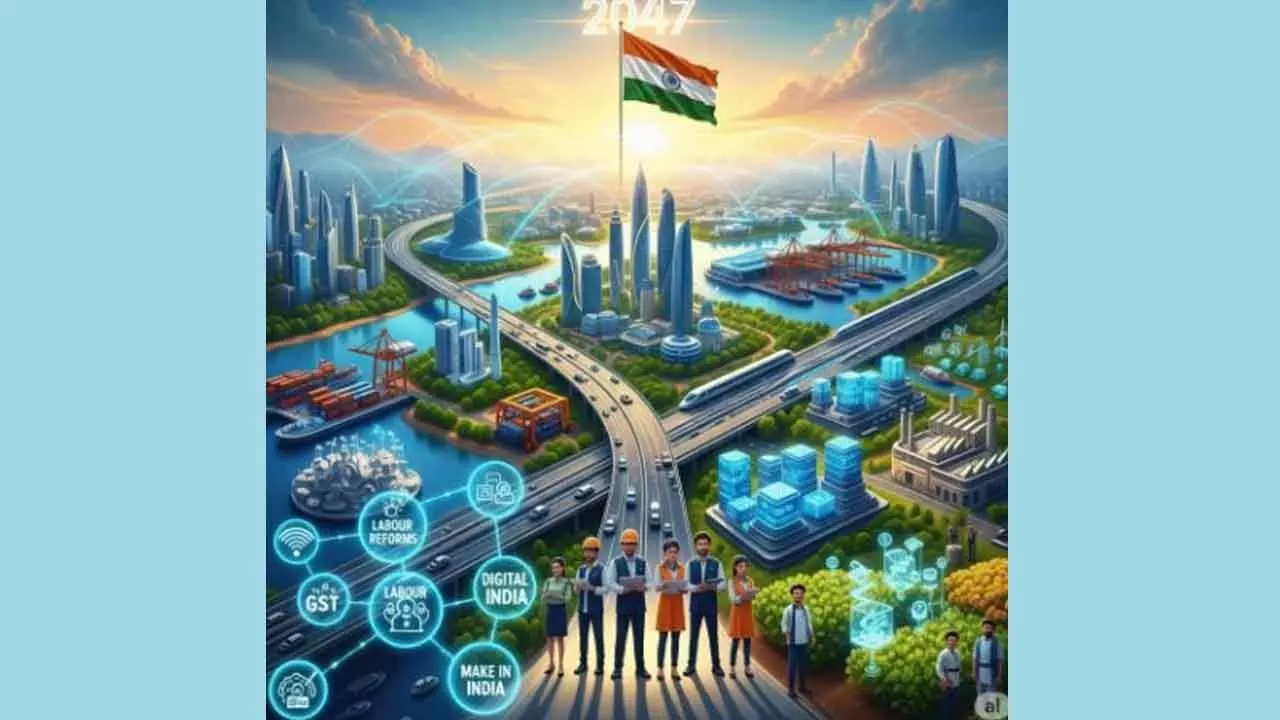

As India prepares to enter 2026, the nation stands at a critical inflection point on its path towards Viksit Bharat by 2047. Having reached the $4 trillion economy milestone, India now faces the formidable challenge of scaling up to a $30 trillion economy while raising per capita in-come to developed-nation levels
The year 2025 is nearing completion, and we are entering the New Year 2026 shortly. Every New Year brings a lot of hopes and promises for an outstanding and successful Year with opportuni-ties and a few challenges.
It is the endeavour of every person, organisation, institutions, states and the Central Government to fully make use of the available opportunities for maximisation of individual, institutional and county's prosperity and wealth maximization along with value creation, value enhancement, value preservation and value maximization. In India's context, our Prime Minister Shri Modi has laid down a long term vision of Viksit Bharat - Developed India by 2047.
Viksit Bharat is a long cherished dream of every proud Indian that India should join the league of developed nations from the current status of a developing economies. This Viksit Bharat will be a game changer as benefits and outcome of achievement will bring tremendous oppor-tunities for Young people, the demographic dividend of India and it is high time every proud citizen of India realises the potential and significance of the Viksit Bharat and take giant steps and put beautiful and powerful steps and plan of action along with the government policies and Reforms to make it happen instead of being mere observer, they must set up a brightful role for themselves which get blossomed for the welfare and prosperity of India.
We are currently reaching $4 trillion Indian Economy, and Viksit Bharat endeavour will be achievement of $30 trillion Indian Economy. India's per capita income as per 2023-24 is at $2,400 to $2,600, which needs to be enhanced substantially to a level of $18,182 based on a $30 trillion Indian Economy by 2047. In order to achieve Developed India status, this per capita in-come should be at a level of $20,000 by 2047.
This should involve a high-growth India, and In-dia should aim at double-digit growth of 10 per cent if not at 8 to 9 per cent growth, plus more than 22 years in its path towards Viksit Bharat. According to PWC India @2047, their projec-tions indicate that India @2047 can exceed per capita income of $26,000-almost 13 times the current level.
According to them, such per capita income is in $terms and not on purchasing pow-er parity ( PPP) terms. Continuing, they state that such increased per capita income may be achieved on the basis of a realistic assessment of a nominal GDP growth rate of 12 per cent and a few other assumptions.
In recent days, India's nominal GDP growth has come down to around 8 per cent plus, which has to be enhanced to the level suggested by PWC and beyond, as with in-flation, which is currently under control. In order to achieve real GDP growth of 10 per cent plus, nominal GDP growth will have to be substantial, as we have a lot to cover for Viksit Bharat.
It is gratifying to note that India in spite of global uncertainties and headwinds, recently registered a real GDP growth rate of 7.8 per cent for April to June 2025 and for July to September 2025 at the robust rate of 8.2 per cent.
This has been possible due to favourable policies support of government like GST rationalisation which has the potential of expand private consumption greatly coupled with stronger services sector, greater thrust given to manufacturing like PLI schemes and ease of doing business which will attract domestic and foreign direct investment in greater numbers even though the desire to achieve 25 per cent of our GDP from manufacturing sector which still a long way to go but not impossible if the current thrust continues.
Government plans of Atmanirbhar Bharat, Made in India, developing Aspirational Districts, Each District One Product, New Industrial Corridors and simplified rules and removing hurdles by abolition of old rules, etc, can provide further impetus to the manufacturing sector. India is aggressively boosting it's hydrogen production via the National Green Hydrogen Mission, targetting 5 million Metric Tons ( MMT) annual capacity by 2030, shifting from current fossil fuel based hydrogen towards Green Hydrogen from renewables, with plans to attract massive investment. Plans to make India a global hub for green Hydrogen, achieving 5 MMT production capacity by 2030, expected to attract over 8 lakh crore investments.
As India's financial sector is in good shape and showing bright prospects, and poised for a great-er role in the path towards Viksit Bharat. India's RBI has also been bringing suitable regulatory positive changes to prepare the Banks, NBFC and other financial sector players to contribute sig-nificantly by providing access to credit and providing all essential services on a tech mode and easy to use.
Recent RBI reforms, large in number in 2025, focus on boosting credit flow, finan-cial inclusion, providing for credit for mergers and acquisitions, higher funding for IPO, relaxed rules for ECB, easing restrictions on large borrowers, ECL provisioning etc are the supporting measures for the financial sector contributing to Viksit Bharat.
It is also happy to note that foreign investments are coming in Banking and NBFC sector in 2025:, with significant stakes acquired by global players like Blackstone ( Federal Bank), Emir-ates NBD ( RBL Bank), SMBC ( Yes Bank) and MUFG ( Shriram Finance), signalling strong confidence in the financial sector, signalling India's robust long- term potential and maturing regulatory environment for foreign ownership.
India recent passing of Sabka Bina Sabki Raksha ( Amendment of Insurance Laws ) Bill, 2025, allows upto 100 per cent FDI in the Insurance Sector, a significant step from the earlier 74 per cent cap, which has the potential to attract further foreign investments in the Insurance Sector which is needed to further facilitate for penetration of Insurance in India with a vission of Insur-ance for All by 2047.
In the year 2025, India has achieved significant milestones in space tech, digital infrastructure, expanding renewable energy, and excelling in sports like winning the ICC Champions Trophy and world games medals. On the economic front, India could demonstrate its resilience in spite of global uncertainties, and India has become $4 trillion Economy.
However there are challenges arising out of US Tariffs of 50 per cent, the US India Trade Agreement yet to happen even though India proceeded with speed with other Regional or free trade agreements with UK( July 2025) the European Free Trade Association or EFTA ( came into effect in October 2025), Oman and New Zealand ( both in December 2025) These efforts to diversify trade and at the same time continuing to finalise US India Trade pact at the earliest will help India to cover up the shortfall if any in exports.
The year 2026 will be a year of substantial opportunities and a few challenges. India, with its strong macroeconomic fundamentals and resilience, should endeavour to take up further economic and policy reforms and focus on boosting greater investments both at Government level, which has been the hallmark in recent years, coupled with the private sector coming forward to invest heavily and also opening for foreign investments.
India should continue to take giant steps in technology, particularly in emerging technology, including AI and be an innovator in technology, products and services, as it has to find new avenues in service exports, as it is believed Invest-ment+Technology+Innovation will help India to move strongly towards Viksit Bharat.
(The author is former Chairman & Managing Director of Indian Overseas Bank)





