

Budget 2026: Can India outrun US tariffs and reboot its growth engine?
A moment to align today’s budget with tomorrow’s India
Budget 2026: Can India outrun US tariffs and reboot its growth engine?
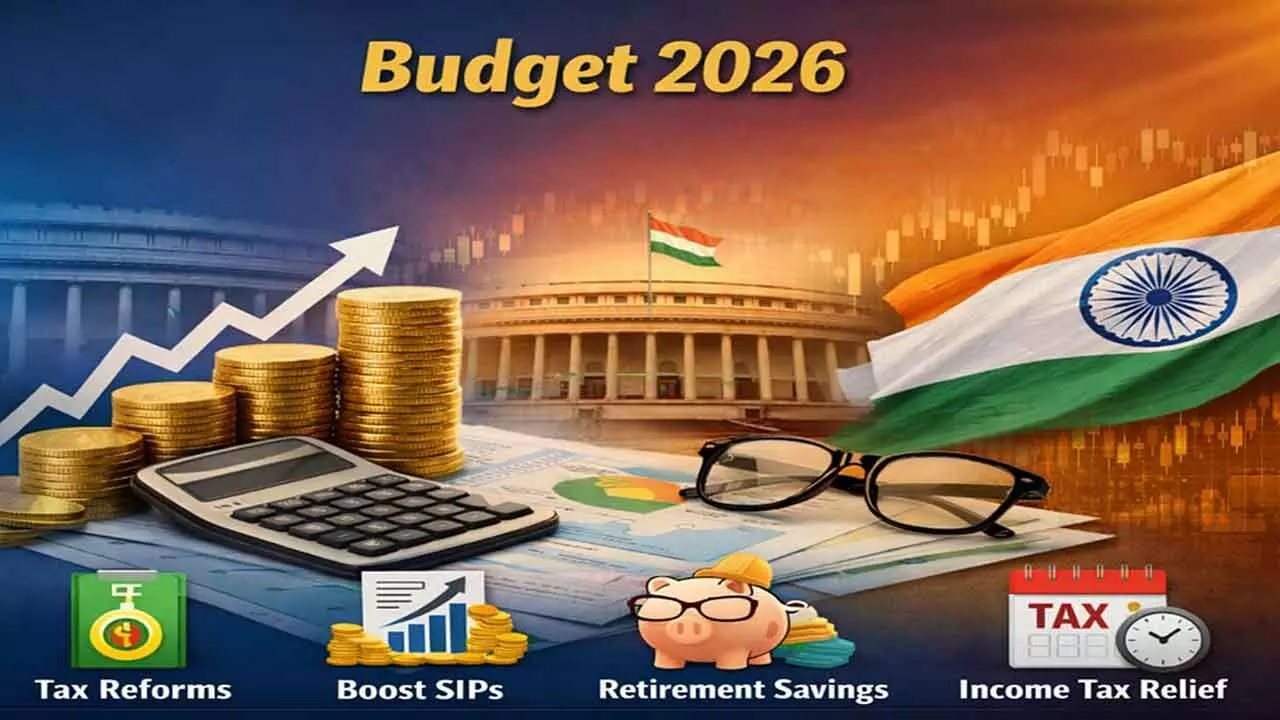

As Finance Minister Nirmala Sitharaman prepares to present the Union Budget on 1 February 2026, India stands at an inflection point. Domestically, the economy retains robust growth fundamentals despite global headwinds, grounded in strong internal demand and rising digital participation.
The expectations are that this budget will be different from the previous ones keeping in view the rising tariff barriers in the United States — including punitive levies of up to 50 per cent on Indian exports — present a significant shock to export-oriented sectors and test the resilience of India’s trade strategy. It will have to be re-tuned to advance the government’s vision of 2047.
The common man is keeping fingers crossed as he awaits announcements on tax relief, market participants are hoping for an easing of capital market taxation, including a higher exemption limit on long-term capital gains.
In this context, Budget 2026 is not merely an accounting exercise but a strategic response to strengthen domestic engines of growth, while cushioning key sectors against external duress. The expectations from industry and the public reflect a blend of urgent relief measures, forward-looking reforms, and a more ambitious global posture for Indian enterprise.
Over the past year, the imposition of steep U.S. tariffs on a broad swathe of Indian exports — encompassing textiles, gems and jewellery, leather, electronics components, and other labour-intensive goods — has reshaped export dynamics. Data suggest that the United States accounts for roughly one-fifth of India’s merchandise exports, and prolonged tariff barriers could erode tens of billions in export revenues if unresolved. Several industries like the Denim industry in Gujarat are redrawing their strategies to make good the loss on account of the negative impact of US tariffs. Budget 2026 is expected to go beyond traditional incentives and design a fiscal framework that helps Indian exporters compete on quality, compliance, and diversified market access rather than solely on cost. The government’s initiatives such as an Export Promotion Mission and expanded credit guarantees underscore the seriousness of the challenge.
Micro, Small and Medium Enterprises (MSMEs) have historically been the backbone of India’s economy — a crucible of innovation, employment, and export potential. Yet they face a confluence of pressures:
Post-GST 2.0, has left some small firms struggling with compliance cost-burdens, credit constraints and liquidity shortages that stifle expansion and innovationthat disproportionately damage export prospects, especially for smaller exporters without risk-hedging capacity.
Industry groups, therefore, anticipate the Budget to champion reinforced GST reforms that simplify compliance, expand the GST exemption threshold (even proposals to Rs 1.5 crore have been floated), and reduce litigation.
Combined with credit support instruments — such as extended Export Credit Interest Subvention, additional loan window for distressed MSMEs, and longer NPA classification periods — the fiscal framework can provide MSMEs the breathing space to innovate and plan with confidence.
The industry also expects that with the tariff shock looming large on exports, special subvention schemes for international orders and export-linked performance incentives can help stabilise order pipelines while India negotiates market access barriers.
India’s digital economy — driven by platforms such as UPI, Aadhaar etc— is a global success story. It now contributes close to 12 per cent of GDP and supports millions of jobs. As we approach Budget 2026, stakeholders in the technology sector (including SaaS, cloud services, fintech, AI, and deep tech) are signalling a need for:Stable regulatory certainty, particularly in areas like data governance, cross-border interoperability and taxation of digital services,enhanced R&D incentives, including tax credits tied to patent development and high-end innovation, rather than mere volume-based subsidies.
Improving IP protections, and offering fiscal incentives for tech startups scaling internationally, industry feels would anchor India’s future-ready services exports — which are far less vulnerable to tariff barriers than goods — as a reliable growth pillar.
India’s agricultural sector remains fundamental not only to food security but also to rural incomes and political economy. The Budget 2026 dialogue has seen calls for a paradigm shift — from production-centric policies to innovation-driven, export-oriented agricultural growth.
Key expectations from the sector include:
There should be a special focus on developing cow dung and cow urine–based products, popularly known as Panchgavya products, especially within the small-scale sector in rural areas. According to Shyambhai of Banaskantha, a pioneer in setting up units that manufacture by-products from cow urine and cow dung, the Budget must prioritise organic farming, reduce taxes on electric vehicles, and extend targeted support for rural entrepreneurs engaged in research and development in organic agriculture. He emphasises the need for special incentives and easy loan facilities to establish Panchgavya manufacturing units at the village level. Gramothan is essential for holistic rural development, as the national economy cannot grow at the desired pace unless the rural economy expands in tandem.
Cow urine and cow dung not only have immense potential to rejuvenate soil health but can also provide farmers with an additional source of income through the sale of gaumutra. In the long run, this model can evolve into a viable cooperative movement, much like the milk cooperatives that transformed India’s dairy sector.
Echoing this vision, VallabhaiKathria, former Union Minister and founder of the Global Confederation of Cow-Based Industries, said that a mega Gautech Expo—GAUTECH 2026 will be organised in Pune from March 20 to 23. The event aims to bring together tradition and technology, showcasing cow-based innovations in agriculture, health and environmental sustainability, smart farming tools for sustainable practices, and providing a platform for networking among farmers, experts and entrepreneurs.
Other expectations are infrastructure outlays for cold chains, processing clusters, logistics nodes and export terminals to reduce post-harvest losses and enhance value addition.
Agri-tech incentives, particularly for drone technology, precision agriculture, bio-inputs and climate-smart farming systems.
MSP reform and market infrastructure that allow farmers to link directly with organised, global supply chains without over-reliance on minimum support price regimes.
The general public — the salaried middle class, small traders, and rural households alike — are looking for relief on several fronts: personal tax rationalisation, improved access to affordable housing and credit, and infrastructure that directly impacts living standards. Investors and markets broadly expect no dramatic populist giveaways but targeted incentives that boost investment, consumption and long-term demand. Personal tax cuts, extensions of key deductions, and rationalisations in long-term capital gains taxes are anticipated measures that could increase disposable income without derailing fiscal discipline.
Budget 2026 must also signal India’s macro-economic stability: predictable tax codes, credible fiscal consolidation plans and a transparent roadmap for capital flow liberalisation. Experts have emphasised reforms to simplify cross-border tax treatment, improve investor certainty, and make India attractive for long-term foreign investment.
Budget 2026 has the opportunity to strike a nuanced balance — by strengthening internal competitiveness, enabling firms to adapt to modern trade realities, and forging deeper bilateral and multilateral trade engagements.
As India confronts the twin challenges of global economic uncertainty and rising trade barriers, Budget 2026-27 must be a statement of confidence — not only fiscal prudence but also strategic ambition. By empowering MSMEs with ease and credit, catalysing tech-led growth, modernising agriculture, and cushioning exporters against tariff shocks, it can set the stage for a more resilient, more competitive India that thrives in a multipolar global economy.
Above all, this budget must chart a path where India’s domestic strengths and global aspirations converge, ensuring that the country does not merely weather external headwinds but emerges stronger in the decades ahead.
(The author is a former Chief Editor at The Hans India)





