

Putin’s India visit underscores enduring logic of New Delhi’s strategic autonomy
Putin’s India visit underscores enduring logic of New Delhi’s strategic autonomy
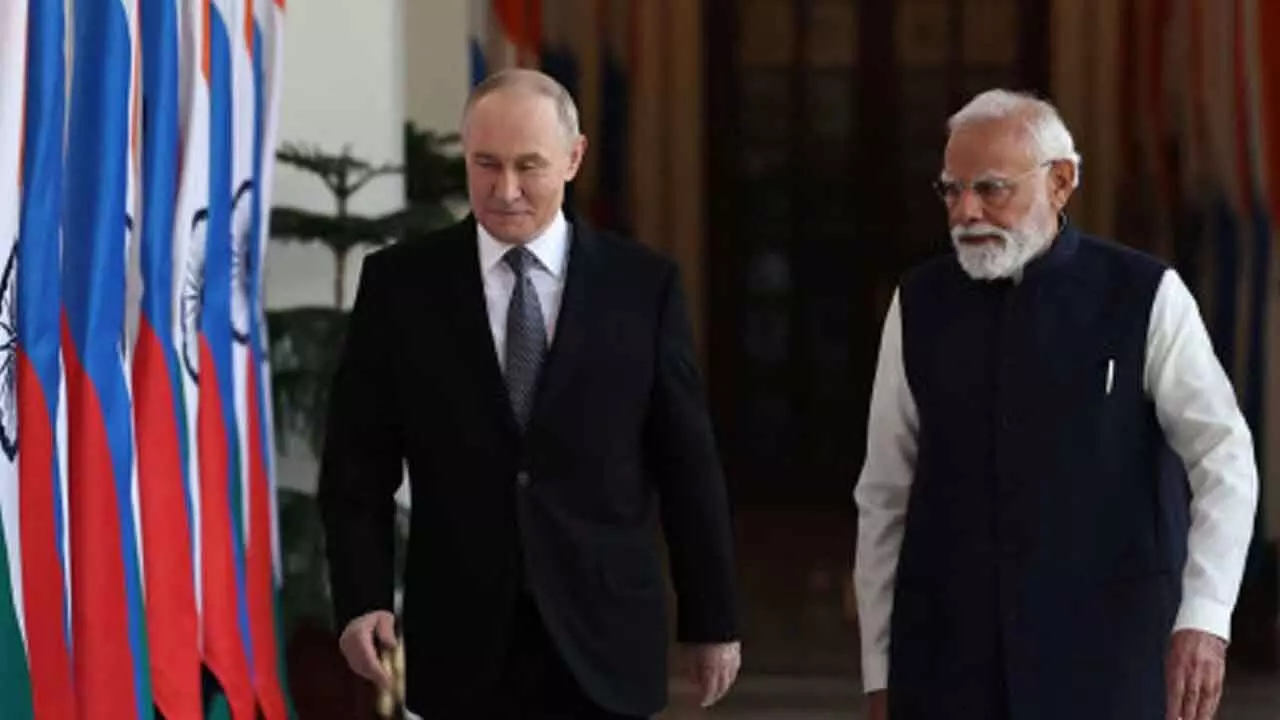
Russian President Vladimir Putin’s visit to India is best read not as a deviation in New Delhi’s foreign policy, but as a reminder of its deepest continuities. From the Nehruvian era to the pre-sent, India has sought something rare in international politics: the ability to engage major powers on its own terms. While the idiom has changed—from non-alignment to multi-alignment—the instinct for strategic autonomy remains intact.
Jawaharlal Nehru’s foreign policy was conceived in a fractured post-war world where newly in-dependent states were pressured to choose sides. India refused. Non-alignment was neither neu-trality nor indecision; it was an assertion of agency. Within that framework, the Soviet Union emerged as a critical partner—not solely out of ideological affinity, but due to its consistent dip-lomatic backing, defence cooperation, and lack of intrusive conditionalities. Moscow supported India on Kashmir, supplied defence platforms when others declined, and helped build strategic capabilities in steel, energy and heavy industry. The India–Soviet relationship thus became a cor-nerstone of autonomy, not alignment.
The end of the Cold War unsettled this equilibrium. The collapse of the USSR, India’s 1991 eco-nomic crisis, and the emergence of a US-led unipolar order forced recalibration. Liberalisation drew India closer to Western markets and institutions, while the 2008 civil nuclear deal with Washington marked a decisive strategic opening.
Yet even then, New Delhi resisted a clean break from Moscow. Defence dependence, technology trust and geopolitical logic ensured conti-nuity, even as India diversified its partnerships.
That hedging instinct became sharper in the Modi–Trump era. Political bonhomie between Prime Minister Narendra Modi and President Donald Trump gave India–US ties unprecedented visibil-ity. Defence interoperability expanded, India was elevated within the Indo-Pacific strategy, and convergence on China appeared strong.
But beneath the optics lay structural friction. Trump’s “America First” doctrine weaponised trade—even against partners. India lost its GSP benefits, faced steel and aluminium tariffs, and was repeatedly threatened with reciprocal measures.
These disputes were instructive. They exposed the reality that under transactional geopolitics, strategic alignment does not guarantee economic stability. For India, the lesson was clear: part-nerships must never come at the cost of leverage or autonomy. The Trump years reinforced—not weakened—New Delhi’s reluctance to place all its bets on one capital.
It was in this context that India’s continued engagement with Russia acquired renewed rele-vance. As Western sanctions mounted after the Ukraine war, India refused to downgrade ties with Moscow.
Instead, it deepened cooperation in defence, energy, nuclear power, space and fertilisers. Russian crude helped insulate the Indian economy from global inflation, while nuclear and space cooperation filled strategic gaps that few others were willing to address.
At the same time, the relationship today is marked less by sentiment than realism. Defence deliv-ery delays caused by the war, a severely lopsided trade balance, payment complications under sanctions, and Russia’s growing dependence on China present serious challenges.
Moscow is no longer the independent Eurasian pole it once was, and New Delhi is acutely aware of the risks posed by a Russia increasingly beholden to Beijing. The primary difference from the Cold War era is that India now engages from a position of confidence, rather than compulsion.
In essence, India’s foreign policy today is neither a return to Nehru nor a rupture from him. It is an inheritance refined by experience—shaped by the unpredictability of the Trump era, the pres-sures of great-power rivalry, and India’s own rise. Strategic autonomy is no longer proclaimed; it is practised. And in that practice, Russia remains not an anachronism, but a calculated partner in India’s long game.





