

Delhi High Court Questions Centre: “How Were Airlines Allowed To Overcharge?” Amid IndiGo Crisis
Delhi High Court questions the Centre over airlines allegedly overcharging passengers amid the IndiGo crisis, seeking clarity on fare regulation and passenger rights.
Delhi High Court seeks Centre’s explanation on airline overcharging amid IndiGo crisis.
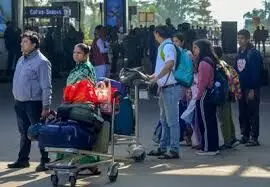
The Delhi High Court on Wednesday sharply criticised the Centre over the IndiGo flight disruption crisis, questioning how airfares were allowed to soar to nearly ₹40,000 during the mass cancellations that left thousands of passengers stranded across major airports.
During the hearing, Justice Sachin Datta Gedela asked why competing airlines were permitted to charge exorbitant fares while IndiGo struggled with operational issues. “If there were a crisis, how could other airlines be permitted to take advantage? How can fares jump to ₹35,000–₹39,000? How can this be allowed?” the court remarked.
Airfares Spiked Amid Chaos
The IndiGo cancellations triggered a rush for last-minute tickets, leading to a surge in prices — often doubling or tripling on key domestic routes. A one-way Mumbai–Delhi ticket touched ₹35,000, almost equivalent to the cost of a round trip on many days. In contrast, several international routes were cheaper than domestic sectors amid the disruption.
Court Pulls Up Centre
After the Centre outlined steps taken to stabilise the situation, the court observed that all measures came after the crisis had escalated.
“These steps were taken once the crisis erupted. The question is why the situation was allowed to arise at all, and what were you doing until then?” the bench asked.
The court also sought clarity on why pilots were overworked and questioned the government on what measures were in place to prevent such operational lapses.
The Directorate General of Civil Aviation (DGCA) informed the court that it had issued a show-cause notice to IndiGo, to which the airline responded with a “profuse apology”. However, the court emphasised that while it appreciated efforts to control the chaos, the root cause should never have been allowed to develop.
Impact on Passengers, Economy
The bench noted that the failure to manage operations left “lakhs of passengers unattended,” adding that disruptions of this scale affect not just travellers but also the broader economy, given the critical role of rapid transportation.
“What steps were taken to compensate passengers? And what action has been taken to ensure responsible behaviour from service provider employees?” the court asked.
Centre’s Action Against IndiGo
The Centre has initiated a series of corrective measures in response:
DGCA cut IndiGo’s winter schedule by 5%, reducing around 110 flights per day.
The freed-up slots will be allocated to other airlines to maintain network stability.
The ministry is monitoring refunds, baggage tracing, and passenger support measures.
Union Civil Aviation Minister K Ram Mohan Naidu stated in Parliament that passenger safety is “non-negotiable,” adding that no airline will be allowed to cause hardship to travellers.
DGCA has also launched a detailed enforcement investigation into IndiGo’s operations, with the minister assuring that strict action will follow if required.





