

British firms ready to seize opportunities from UK-India CETA
UK govt expects the trade pact to significantly enhance the 44.1-bn pound bilateral trade partnership
image for illustrative purpose
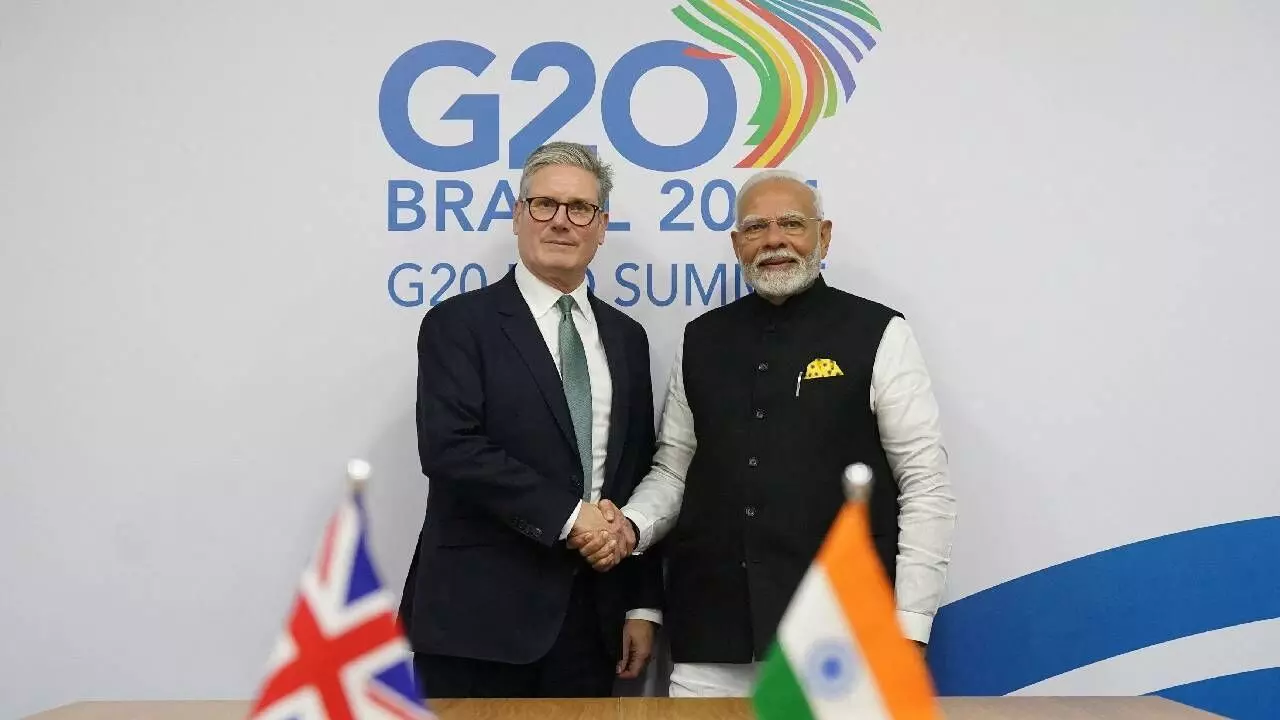
London: The UK government has said that the free trade pact with India, once implemented, is expected to significantly enhance the 44.1-billion-pound bilateral trading partnership, and companies from both sides are "excited" to seize the investment and growth opportunities.
Speaking at the Lord Mayor's Guildhall banquet in London, Prime Minister Keir Starmer also termed the India-UK Comprehensive Economic and Trade Agreement (CETA) as a "historic deal".
The deal agreed during Prime Minister Narendra Modi's UK visit in July is now undergoing a parliamentary ratification process in Britain. Once it comes into force by next year, the CETA is expected to significantly enhance the 44.1-billion-pound bilateral trading partnership as a result of tariff cuts and easier market access for goods and services between the two economies.
"We've struck a historic trade deal with India, and in October I led the biggest British trade delegation to that country ever," said Starmer, referring to his Mumbai visit accompanied by 127 business chiefs, entrepreneurs and university vice-chancellors.
His minister in the UK Foreign, Commonwealth and Development Office (FCDO), Seema Malhotra, addressing the Indo-Pacific Conference in London on Monday, also talked about her recent follow-up visit to Chennai and Bengaluru, and said that the deal is set to boost the bilateral trade by over 25 billion pounds.
"My visit last week, a month after the Prime Minister, recognised the growing ambition for collaboration following the success of the recently signed Free Trade Agreement, which is set to boost bilateral trade by over 25 billion pounds," said the Indian-origin Minister for the Indo-Pacific.
"I heard from British companies excited to seize the opportunities – including businesses already thriving in India like Tesco, Revolut, BT and Marks and Spencer. And Indian businesses alike are looking for new opportunities. "More broadly, the UK and India's shared 'Vision 2035' is our commitment to face the future together, strengthening collaboration on our shared priorities. And that spirit of partnership and ambition for each other's future is a thread that connects us across the region," she said. The annual conference, organised by the High Commission of India in partnership with the Australian High Commission, was themed around 'Re-thinking Cooperation in a Fragmented World' in its third year. Malhotra pointed out that by 2050, more than half of the global growth is expected to come from the Indo-Pacific region.
"This region matters – for our growth, for our security, for the climate – and we're determined to build a reputation as a trusted partner for the long haul; because for us, this isn't about short-term headlines, it's a generational mission, a long-term strategic posture that will shape the decades ahead," said Malhotra.
"Rethinking cooperation is a matter for all of us, not just to how we survive in a fragmented world, but how we work towards a less fragmented and more secure world of the future," she said.
The day-long conference opened at King's College London before moving to India House and then Australia House, all within proximity of each other in central London.





