

EESL to develop Srinagar as world’s first energy-efficient tourist capital
Vizag is a gateway for LED street lighting tech, says official
Mandeep Kaur, Principal Secretary, Housing & Urban Development Department of Jammu & Kashmir unveiling a comprehensive report of proposed energy efficiency programs in Jammu. EESL CEO Akhilesh Kumar Dixit is also present
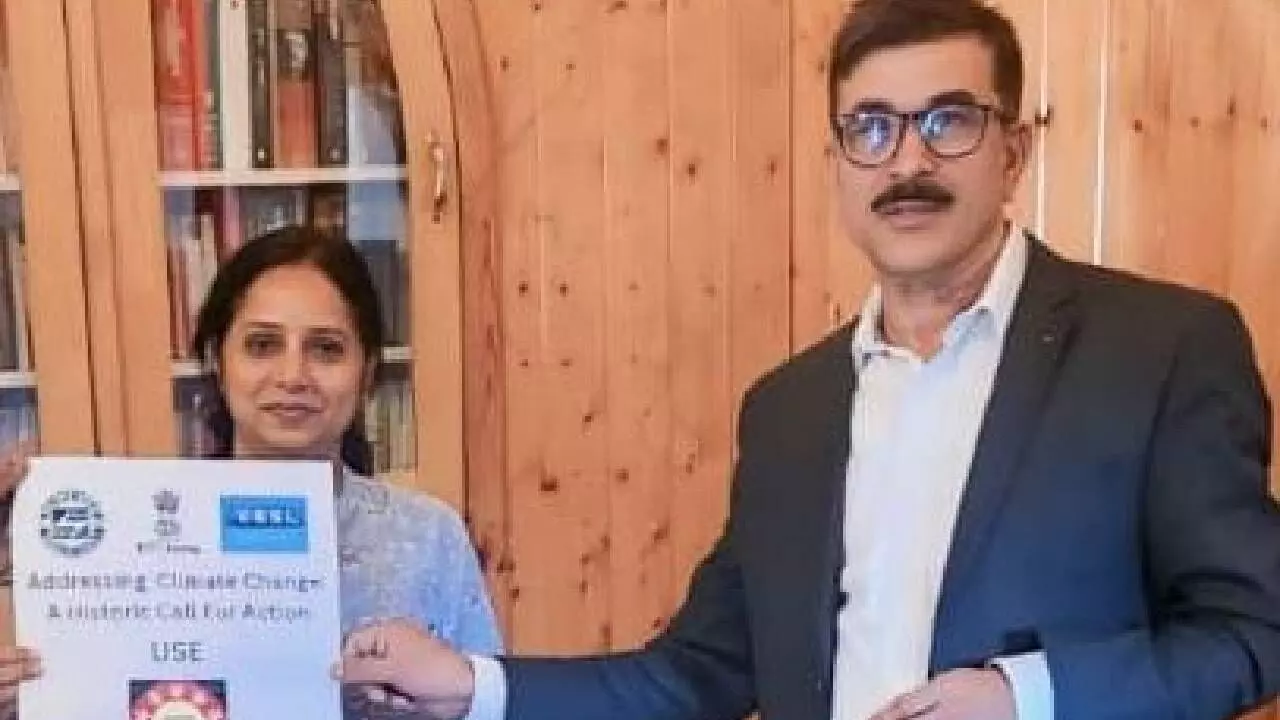
Vijayawada: In line with the Government of India’s climate goals and the Union Territory of Jammu & Kashmir’s sustainability commitments, Energy Efficiency Services Limited (EESL)—a joint venture of public sector undertakings under the Ministry of Power—has proposed to support J&K in transforming Srinagar into the world’s first “Energy-Efficient Tourist Capital.”
The initiative aims to set new global benchmarks for green, resilient and highly liveable tourism-driven cities.
EESL CEO Akhilesh Kumar Dixit submitted a detailed Comprehensive Roadmap to Mandeep Kaur Principal Secretary, Housing & Urban Development Department, and Satish Chandra, Chairman, Real Estate Regulatory Authority (RERA), J&K. The roadmap outlines the adoption of global best-in-class energy efficiency technologies across rural and urban regions of the UT, highlighting significant opportunities arising from J&K’s rapidly expanding development landscape.
Speaking on the occasion, the Secretary, Housing & Urban Development, emphasised that J&K is entering a phase of high-energy demand, high electric mobility and booming tourism.
“Under these conditions, energy efficiency is the most powerful, affordable and immediate strategy to strengthen power system reliability, improve service delivery and advance the UT’s long-term economic vision—while substantially reducing carbon emissions,” she noted.
Mandeep Kaur further highlighted J&K’s position at a critical growth inflection point, with a real GSDP growth of 7.06 per cent in 2024–25 and a record 2.36 crore tourist arrivals in 2024.
RERA Chairman Satish Chandra, who has over three decades of public service including his tenure as Principal Secretary to the Chief Minister of Andhra Pradesh, advised the Housing & Urban Development Department to evaluate and implement proven global technologies in energy efficiency and renewable energy.
He stressed the importance of leveraging the expertise of Bureau of Energy Efficiency (BEE) and EESL, the world’s largest energy-efficiency utility, to achieve transformative developmental outcomes.
Recounting successful precedents, Satish Chandra highlighted the first-of-its-kind LED street lighting initiative implemented a decade ago in Visakhapatnam, Andhra Pradesh, in partnership with EESL.Following the devastation caused by Cyclone Hudhud in October 2014, swift action by Prime Minister Narendra Modi and continuous monitoring of the then Chief Minister N Chandrababu Naidu enabled the retrofitting of one lakh LED streetlights within a month under the Government of India’s Street Lighting National Programme (SLNP).
This innovation allowed the Greater Visakhapatnam Municipal Corporation (GVMC) to achieve around 40 per cent energy savings, significantly lowering electricity bills, improving the quality of life and establishing Vizag as a national and global model for LED-based urban transformation.
The success of the Andhra Pradesh–EESL model attracted global recognition from BRICS nations, and led to large-scale adoption by states such as Rajasthan, Gujarat, Maharashtra and Telangana. To date, over 1.30 crore LED streetlights have been installed across India through the Ministry of Power, EESL and partner states—resulting in annual CO₂ reductions of 6.2 million tonnes and financial savings of approximately Rs6,000 crore.





