

Trade Setup 27 January: Nifty’s weekly chart forms a sizable bearish candlestick
Nifty ends lower as selling persists; key support at 25,000-24,800 and resistance at 25,400-25,500. Weakness likely to continue amid FII outflows and rupee pressure.
Nifty’s weekly chart forms a sizable bearish candlestick
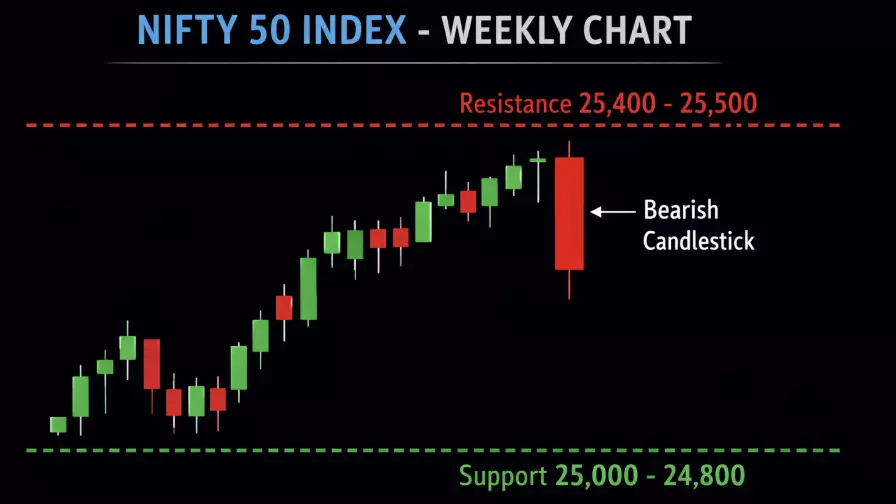
The Indian stock market slipped on Friday, with Nifty closing below 25,050 amid FII outflows, a weak rupee, and broad-based selling. Analysts expect continued weakness, with key support at 25,000–24,800 and resistance at 25,400–25,500 in the near term.
The Indian stock market failed to sustain its previous session gains and ended in negative territory on Friday, reflecting continued selling pressure amid a weaker rupee and ongoing FII outflows. Both Nifty and Sensex closed sharply lower, with broad-based weakness across sectors, signaling that market sentiment remains fragile.
The Nifty 50 index dropped 241.25 points, or 0.95%, to close at 25,048.65, while the BSE Sensex declined 769.67 points, or 0.94%, to finish at 81,537.70. Both indices registered losses of around 2.5% over the week. Analysts pointed out that volatility persisted throughout the session, as investors reacted to global trade concerns, geopolitical tensions, and stock-specific earnings updates.
According to Bajaj Broking Research, the Nifty’s weekly chart formed a sizable bearish candlestick with a lower high and lower low, indicating a continuation of the downward trend for the third consecutive week. Analysts highlighted that the key support zone for Nifty lies between 25,000 and 24,800, while immediate resistance is expected around 25,400–25,500.
Amol Athawade, VP of Technical Research at Kotak Securities, warned that a further breach below the support could see Nifty slipping to 24,700–24,500. He noted, “The market is likely to remain under pressure until decisive moves above resistance levels are seen.”
The broader market witnessed widespread selling, with capital goods, power, realty, PSU banks, and media stocks emerging as the biggest drags, shedding 2–3% each. Analysts emphasized that stock-specific moves will remain influenced by ongoing Q3 earnings announcements, while macro developments such as global trade negotiations and geopolitical dynamics will continue to steer broader market trends.
Bank Nifty Outlook
The Nifty Bank index mirrored the broader market trend, continuing its corrective bias. Bajaj Broking Research observed that Bank Nifty’s weekly chart also formed a bearish candlestick with a lower high and lower low, signaling ongoing corrective pressure. Analysts identified 25,000–24,800 as critical support levels, while immediate resistance is placed at 25,400–25,500.
Athawade added, “For Bank Nifty, 58,000 is a key level for traders. Breaching this could extend the correction toward 57,500–57,100, while a move above 59,000 may trigger a rebound to 59,350–59,500.”
Market participants are expected to closely track upcoming earnings announcements and macroeconomic cues, as these factors are likely to dictate short-term trends. Analysts caution that the weak momentum may persist until global cues and domestic policy developments provide clarity.
In summary, the Indian equity market is navigating a phase of correction, with Nifty poised to test its key support zone in the coming sessions. Investors are advised to exercise caution, monitor critical levels, and stay alert to both global and domestic triggers that could influence market direction.





