

Rising crude, global uncertainty to weigh on investor sentiment outlook
Markets have been rattled as the escalating conflict in the Middle East has disrupted shipping and energy exports through the crucial Strait of Hormuz
Rising crude, global uncertainty to weigh on investor sentiment outlook
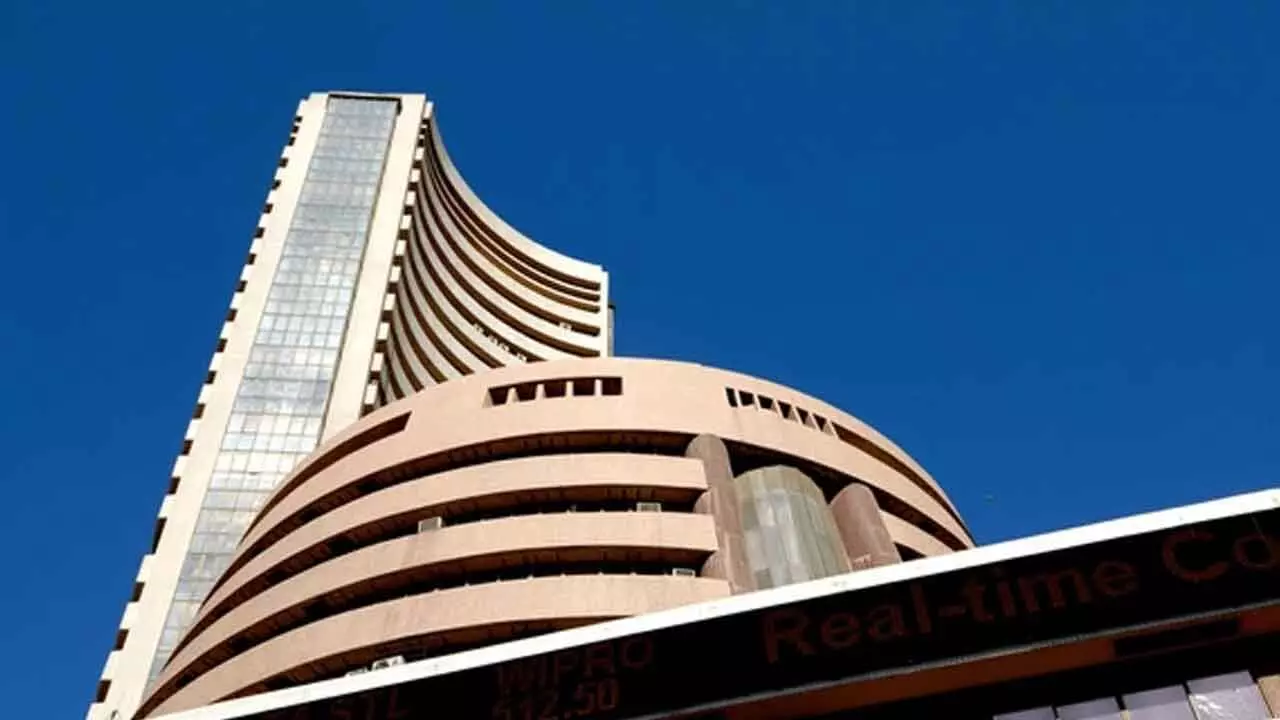
Amid escalating geopolitical tensions between the US and Iran, which led to a sharp jump in crude oil prices. a declining rupee, unabated FII selling and weak global cues; the markets traded with a clear negative bias witnessing persistent selling pressure during the week ended.
The Sensex slipped 2,368.29 points, or 2.91 percent, to finish at 78,918.90, while the Nifty shed 728.2 points, or 2.89 percent, to close at 24,450.45. Broader markets also witnessed consistent selling; the BSE Smallcap and the BSE Midcap index indices fell 3.3 percent and 3 percent during the week.
After attempting to stabilize early in the week, the indices gradually drifted lower as selling intensified at higher levels. Most sectoral indices ended in the red during the week. The Nifty PSU Bank index declined 6.5 percent, followed by the Nifty Realty index, which fell 5 percent. The Nifty Bank index dropped 4.5 percent, while the Nifty Media index slipped 4.3 percent and the Nifty Private Bank index shed 4 percent. However, the Nifty Defence index bucked the trend, gaining nearly 5 percent.
FIIs sold equities worth Rs 21,831.19 crore, extending their selling streak to the third consecutive week. Expectedly, DIIs remained net buyers, purchasing equities worth Rs 32,786.92 crore, during the week. The Indian rupee touched a fresh record low against the US dollar this week amid surging crude oil prices. During the week, the domestic currency moved within a band of 91.22 to 92.30.
Markets have been rattled as the escalating conflict in the Middle East has disrupted shipping and energy exports through the crucial Strait of Hormuz. This narrow chokepoint between Iran and Oman normally carries around one-fifth of the world’s crude oil and liquefied natural gas supplies. India remains critically dependent on Middle Eastern supply of crude oil, refined products and LNG and observers believe the market is too complacent about supply chain risks.
This combination of macroeconomic uncertainty and geopolitical risk is likely to influence market sentiment in the near term. Unless there is a positive development in the Middle East conflict that brings crude oil prices lower, Indian markets could witness continued volatility.
Historically, sectors such as aviation, paints, chemicals and logistics tend to face the most pressure when oil prices surge sharply. The March deadline for the India-US trade deal will be set aside and it may take another three-four months to reassess the situation and conclude the deal after the US Supreme Court struck down the tariffs imposed under the International Emergency Economic Powers Act (IEEPA).
Market Musings: Investors started the past week confident that the Israeli-U.S. attack on Iran would be another short war they could all but ignore. They ended the week worried that a global shock to oil prices from what’s become a widespread Middle East conflagration is in some ways a repeat of 2022’s Russia invasion of Ukraine and threatens stagflation.
For years, investors treated the Persian Gulf as a bastion of calm in a deeply unstable region. Oil wealth and careful diplomacy kept turmoil at arm’s length. Markets are repricing risk across the region forcing investors to recalibrate their perception of the region’s stability.
None of the Gulf states are on the brink of an economic crisis: They sit atop trillions of dollars of sovereign-wealth funds and foreign currency reserves. But with the Iran war widening, investors are being forced to reassess which economies stand to lose the most. The investment question now is whether signs of worry are a reason to buy the dip, or a reason to get out before things get even worse. At some point between now and then, history suggests investors should buy the dip.
Market saying to “buy when there’s blood in the streets,” neatly captures the idea that investors often panic when there’s a war on. The trouble is to know when, which means watching for the initial signs of market chaos getting even worse—and knowing yourself. If you buy too early, will you sell again as losses build, and so miss the eventual bounce? When the market is truly swimming in red, will you actually have the guts to buy? Get ready.
Do your homework before making a decision. Once you’ve made a decision, make sure to re-evaluate your portfolio on a timely basis. A wise holding today may not be a wise one in the future.
FUTURES & OPTIONS / SECTOR WATCH
Markets witnessed a tough and volatile week as a perfect storm of geopolitical friction in Middle East and a sharp spike in crude oil prices rattled investor confidence. Volumes in the derivative segment are reflecting a clear “risk-off” mood.
Heavy Call writing was seen at 25,000 strike and highest open interest in Put options was seen at 24000 and 24500 strikes. The Implied Volatility (IV) of calls closed at 15.74 per cent while that for put options closed at 16.05 per cent. The Nifty VIX for the week closed at 17.85 per cent and is expected to remain volatile.
PCR OI for the week closed at 1.17. Risk aversion is reflected by a significant 45 per cent surge in the India VIX, which hit 21 levels during the week, signalling that fear and uncertainty have firmly moved into the driver’s seat. Nifty is taking support near 24300 but remains highly volatile.
On the upside, the 24,900–25,000 range is expected to act as an immediate supply zone, where selling pressure could emerge if the index attempts a recovery. The index is currently leaning on a critical floor between 24,300 and 24,250. For the coming week, markets may begin on a cautious note as traders react to the index testing this important long-term moving average support.
On the downside, 24,300 remains the first key support, and if the index slips below this level, 23,800 will be the next important support area. Technically, the market’s structure has shifted to a “sell on rise” bias. Traders should remain cautious and avoid aggressive fresh buying until stability emerges near support levels. The rising volatility and weakening breadth suggest that risk management should remain a priority.
Any pullbacks toward resistance zones may continue to invite selling pressure. Adopting a defensive, stock-specific approach while protecting gains and maintaining strict stop-losses would be the most prudent strategy for the coming week. Avoid temptation of attempting to catch the falling knife. Stocks looking good are Astral, Bandhan Bank, Mazagon Dock, NTPC, Sun Pharma and Siemens. Stocks looking weak are Angel One, Cipla, ICICI Bank, Kotak Bank, KPIT and Union Bank.
(The author is a senior maket analyst and former vice-chairman, Andhra Pradesh State Planning Board)
STOCK PICKS
Belrise Industries Limited (BIL)
The company is a leading automotive component manufacturer in India, delivering safety-critical systems and advanced engineering solutions for two-wheelers, three-wheelers, passenger vehicles, commercial vehicles, and agricultural vehicles.
The company’s manufacturing expertise spans multiple steel grades, custom special-purpose machinery, and proprietary technologies such as patented suspension systems and high-precision steering columns. Its product portfolio spans metal chassis systems, polymer components, suspension systems, body-in-white parts, exhaust systems, and other critical assemblies.
Designed to be largely powertrain-agnostic, the company’s offerings cater to both internal combustion engine (ICE) and electric vehicles (EVs), positioning the company to capitalise on the industry’s shift toward electrification. Company has built long-standing partnerships with over 30 leading OEMs in India and abroad, including prominent multinational brands. Company acquired H-One India Private Limited, a subsidiary of Japan’s H-One Company Limited.
This strategic acquisition provides access to high-tensile steel manufacturing—critical for lightweighting and improving durability and strength—along with a complete R&D setup and two state-of-the-art manufacturing facilities in Greater Noida and Bhiwadi. It has also added one new Japanese four-wheeler OEM to our Company’s customer base and increased penetration with two existing Japanese two-wheeler OEMs. Buy on declines for medium term target of Rs300.





