

From AI anxiety to oil shock: The many fault lines beneath Indian markets
From AI anxiety to oil shock: The many fault lines beneath Indian markets
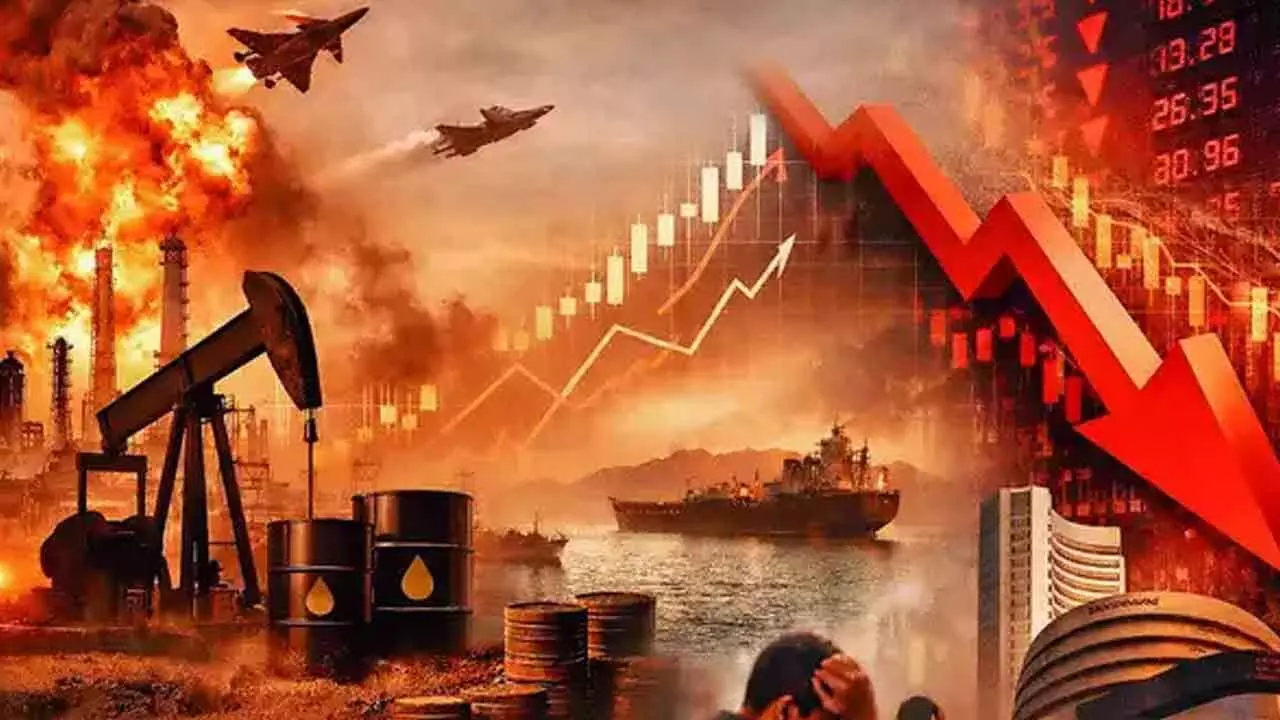
The Indian equity market did not need another tremor. Yet, just as benchmark indices were nursing bruises from a punishing week, fresh tensions in the Middle East arrived like an aftershock—sharp, unsettling, and impeccably timed to test investor nerves.
The damage had already begun. The NIFTY 50 and the BSE SENSEX cracked below their recent trading bands, shedding over 1.5 per cent and, more ominously, slipping beneath their 200-day moving averages—a line that often separates confidence from caution. The break was less a stumble and more a statement. Momentum, at least in the short term, has shifted.
Technology stocks bore the brunt of the fall. The domestic IT pack, long the market’s glamour segment, came under heavy selling pressure amid rising anxiety over artificial intelligence-led disruption.
The latest AI plugin releases by Anthropic were enough to rekindle concerns about the competitive positioning and earnings outlook of Indian IT majors. At the same time, the Nifty Realty index slumped nearly 5 per cent, underscoring discomfort in rate-sensitive pockets.
Yet, the market was not entirely devoid of resilience. Metals, healthcare, pharma and PSU banks showed relative strength, while oil & gas and power stocks offered selective comfort. The divergence is telling: in periods of stress, investors are not fleeing equities altogether but gravitating toward perceived defensiveness.
Then came geopolitics. Renewed tensions between the U.S. and Iran pushed crude oil prices higher and revived the appeal of safe-haven assets such as gold and silver. For an oil-importing economy like India, sustained crude spikes are no trivial matter.
They threaten to disrupt the inflation trajectory, complicate fiscal arithmetic and dim expectations of rate cuts. External shocks are always uncomfortable; they are doubly so when markets are already technically vulnerable.
Santosh Meena of Swastika Investmart notes that the Nifty’s breach of its 200-DMA near 25,350 opens the door to a retest of the Budget-day low around 24,600. The gap-fill zone near 25,100 may offer temporary relief, but any rebound is likely to face stiff resistance in the 25,600–25,800 band. The undertone remains fragile.
The NIFTY Bank reflects similar caution, having formed a double top near 61,600 and slipped below its 20-DMA. The psychological 60,000 mark is now the key line bulls must defend.
Flows tell their own story. Foreign institutional investors began the week tentatively constructive, only to reverse course and end as net sellers, offloading roughly Rs4,600 crore. Domestic institutional investors, in contrast, absorbed more than Rs24,000 crore worth of equities—an emphatic display of local conviction. The tussle between global caution and domestic confidence has become the market’s defining feature.
Retail and HNI investors, meanwhile, are grappling with a prolonged phase of muted returns. Volatility in FII flows adds another layer of uncertainty. Markets may open with a cautious, even negative bias, particularly if global cues remain weak and crude stays elevated. A gap-down cannot be ruled out. Investors will closely track Q3 GDP data, auto sales, IIP and PMI numbers for reassurance.
Globally, economic releases from the U.S. and China will shape risk appetite. History offers perspective. Geopolitical shocks tend to trigger sharp but temporary volatility—unless they morph into sustained supply disruptions or structurally higher energy prices. India’s long-term equity narrative—anchored in demographics, domestic demand and digital depth—remains intact. What has changed is the comfort level.
In the near term, rallies may be sold into, and caution may masquerade as prudence. But unless geopolitical tremors evolve into economic earthquakes, the structural story of Indian equities is unlikely to derail. Markets, like nations, endure turbulence. The real test is not whether volatility arrives—but whether conviction survives it.





