

Snap! ESA’s Jupiter-Bound Spacecraft Captures Stunning New Image of Interstellar Comet 3I/ATLAS
ESA’s Juice spacecraft, currently en route to Jupiter, has captured a new image of interstellar comet 3I/ATLAS. Here’s why the rare 7-billion-year-old comet is exciting scientists and what new data is expected in 2026.
ESA’s Juice spacecraft captures a rare NavCam image of interstellar comet 3I/ATLAS during its November 2025 flyby, revealing an active coma and dual tails.
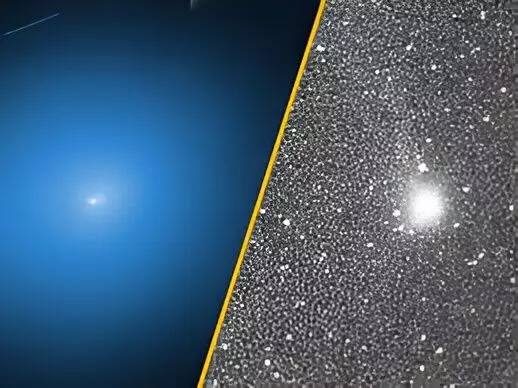
A rare interstellar visitor has once again captured the attention of astronomers. The European Space Agency’s (ESA) Jupiter-bound Jupiter Icy Moons Explorer (Juice) spacecraft has snapped a fresh image of comet 3I/ATLAS, one of only three interstellar objects ever detected in our Solar System.
Originally discovered on 1 July 2025, 3I/ATLAS is believed to have formed beyond our Solar System—possibly over 7 billion years ago, making it older than the Sun itself. As the comet makes its brief passage through our celestial neighbourhood, scientists across the globe are racing to study it before it disappears forever.
A Unique Opportunity in Deep Space
Because 3I/ATLAS was spotted only in mid-2025, there wasn’t enough time to send a dedicated mission. Instead, researchers have been relying on available spacecraft positioned around the Solar System.
NASA’s Mars orbiters, ESA’s Mars probes, and several solar-monitoring missions have all captured images and data. Now, the Juice spacecraft has added to this growing archive.
Juice is primarily designed to explore Jupiter’s icy moons — Europa, Ganymede, and Callisto — which are believed to host vast subsurface oceans that may support life. But during its journey to Jupiter, it turned its Navigation Camera (NavCam) toward the interstellar comet in early November 2025.
Juice’s Rare Glimpse of 3I/ATLAS
On 2 November 2025, just two days before its closest approach to the comet (66 million km away), Juice captured a frame showing 3I/ATLAS in a highly active state, shortly after the comet’s closest passage to the Sun.
The image reveals:
- A bright gaseous halo, known as the coma
- A powerful ion tail stretching upward
- A faint dust tail drifting to the lower left
- Clear signs of ice sublimation triggered by solar heating
Although the NavCam is not a high-resolution science camera, the image still offers an impressive view of the comet’s dynamic activity.
More High-Resolution Data Is Coming
Juice used five scientific instruments during its observations — JANUS, MAJIS, UVS, SWI, and PEP. However, because the spacecraft is currently using its high-gain antenna as a heat shield, data transmission is slow. ESA says the full dataset will reach Earth in February 2026.
When complete, the package is expected to include:
- High-resolution JANUS images
- Spectrometry data revealing chemical composition
- Particle data describing comet behaviour
- Ultraviolet and infrared measurements
Scientists believe this early peek is just the beginning — and that Juice may soon provide the most detailed look yet at an interstellar comet.





