

NASA Confirms Third Interstellar Visitor 3I/ATLAS Is a Natural Comet
NASA has confirmed that interstellar object 3I/ATLAS is a natural comet with no alien technosignatures. Its unusual CO₂ and nickel-rich composition reveals ancient origins from a distant star system.
NASA images show interstellar comet 3I/ATLAS from multiple spacecraft, confirming its natural composition and unusual chemistry from a distant star system.
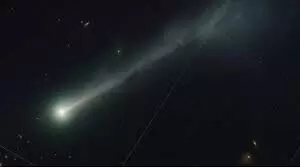
NASA has formally acknowledged that 3I/ATLAS — just the third one of the interstellar objects that have been detected to come into our Solar System — is a comet formed by natural processes, not an alien invention. The finding gives the researchers a unique chance to analyze the very old substance that came from a star system which is very far away.
NASA’s ATLAS telescope in Chile detected the comet-like object on July 1, 2025, and it has been moving at a fast speed. More than 20 spacecraft and major telescopes, including Hubble and Webb, have been monitoring the object very closely. The new data shows that 3I/ATLAS is acting like a normal comet which implies that there are no more doubts about the non-artificiality of its origin.
A Comet, Not a Technological Artifact
During a NASA briefing, Associate Administrator Amit Kshatriya confirmed that “this object is a comet… it looks and behaves like a comet,” while science chief Nicky Fox added that no technosignatures or artificial patterns were found in its chemical or physical behavior.
NASA also clarified that 3I/ATLAS poses no threat to Earth. Its closest approach will be about 1.8 AU, meaning it will safely pass our planet during its journey through the Solar System.
Unusual Chemistry Reveals Ancient Origins
What makes 3I/ATLAS extraordinary is its chemical makeup. Spectral analysis indicates unusually high levels of carbon dioxide and nickel vapour—elements not typically seen in comets formed within our Solar System.
These exotic signatures suggest the comet was born in a very ancient and distant star system, carrying pristine material from an era predating the birth of the Sun.
NASA astrophysicist Tom Statler expressed excitement over the discovery, saying that studying a comet carrying matter from before the Sun formed “gives me goosebumps.”
This rare interstellar visitor is expected to provide astronomers with invaluable insights into the chemistry, evolution, and diversity of planetary systems across the galaxy.





