

Mars Once Rained Heavily: New Rocks Reveal a Humid Ancient World
New Mars research finds kaolinite rocks in Jezero Crater, revealing a humid, tropical past and hints at possible ancient life on the red planet.
image for illustrative purpose
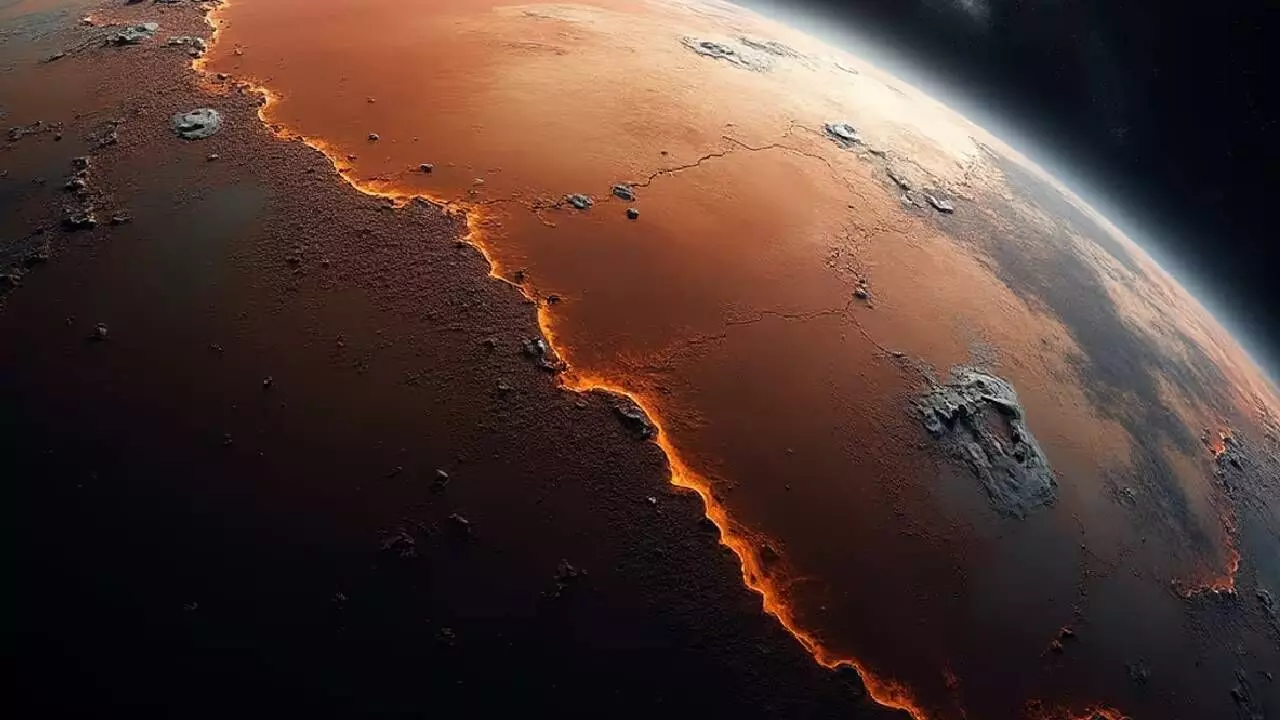
New findings suggest that Mars, which is not covered with and has no life, went through a period of four billion years ago with a wet and very humid climate, the time when life is thought to have appeared on Earth. Continuing their research in Jezero Crater, where the rover Perseverance is exploring, the scientists have come up with new evidence pointing to the opposite- that Mars was a much friendlier planet than it was assumed earlier.
The latest study published by Purdue University delved into pale and light-colored rock pieces that were picked by Perseverance from the lake that was approximately the same size as Lake Tahoe. These pieces have a high percentage of kaolinite in them, a very fine mineral that is often associated with hot climates and heavy rains on Earth.
“Kaolinite is a key indicator of such life-friendly Earth-like environments on other planets,” said Roger Wiens, co-author of the study and Purdue planetary scientist.
The rover's SuperCam, which integrates a laser, spectrometers, and camera, was used by the researchers to scrutinize the light-colored rocks. The analyses show the rocks contain water and have a large amount of aluminum, which is indicative of weathering that has taken a long time. This means that over the course of millions of years, flowing water has dissolved most elements from the rocks leaving only the ones that do not dissolve behind.
The rocks, which vary in size from small pebbles to big boulders, are referred to as "float rocks" because they have been displaced from their original positions. Scientists think that these rocks could have been moved by water flow, erosive processes, or impacts across the crater, although their exact point of origin continues to be a mystery.
Kaolinite-bearing formations are found as a widely spread feature throughout Mars' equator and sub-equator and are dated back to the Noachian period, which was about 4.1 to 3.7 billion years ago, besides that, they are even considered to be younger. The Perseverance rover not only detected some of these rock fragments, which are about the size of a pebble, during its landing but also the investigation of thousands of the specimens has just happened a few months ago.
The revelation indicates that there is still some water locked up in the minerals on Mars despite the planet's current dry state. It also points to the planet's transformation from wet to dry. Mars has no tectonic forces or volcanic activities that could release water which means that the rocks could have played a significant role in the long-term depletion of the atmosphere.
The investigators insist that more research is essential. The kaolinite study concludes the formation with the most life-rich and the wettest periods of Mars while drawing a comparison with Earth's ancient greenhouse climates.
Further, the rocks from Mars under investigation have been found to be similar to samples collected from California's San Diego and South Africa. These comparisons serve to strengthen the hypothesis that ancient Mars might have been a stable and water-rich environment propitious for the development of life.





