

Global Trade in 2026 faces headwinds between rising barriers and new trade bridges: Report
HSBC says 2026 global trade will hinge on tariffs, critical minerals, new trade deals and AI growth, as barriers and bridges shape a fragile trade balance.
Global trade in 2026 will be shaped more by geopolitics and policy than demand cycles: HSBC
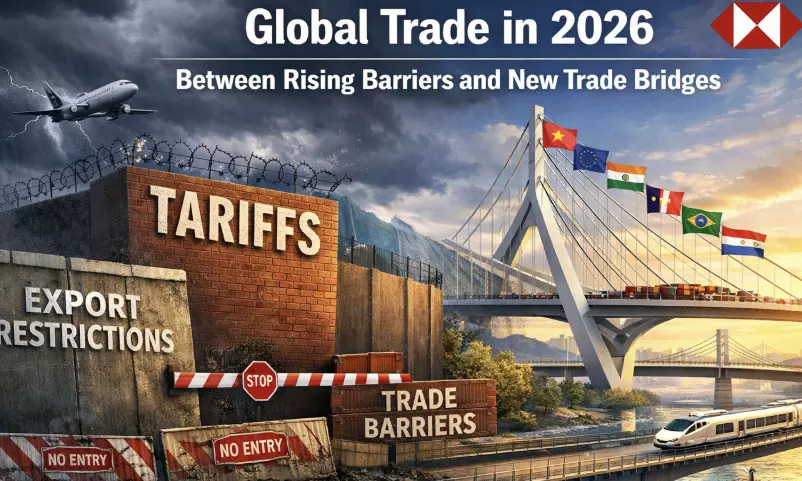
Global trade in 2026 will be shaped more by geopolitics and policy than demand cycles, HSBC says. Rising tariffs, critical mineral competition, new trade deals, and AI-driven sectors will define a fragile balance between protectionism and resilience in an increasingly fragmented global economy.
Global trade is stepping into 2026 at a defining crossroads, where government policy, geopolitics, and strategic competition are set to influence trade flows more deeply than traditional demand cycles. According to a new report by HSBC Global Research, the year ahead will be marked by a delicate balancing act between rising trade barriers and the creation of new trade linkages across regions.
After a volatile but surprisingly resilient 2025, the global trade environment is now entering a phase of structural adjustment. While economic fundamentals still matter, HSBC notes that policy shifts, tariff strategies, and geopolitical alignments are increasingly dictating how goods, services, and capital move around the world.
Tariff Uncertainty Remains a Key Risk
One of the central themes of the HSBC outlook is the persistent uncertainty surrounding US trade policy, particularly the continued emphasis on Section 232 sector-specific tariffs. These duties, originally framed around national security concerns, remain a powerful policy tool with wide-reaching implications for global supply chains.
Even in cases where tariff threats have not been fully implemented, their announcement alone has influenced corporate behaviour and market sentiment. For instance, proposals linked to territories such as Greenland may have been paused, but they have already contributed to volatility and shifts in sourcing decisions. Businesses, wary of sudden changes, have been adjusting procurement strategies and inventory planning accordingly.
HSBC points out that earlier in 2025, many US importers rushed to bring goods into the country ahead of potential tariff actions. This front-loading of imports temporarily boosted trade volumes. However, that surge has since reversed into a sharp pullback, distorting global trade patterns and creating a weaker baseline for export growth in 2026.
Slower Export Growth Ahead
Reflecting these distortions and policy headwinds, HSBC forecasts that global export volume growth will slow to around 2% year-on-year in 2026, down from an estimated 3.8% in 2025. This moderation signals a cooling of momentum, particularly in regions heavily exposed to US demand.
However, the outlook is not uniformly negative. Certain regions are expected to show comparatively stronger performance. HSBC highlights Central and Eastern Europe, the Middle East, Africa, and Latin America as areas that could benefit from shifting trade routes, diversification strategies, and new regional partnerships. These regions may capture investment and trade flows redirected away from more contested trade corridors.
Race for Critical Minerals Intensifies
Another major force shaping global trade in 2026 is the intensifying competition over critical minerals. Materials such as rare earth elements, lithium, cobalt, and other strategic inputs are essential for technologies ranging from electric vehicles and renewable energy systems to defence equipment.
China’s dominant position in several of these supply chains has prompted the United States, Europe, and allied economies to accelerate efforts to diversify sources. Governments and companies are increasingly investing in alternative mining projects, processing facilities, and recycling technologies.
While new partnerships and investment commitments are emerging across Africa, Latin America, and parts of Asia, HSBC cautions that building alternative supply networks will be a long-term and capital-intensive process. Developing mines, establishing processing capacity, and creating reliable logistics chains can take years. In the meantime, supply concentration remains a vulnerability and a potential source of geopolitical leverage.
New Trade Agreements as a Counterbalance
Despite the rise in protectionist measures, HSBC sees a parallel push toward bilateral and regional trade agreements that could help sustain global trade flows. Reduced or uncertain access to the US market has encouraged many economies to deepen ties elsewhere.
The report points to growing momentum in trade discussions and agreements involving the European Union, India, the United Kingdom, and several emerging market economies. These deals are aimed at lowering barriers, harmonising standards, and creating new growth corridors that are less dependent on a single major market.
However, this proliferation of agreements also introduces complexity. Overlapping rules of origin, regulatory standards, and compliance requirements can make it more challenging for companies to operate seamlessly across multiple trade blocs. Businesses may face higher administrative costs and the need to adapt products or processes to meet different regional requirements.
Artificial Intelligence as a Trade Driver
Technology, and particularly artificial intelligence (AI), is emerging as a crucial pillar of trade resilience. HSBC notes that AI-related goods and components have accounted for a significant share of recent trade growth. This includes semiconductors, advanced computing hardware, sensors, and networking equipment.
Beyond physical goods, digitally delivered services are expected to expand strongly over the long term. Software, cloud services, data analytics, and AI-driven solutions are increasingly traded across borders without the need for traditional logistics. This shift toward digital trade offers new avenues for growth even when physical goods trade faces constraints.
However, HSBC warns that the heavy concentration of trade growth in AI-linked sectors also introduces risks. If investment in AI infrastructure, chips, or data centres were to slow due to financial conditions, regulation, or market saturation, global trade growth could face a sharper-than-expected downturn. In this sense, AI is both a stabiliser and a potential vulnerability.
A Fragmented but Adaptive System
Overall, HSBC concludes that global trade in 2026 will be defined by a “barriers versus bridges” dynamic. On one side are tariffs, strategic resource competition, and geopolitical tensions that fragment markets. On the other are new trade agreements, supply chain diversification, and technological innovation that help maintain connectivity.
The outcome will depend heavily on how governments design policies and how businesses adapt. Companies that invest in flexible supply chains, diversify markets, and integrate digital tools may be better positioned to navigate the shifting landscape. Policymakers, meanwhile, face the challenge of balancing domestic priorities with the benefits of open trade.
In an increasingly fragmented global economy, trade resilience will not be automatic. It will require active management, sustained investment, and international co-operation. HSBC’s message is clear: 2026 will not be defined by traditional boom-or-bust cycles, but by how effectively the world manages the tension between protectionism and partnership.





