

Dogs on Mars? NASA Tests Robo Dog LASSIE-M for Future Red Planet Missions
NASA is training a dog-shaped robot, LASSIE-M, to explore Mars' challenging terrain. The agency also tested advanced drones in Death Valley to develop future Martian navigation technology.
NASA’s LASSIE-M robot dog undergoes field testing in Mars-like terrain, showcasing its ability to navigate rocky and sandy surfaces.
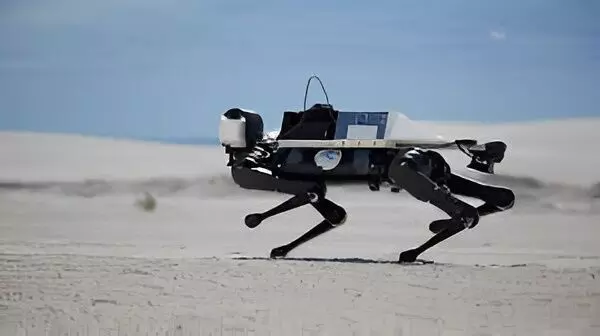
NASA has made a figment of imagination and thereby a gigantic step towards the exploration of Mars in the future by training a dog-shaped robot which will be capable to traverse the most difficult parts of the Red Planet. The robot pet LASSIE-M (Legged Autonomous Surface Science in Analogue Environments for Mars) is being created to work on the very surfaces that are rocky, sandy and unstable; such areas are often considered too risky for the use of conventional rovers.
NASA researchers from the Johnson Space Center in Houston, conducted field trials at the White Sands National Park in New Mexico earlier this year. The shifting, dune-filled landscape of the location was the perfect condition for the assessment of the robot’s mobility and adaptability.
NASA reports that the sensors and motors of LASSIE-M's legs provide the capability of evaluating the surface properties in real-time, adjusting the walking pattern as soon as it crosses the soft, loose, or crusty terrain. Such changes are typical of areas that are scientifically interesting, which, in turn, makes the robo dog a great asset for future missions.
Robot Tests in Death Valley
In the meantime, the engineers at NASA's Jet Propulsion Laboratory (JPL) in Southern California are working on parallel experiments with cutting-edge research drones. Drones tested across extreme conditions of Death Valley and the Mojave Desert are being developed to facilitate future Mars rotorcraft.
The drones were provided with new navigation software and were tested under the scorching heat of 113°F (45°C). NASA stated that the trials yielded important information regarding the different camera filters that help in ground tracking and how the algorithms that are rotated have been improved to be able to identify areas with a high degree of terrain clutter as being safe for landing—skills that are very much needed in Mars missions.
NASA’s exploration of the robot innovations on multiple fronts is LASSIE-M and the new drone technologies that are right at the forefront of advancing the exploration of the more demanding Martian landscapes.





