

Why Dubai Islands Matter for Long-Term Property Investors
image for illustrative purpose
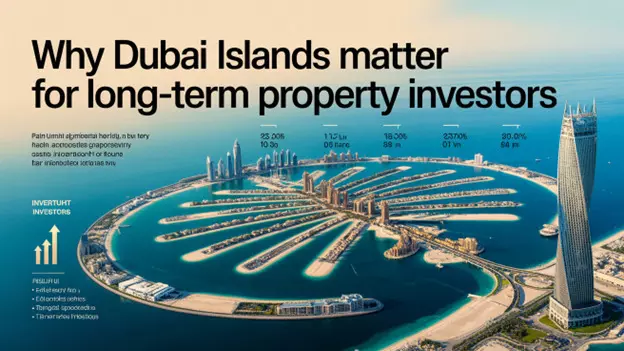
A new large-scale waterfront district is slowly developing along Dubai's northern coastline and will become one of Dubai’s most important real estate developments. The Dubai Islands Project is still being referred to online as Deira Islands, which reflects the project's prior and still present planning identity within market discussions. The district, despite the overshadowing naming conventions, illustrates the changing face of Dubai’s long-term developments. Unlike previous developments offering a short-cycle supply of dwellings, Dubai Islands is designed to create an urban sprawl over several decades, aimed at securing sustained and diversified demand coupled with long-term financial market stability.
Analysts observing the initial development of Dubai Islands have begun to describe the different phases of the development to discern the new approaches being implemented. A range of diversified residential and mixed developments have commenced, including Villa Del Arte, Ellington Cove, Azizi Wasel, Nakheel Bay, and other waterfront developments. Such developments are being purposely built as parts of a greater master-planned environment, as opposed to being considered stand-alone projects. The district’s planners have incorporated a different value metric for the district’s long-term development as opposed to the traditional short-term market turnover valuation to determine the environment’s profitability.
A fresh supply cycle within a controlled environment
For long-term investors, the Dubai Islands potential must also be understood in the context of the Dubai supply cycle. Dubai Islands acts as a new coastal zone with phased development and controlled density. Unlike the established waterfront districts where investment opportunities may be limited, Dubai Islands provides multiple entry points as escrows are set to different phases within the development. This allows investors to time their acquisitions with their long-term holding strategies instead of having to speculate on resale opportunities.
A master planned district provides more certainty on future land use. The planning of infrastructure, transport, public amenities, and zoning, which are set in advance, mitigate the risk of land uses becoming overdeveloped. This predictability in investment is more attractive to institutional investors, family offices, and private capital focused on wealth preservation as opposed to more erratic urban environments.
Strategic Location and Urban Expansion
With the necessary approvals in hand, Dubai Islands helps facilitate the much-needed northward expansion of the urban fabric of Dubai. Until recently, the premium residential and hospitality developments in Dubai have been largely concentrated within the central and southern corridors. With the addition of quality developments along the northern coastline, Dubai can also increase and better distribute these developments.
From an investor’s standpoint, there is a noticeable geospatial shift. Early-stage districts associated with extensive urban sprawl tend to appreciate in value over the long term, as the infrastructure, services, and social frameworks mature. Dubai Islands is at an advantage as it is situated close to established urban zones, and is also self-contained as a retail and leisure waterfront destination. This offers the Islands the potential to meet both organically generated residential demand as well as destination demand.
Factors Generating Sustained Demand
Dubai Islands, unlike many other markets that primarily depend on short-term speculative investments, has a well-rounded solid demand framework. In the Islands, residential purpose, hospitality, leisure and tourism are all interwoven into the district’s purpose, hence demand is somewhat insulated across the economic cycles and is diversified beyond reliance on a single significant buyer.
Long-term property investors are increasingly looking for and prioritizing assets that are able to perform in a variety of market conditions. Waterfront residential units that offer leisure components usually retain occupancy and rental demand in all phases of the market as transactional activity slows down. Also, the presence of resorts, hotels and other public leisure waterfront spaces increases the district’s activity and foot traffic, hence improving the overall value proposition of the district.
Infrastructure as a Value Multiplier
In Dubai Islands, considerable public and private investments have been made in infrastructure, a critical factor in the island’s long-term real estate value drivers. Besides the bridges and main roads that provide access to the mainland, the islands' internal road networks enhance walkability and are conducive to efficient vehicular movement.
At the district level, utilities, drainage, and coastal works are retrofitted to integrate new systems. From an investor’s perspective, this condition optimizes the long-term maintenance and durability of the infrastructure. climate and environmentally sensitive real estate markets. Master-planned districts, in which properties are integrated, perform particularly well in terms of value retention.
Waterfront Scarcity and Long-Term Value
Globally, waterfront real estate remains a highly valued and limited resource. Throughout the world, as more people are moving to urban centers, the coastal development regulations have become more stringent. As a result, connected-to-the-water real estate opportunities have decreased. Dubai Islands offers new controlled scarcity that allows the integration of new water’s edge inventory without devaluing the unique water’s edge location.
Long-term investors understand the importance of scarcity as the foundation of value retention. Waterfront properties outperform their inland counterparts after holding periods of several years because demand for these properties as a lifestyle continues to grow. With a combination of modern amenities and a city with transparent investor-friendly regulations, Dubai Islands enhances that demand.
Alignment With Dubai's Economic Vision
The Dubai Islands development is also aligned with the Dubai Islands’ emirate’s economic and spatial development principles of diversification, increased tourism, and sustainable development. This means that there is less policy risk for the Dubai Islands development as it is part of Dubai’s integrated development of the Islands and is not only a commercially viable standalone proposition.
`The Dubai Islands’ place within Dubai’s integrated development also means it will benefit from real positive support from the public sector beyond real estate, especially within transport, tourism, and Dubai’s position to the world. All of this allows for greater confidence for investors who intend to hold for long periods.
A Long-Term Perspective on Returns
Investor sentiment focuses on short-term, daily price changes without taking a step back to observe Dubai Islands from a far distance, and seeing the full picture. Positive returns are a result of gradual and steady growth of the district and its markets. Potential returns are a mixture of the maturity of the district, the maturation of the social and economic markets, the economic and social capital, and the district's increasing recognition. Early investors capture the growth curve early and may avoid significant potential returns to district maturity to reduce potential social and economic market risks.
Dubai's Islands, are now becoming one of the more prominent districts, especially with long-term investors looking to capture capital appreciation. As one of Dubai's western districts Islands is also becoming prominent in its role of creating a new coastline by Dubai's Islands. As Dubai's western districts Islands, Dubai's new coastline is also becoming prominent in its role of creating Dubai's western districts.





