

What is Personal Loan Tenure? Meaning, Types & Why It Matters
Choosing the right personal loan tenure affects EMI, interest cost, and cash flow. Learn how to balance repayment period and financial health in 2026.
Revenue cycle service centers help organizations reduce claim denials, accelerate payments, and improve financial stability through streamlined billing workflows.
Funding a milestone such as a child’s wedding or refurbishing a family home can require quick access to capital.
Attention in loan discussions usually rests on the interest rate, yet the length of repayment has just as much bearing on the instalment size and the final amount repaid.
What Exactly is Personal Loan Tenure?
Personal loan tenure simply refers to the agreed period within which the borrowed amount, along with interest, must be repaid. It defines how long the obligation will remain active. In India’s 2026 lending environment, repayment periods commonly range from 12 to 60 months, with some lenders extending the term up to 84 months for higher loan amounts.
The choice of tenure creates a direct "see-saw" effect on a household budget:
• Longer Tenure: Results in a smaller, more manageable Equated Monthly Installment (EMI) but a higher total interest outgo over the years.
• Shorter Tenure: Results in a higher monthly EMI but allows the borrower to become debt-free faster with significantly lower total interest costs.
Decoding the Types of Personal Loan Tenures
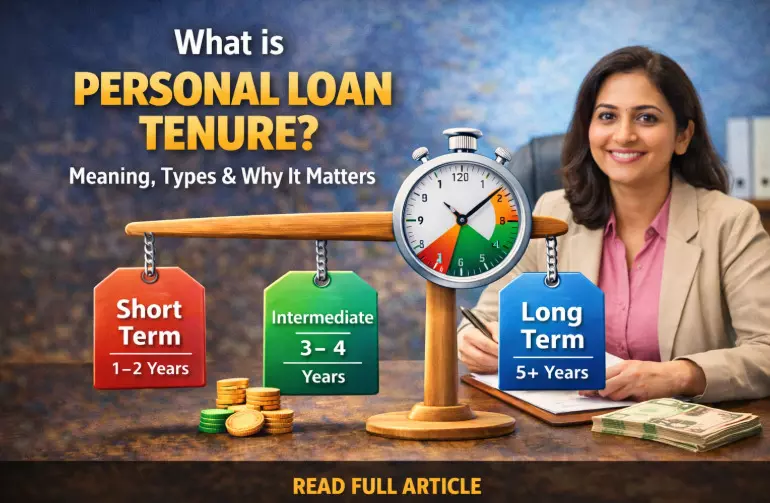
The repayment period cannot be decided on a standard formula. It usually falls into three broad ranges, each suited to different financial situations and objectives.
1. Short-Term Tenure (12 to 24 Months)
This is ideal for individuals with high disposable income who wish to close liabilities quickly. If a loan is taken for a minor medical procedure or a quick business bridge, a shorter tenure ensures the personal loan interest rate does not erode savings for an extended period.
2. Medium-Term Tenure (24 to 48 Months)
This is the "sweet spot" for many middle-income families. It provides a balanced approach where the EMI remains affordable, and the debt does not linger into the next decade.
3. Personal Loan Maximum Tenure (60 to 84+ Months)
Opting for a personal loan with a maximum tenure is a strategic move when managing multiple financial responsibilities simultaneously—such as a child’s education and a home loan. It keeps the monthly outflow at its lowest, ensuring that a liquidity crunch never arises.
FeatureShort TenureLong Tenure
Monthly EMI High Low
Total Interest Paid Low High
Budget Flexibility Tight Relaxed
Debt Duration 1–2 Years 5–7 Years
Why the Right Tenure Matters for Long-Term Financial Health
Tenure is not just a number; it is a lifestyle choice that dictates financial freedom. Here is why it requires careful consideration:
• Impact on Credit Score: Opting for a tenure that results in an EMI beyond one’s repayment comfort can increase the risk of missed payments. On the other hand, selecting a manageable term and paying instalments on schedule contributes positively to credit history over time.
• Total Cost of Borrowing: It is a common myth that the "lowest interest rate" always means the "cheapest loan." A loan at 11% for 7 years often results in a higher total repayment than a loan at 13% for 3 years. The total outgo is the true metric of cost.
• Liquidity for Emergencies: For borrowers managing multiple obligations, choosing a flexible tenure is crucial. It is unwise to have the entire monthly surplus dedicated to a personal loan EMI, leaving no room for emergency expenses.
In such circumstances, the choice of lender carries considerable weight. An established institution such as Muthoot Finance is often regarded as dependable within the Indian market. Rather than encouraging repayment periods that may strain cash flow, its approach is generally centered on clarity in terms and suitability for the borrower’s situation.
Their advisors assist in mapping income cycles—be it seasonal business gains or monthly salaries—to a tenure that keeps assets safe and financial stress at bay.
Common Myths vs. 2026 Realities
In 2026, the financial world has evolved, yet several myths persist among borrowers.
• Myth: "Tenure cannot be changed once the loan starts."
Reality: Under the present regulatory structure, repayment terms are not always rigid. In the case of floating rate loans, subject to lender policy, some borrowers may have the option to modify repayment terms during the loan lifecycle.
• Myth: "Maximum tenure is always a financial trap."
Reality: For many small business owners, the maximum available tenure can offer breathing space. Lower instalments over a longer period may help keep cash circulating within the business instead of being tied up in heavier monthly repayments.
Strategic Recommendations for Choosing Tenure
Before signing a loan agreement, these expert steps should be followed:
1. Calculate the Debt-to-Income (DTI) Ratio: Total EMIs should ideally not exceed 40% to 50% of take-home pay to maintain a healthy standard of living.
2. Factor in Prepayment: It is wise to check if the lender allows "part-prepayments." If they do, one can opt for a longer tenure to keep EMIs low but pay off lump sums whenever a bonus or windfall is received.
3. Select a Proven Partner: An established institution such as Muthoot Finance provides structured personal loan solutions with clearly documented repayment schedules and Key Fact Statements. Access to branch level guidance and digital application channels can assist borrowers in selecting a tenure aligned with actual cash flow patterns.
Conclusion: Taking Control of the Repayment Timeline
The length of repayment plays a central role in how a loan fits into day to day finances. A shorter term can raise the monthly instalment to uncomfortable levels, while a longer one may increase the overall payout and extend the obligation further than intended.
Looking at future responsibilities and present resources helps in settling on a term that sits well within one’s means. Borrowing should ease the journey toward planned goals, not complicate it.
Ready to find a repayment plan that aligns with your financial goals? Exploring structured personal loan options with an established financial institution can help align tenure with repayment capacity.





