

Optimising Pacemaker Battery Longevity Through Improved Prediction Techniques
Researchers at the University of Leeds, Université Grenoble Alpes and the University Hospital of Grenoble-Alpes in France have created an algorithm that helps doctors identify which pacemaker functions consume the most battery power.
image for illustrative purpose
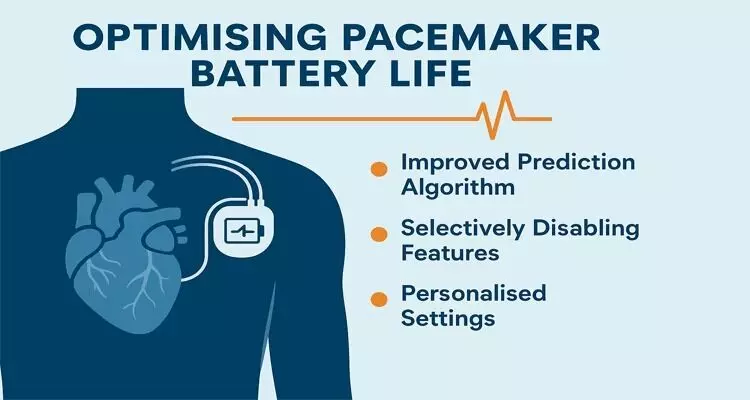
Bengaluru : Researchers at the University of Leeds, Université Grenoble Alpes and the University Hospital of Grenoble-Alpes in France have created an algorithm that helps doctors identify which pacemaker functions consume the most battery power. Based on a patient’s specific needs, some of these features can be turned off to conserve energy. Since pacemakers typically last between seven and 14 years depending on the functions used, disabling unnecessary features could significantly extend their lifespan. This would mean fewer surgeries for patients and reduced costs for the NHS.
According to Dr Klaus Witte, School of Medicine, "This represents an initial step toward enabling clinicians to select the most appropriate pacemaker and optimise its settings to deliver the required performance and battery longevity for each patient.”
The research paper, ‘Cardiac implantable electronic devices’ longevity: A novel modelling tool for estimation and comparison,’ has been published in PLOS One. The University of Leeds has made it open access so that doctors worldwide can freely use the modelling tool to support their clinical decision-making.
Dr Klaus Witte, Senior Lecturer and Consultant Cardiologist in the University of Leeds’ School of Medicine and at Leeds Teaching Hospitals NHS Trust, said: “This is an important first step in helping doctors determine which pacemaker to select and which settings to use so that patients receive the device and battery life best suited to their needs. Ideally, this will delay battery replacements—or even remove the need for them altogether—which benefits patients, the NHS and society more broadly.”
Professor Pascal Defaye of Université Grenoble Alpes and the University Hospital of Grenoble-Alpes said: “This approach is unique because it draws on real-world data and enables direct comparisons across devices, features and manufacturers.”
A pacemaker is a small implanted device that uses electrical pulses to help the heart maintain a regular rhythm. It is commonly used to treat heart failure and abnormal heart rhythms that can cause patients to faint. The device—essentially a tiny metal box containing a battery and a miniature computer—is placed under the skin near the collarbone. Thin leads connected to the box run through a blood vessel into the heart’s chambers. Through these leads, the pacemaker monitors the heart’s activity and delivers extra beats when required. If the heart slows or skips a beat, the device sends a controlled electrical impulse to bring the heartbeat back to a normal rate.
There are several types of pacemakers, each offering a variety of advanced features. These can include correcting a slow heart rate, coordinating the timing of heart chamber contractions, increasing the heart rate during physical activity, enabling remote monitoring, and recording activity patterns. However, not every patient requires all of these functions.





