

Invisalign Aligners: The Ultimate Guide to Clear Aligners in Brea, CA (2026 Edition)
Straighten your teeth discreetly with Invisalign in Brea, CA. Learn how clear aligners work, costs in 2026, treatment steps, and Invisalign vs braces—all explained by local dentists.
Invisalign clear aligners use controlled, gradual force to straighten teeth discreetly—guided by digital planning and professional supervision in Brea, CA.
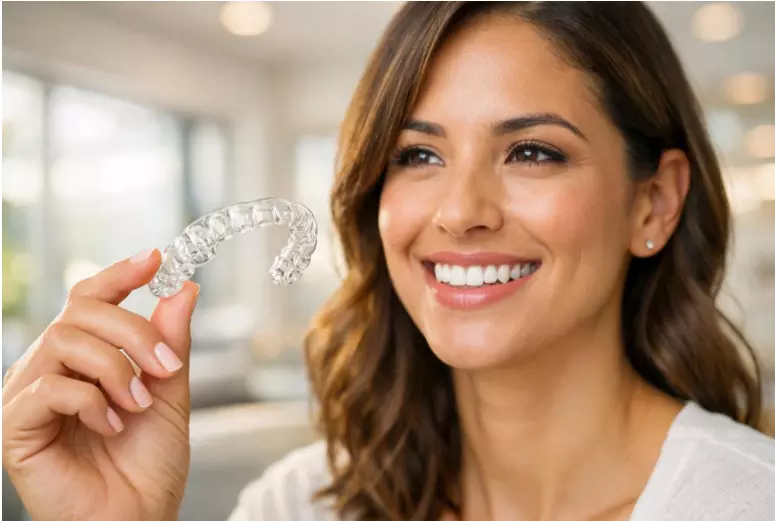
Want straighter teeth without visible metal brackets or wires? You are not alone. In 2026, adults and teens in Brea, CA increasingly choose Invisalign aligners as a discreet alternative to traditional braces. Clear aligners fit more easily into work, school, and social life while still following the same biological principles used in orthodontics for decades.
At Gold Coast Dental in Brea, patients often arrive with similar questions. How can a clear plastic tray move teeth and bone? Is Invisalign slower than braces? And is the cost justified compared to other options? This guide answers those questions clearly, without marketing hype.
This comprehensive 2026 guide explains how Invisalign aligners straighten teeth, the science behind tooth movement, what treatment looks like step by step in Brea, how costs are typically structured, and how supervised Invisalign compares with braces and mail-order aligners. If you are searching for dentist near you for Invisalign in Brea, CA or need a same-day local evaluation, this article is designed to help you make an informed decision.
How Do Invisalign Aligners Work? (The Science)
Invisalign straightens teeth by applying controlled, gradual force through a sequence of custom-made clear aligners. While the trays look simple, the biology behind them is not.
Traditional braces use wires and brackets to pull teeth into position. Invisalign works differently. Each aligner is designed to gently push teeth toward a planned position. Every tray is slightly different from the one before it, creating small, intentional changes rather than sudden movement.
When you place a new aligner, it feels snug because it is shaped for where your teeth are going next, not where they currently sit. That controlled pressure is what triggers the body’s natural remodeling process.
The Role of the Periodontal Ligament (PDL)
Teeth are not fused directly to bone. They are suspended in a microscopic network of soft tissue called the periodontal ligament (PDL). This ligament acts like a biological shock absorber and allows teeth to move safely.
When Invisalign applies pressure:
- On the pressure side, the PDL compresses and signals the body to resorb a small amount of bone.
- On the tension side, the PDL stretches and signals new bone formation.
This cycle of bone resorption and deposition allows teeth to shift through the jaw. Invisalign relies on the same biological process as braces, but delivers force through removable clear aligners rather than fixed hardware.
Step-by-Step Invisalign Treatment Process in Brea, CA
Patients at the Brea location follow a structured, supervised process designed to reduce uncertainty and improve predictability.
Step 1: Digital Consultation and Scan
Treatment begins with a consultation and a digital intraoral scan rather than traditional impressions. The scan creates a precise 3D model of your teeth and bite. During this visit, your dentist also evaluates gum health, existing restorations, and overall oral stability. Straightening teeth only works well when the foundation is healthy.
A digital preview of expected tooth movement helps set realistic expectations before treatment starts.
Step 2: Treatment Planning
Your scan is used to create a detailed digital treatment plan. Your dentist reviews this plan carefully, adjusting movement timing and sequencing where needed. Software assists with planning, but clinical judgment ensures teeth move safely within bone limits.
Step 3: Attachments and Space Management
Some cases require small, tooth-colored attachments bonded to specific teeth. These attachments give aligners additional grip for rotations or vertical movement. In crowded cases, minor enamel reduction between teeth may be recommended to create space without extractions.
Step 4: Active Wear and Monitoring
Aligners are worn 20 to 22 hours per day and changed every one to two weeks. Progress is monitored through scheduled visits and, in some cases, digital check-ins. Monitoring allows adjustments if teeth are not tracking as planned.
Step 5: Refinements
Teeth do not always move exactly as predicted. Refinement aligners may be ordered near the end of treatment to fine-tune alignment. These refinements are commonly included in comprehensive Invisalign plans.
Invisalign vs Traditional Braces vs Mail-Order Aligners
Choosing the right orthodontic approach matters. Each option has strengths and limitations.
Invisalign vs Traditional Braces
Feature Invisalign Aligners Traditional Braces
Visibility Nearly invisible Highly visible
Removable Yes No
Eating restrictions None Several
Oral hygiene Easier brushing and flossing More difficult
Office emergencies Rare More common
Best suited for Mild to moderate cases Severe or skeletal cases
Braces remain effective for complex skeletal problems. Invisalign is often preferred by adults who want flexibility and aesthetics without compromising clinical supervision.
Invisalign vs Mail-Order Aligners
Mail-order aligners may appear cheaper, but they lack critical safeguards. Without X-rays, attachments, or professional monitoring, teeth may tip without proper root movement. Professional organizations consistently advise supervised care to reduce risks such as gum recession, bite problems, and unstable results.
Invisalign Cost in Brea, CA
Invisalign costs vary based on complexity, duration, and the number of aligners required. In Brea, CA, pricing is generally comparable to traditional braces.
Typical cost ranges:
- Minor alignment or relapse cases: lower cost and shorter treatment
- Moderate crowding or bite correction: mid-range pricing
- Comprehensive cases: higher cost due to longer treatment time
Many Invisalign plans include refinements and retainers. Dental insurance often contributes when orthodontic benefits are available, and flexible payment plans are commonly offered to spread costs over time.
Living With Invisalign – What to Expect
The first days with aligners often involve mild pressure or tightness, which usually fades quickly. Some patients notice a brief speech adjustment period. Because aligners are removable, eating and oral hygiene remain straightforward.
Patients must remove aligners for meals and brush before reinserting them. Hot drinks and sugary beverages should be avoided while wearing trays. These habits reduce the risk of staining and cavities during treatment.
Retention after treatment is essential. Wearing retainers helps stabilize bone and prevent teeth from shifting back over time.
Who Is a Good Candidate for Invisalign?
Invisalign can treat many alignment issues in 2026, including crowding, spacing, mild overbites or underbites, and relapse after previous braces. Candidacy depends not only on tooth position but also on gum health and patient compliance.
Patients who struggle to wear aligners consistently may be better suited for fixed orthodontic options. A professional evaluation remains the only reliable way to determine suitability.
Why Choose Gold Coast Dental in Brea?
Local, supervised care offers advantages that remote options cannot match. Same-day evaluations, in-person monitoring, and quick access for lost trays or attachment issues improve both safety and convenience. A holistic approach also considers bite function, jaw comfort, and long-term stability, not just cosmetic alignment.
Frequently Asked Questions (FAQ)
How long does Invisalign treatment take?
Many patients complete treatment within 12 to 18 months, though simpler cases may finish sooner.
Is Invisalign painful?
Most patients describe mild pressure rather than pain, especially when switching aligners.
Can adults use Invisalign?
Yes. Age is not a limitation as long as teeth and gums are healthy.
Do I need retainers after Invisalign?
Yes. Retainers help maintain alignment and are essential for long-term stability.
Does insurance cover Invisalign?
Many dental plans apply orthodontic benefits to Invisalign similarly to braces.
Conclusion
Invisalign aligners offer a modern, predictable approach to teeth straightening when guided by a qualified dentist. Through digital planning, gradual force, and professional monitoring, clear aligners can deliver reliable results for adults and teens alike.
If you are considering Invisalign in Brea, CA, reviewing your options with a local provider is the best next step. You can learn more or schedule an evaluation at our Brea dental office on the Gold Coast Dental website, explore Invisalign treatment details to understand how clear aligners work and what to expect, or visit Gold Coast Dental to review our full range of dental services and locations
References (APA)
Align Technology. (2025). ClinCheck treatment planning and clear aligner outcomes.
American Journal of Orthodontics and Dentofacial Orthopedics. (2024). Clear aligner biomechanics and root response.
California Dental Association. (2026). Guidelines for clear aligner therapy.
Gold Coast Dental. (2026). Invisalign patient outcomes and clinical protocols.
This article was medically reviewed by Diane Boval, DDS, a licensed dentist practicing in California.
Last reviewed February 2026.





