

MH370: The grieving families who never got to say goodbye!
MH370: The grieving families who never got to say goodbye!
Every story about Malaysia Airlines Flight MH370 begins with a plane.
For the families, it begins with a phone that never rang.
On March 8, 2014, MH370 departed Kuala Lumpur for Beijing carrying 239 people — mothers and fathers, sons and daughters, friends and colleagues. Many families were already asleep when the aircraft took off. Others were waiting at Beijing Capital International Airport, watching arrival boards, planning breakfasts, rehearsing embraces.
Then the board changed.
At first, no one panicked. Flights are delayed all the time. But minutes stretched into hours. Phones stayed silent. Officials avoided eye contact. Somewhere between confusion and dread, families began to realize something was terribly wrong.
They are still waiting.
The Moment Time Stopped
For most people, March 8, 2014, is a date.
For the families of MH370, it is a permanent present.
Some remember the last text message: “Just boarded.”
Some remember a missed call they assumed they would return later.
Some remember nothing at all — because the goodbye had already been said days earlier.
When news broke that MH370 had vanished, families rushed to airports and crisis centers, clutching passports, photos, anything that might help them feel useful. They demanded answers that no one could give.
“How can a plane disappear?” they asked.
“Where are our people?”
“When will you find them?”
No one had answers. Not then. Not now.
Silence Is Cruel
Air disasters usually come with wreckage, timelines, final transmissions. MH370 offered none of these. There was no explosion on radar. No debris field. No mayday call. Just silence.
For families, that silence became its own kind of trauma.
Some refused to believe their loved ones were gone. Without evidence, death felt like an accusation rather than a fact. Others imagined endless scenarios: emergency landings, hijackings, survivors stranded somewhere, waiting.
Hope, in this case, was not comforting. It was exhausting.
One family member later said, “If they had told us everyone died that night, it would have been unbearable — but at least it would have been something. Instead, we were left floating.”
Waiting in Public
The families did not grieve privately. They waited on camera.
Press conferences were held. Officials spoke carefully. Words like “uncertain,” “ongoing,” and “investigating” became part of daily life. Each update raised expectations and then quietly lowered them again.
When satellite data suggested the plane had flown on for hours, families were told their loved ones might still be alive somewhere. When northern routes were ruled out, they were told to prepare for the worst. When debris was found years later, they were told it was “likely” from MH370.
Likely is not closure.
Grief, when performed publicly, becomes complicated. Families were expected to be dignified, grateful, patient. Anger was often framed as unreasonable. Despair was treated as inconvenient.
But grief does not follow press schedules.
The Ocean Gives, but Not Enough
In 2015, a flaperon washed ashore on Réunion Island. It was confirmed to belong to MH370. For investigators, it was a breakthrough. For families, it was devastating.
It proved the aircraft had ended in the ocean.
It did not say where.
It did not say how.
It did not say why.
More debris followed — pieces of wing, interior panels, fragments without stories. Families were asked to see them as progress. Many saw them as reminders that their loved ones had been reduced to parts.
One relative said quietly, “They found pieces of the plane, but not pieces of our lives.”
Living With Theories
As evidence trickled in slowly, theories flooded in quickly.
Remote hijacking. Military shoot-downs. Secret landings. Intelligence operations. Aliens.
For families, these theories were not entertainment. Each one reopened wounds. Each viral video or dramatic claim forced them to relive the disappearance all over again.
Some families tried to follow every lead, hoping one might finally explain the silence. Others withdrew completely, unable to endure the cycle of hope and disappointment.
What hurt most was not disagreement — it was certainty without evidence. Strangers online spoke with confidence about what happened to people they had never met.
The families learned that the internet does not grieve. It speculates.
The Hardest Possibility
Eventually, attention turned inward — toward the cockpit.
Evidence suggested deliberate actions had been taken. Systems switched off manually. A flight path carefully chosen. Data from a home flight simulator showing routes into the southern Indian Ocean.
For families, this was the hardest chapter.
Accepting the possibility that a human decision caused the loss meant confronting a reality that felt almost unbearable. It complicated grief. It raised questions with no comforting answers.
Many families emphasized one thing again and again: understanding what happened is not about blame. It is about truth.
They did not want a villain.
They wanted honesty.
Grief Without a Body
Most cultures rely on rituals to process loss — funerals, burials, prayers over remains. MH370 denied families all of that.
Without bodies, grief becomes abstract. Some families kept bedrooms untouched. Others marked birthdays with empty chairs. Children grew up knowing parents only through photographs and stories.
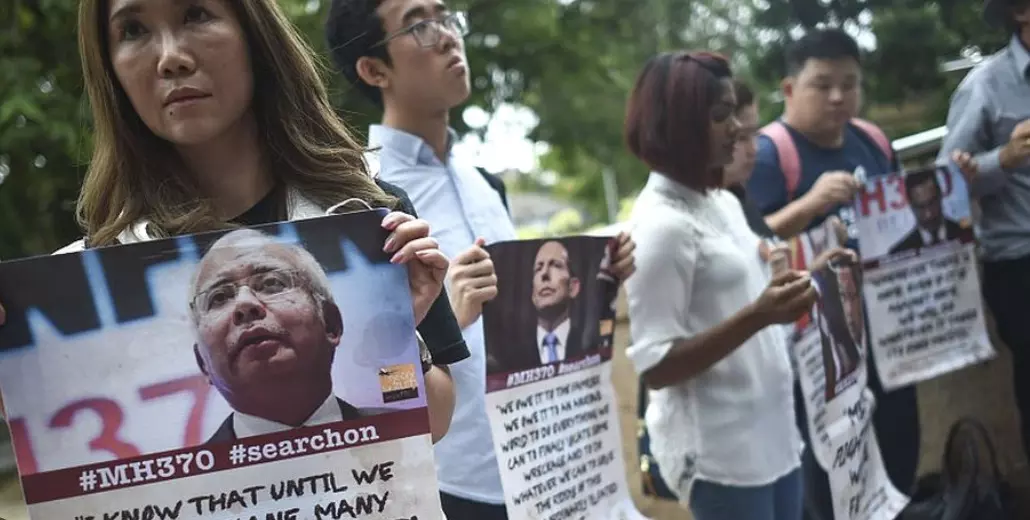
In China, Malaysia, Australia, and beyond, families gathered year after year, holding portraits of faces frozen in time. They aged. Their loved ones did not.
One mother said, “The world tells us to move on. How do you move on from someone who never came back?”
Why the Search Still Matters
To outsiders, MH370 may feel like a solved mystery without a wreck. To families, it is unfinished business.
Finding the aircraft would not erase pain. But it would end the waiting. It would replace imagination with facts. It would allow grief to settle into something solid instead of endlessly circling the unknown.
Black box data could answer questions families still ask in the quiet:
Were they afraid?
Were they conscious?
Were they together at the end?
These are not morbid curiosities. They are human needs.
Carrying the Missing Forward
As years passed, media attention faded. Funding debates returned. Search efforts paused and restarted. Families remained.
They became advocates, investigators, archivists of their own tragedy. Some learned aviation terminology they never wanted to know. Others dedicated themselves to ensuring MH370 would not be forgotten.
What they asked for was simple: do not let silence win.
MH370 was not just a missing aircraft. It was 239 individual lives, each with unfinished sentences, unopened messages, futures that never arrived.
Until the wreckage is found, the families live suspended between memory and absence.
They are not asking the world to grieve forever.
They are asking it not to forget.
Because for them, March 8, 2014, never ended — it only learned how to breathe.





