

India’s twin trade pivots: EU FTA & US deal redraw global economic alignments
Tariff cuts, strategic alignment and a $24-trillion opportunity redefine India’s global trade footprint
India’s twin trade pivots: EU FTA & US deal redraw global economic alignments
In a world marked by fractured supply chains, sanctions, political uncertainty and sharpening great-power rivalry, India and the European Union have taken a decisive geopolitical and economic step by signing the India–EU Free Trade Agreement (FTA).
With bilateral trade at $136 billion, the EU accounting for 16 per cent of India’s foreign direct investment, and the agreement expected to unlock nearly $75 billion in additional exports, economic integration is now reinforcing strategic alignment.
For Europe, the FTA offers a pathway to diversify supply chains away from China and reduce excessive dependence on the US. For India, it secures preferential access to the world’s largest single market. Together, the two partners are positioning themselves as anchors of stability in an emerging multipolar, rules-based global order.
The EU and India already trade over €180 billion worth of goods and services annually, supporting nearly 800,000 jobs across the EU.
The deal is expected to double EU goods exports to India by 2032 by eliminating or reducing tariffs on 96.6 per cent of EU goods exports to India. Overall, the tariff cuts are estimated to save European exporters around €4 billion per year in duties.
India will grant the EU tariff reductions unmatched by any of its other trading partners. Tariffs on automobiles will be gradually reduced from 110 per cent to as low as 10 per cent, while duties on auto components will be fully eliminated within five to ten years.
Tariffs of up to 44 per cent on machinery, 22 per cent on chemicals and 11 per cent on pharmaceuticals will also be largely phased out.
The agreement removes or significantly reduces often prohibitive tariffs, averaging over 36 per cent, on EU agri-food exports, opening a vast market for European farmers.
At the same time, sensitive European agricultural sectors remain fully protected, with products such as beef, chicken meat, rice and sugar excluded from liberalisation. All Indian agricultural imports will continue to comply with the EU’s stringent health and food safety standards.
With a combined market valued at over Rs2,091.6 lakh crore (around $24 trillion), the FTA offers unprecedented opportunities for nearly two billion people across India and the EU.
It delivers enhanced market access for more than 99 per cent of India’s exports by trade value, while preserving policy space for sensitive sectors and reinforcing India’s developmental priorities.
Bilateral merchandise trade between India and the EU has shown steady growth, reaching approximately Rs11.5 lakh crore ($136.54 billion) in 2024–25, with Indian exports accounting for nearly Rs6.4 lakh crore ($75.85 billion). Trade in services touched Rs7.2 lakh crore ($83.10 billion) during the same period.
Despite this robust expansion, significant untapped potential remains, given the scale of both economies. The FTA provides a clear and credible pathway for India and the EU to emerge as each other’s major economic partners.
Crucially, the agreement creates a stable and predictable environment for exporters, enabling Indian businesses, including MSMEs, to plan long-term investments, integrate into European value chains and secure consistent market access amid global economic uncertainty.
For businesses on both sides, the agreement promises a structural shift. From automobiles and food products to advanced machinery, tariffs that have long acted as barriers are set to ease.
“Cars are dear to Austrians,” Zischg remarked, referring to Europe’s strong automotive heritage. “But this agreement is not just about cars. It is about the entire automotive supply chain behind them.”
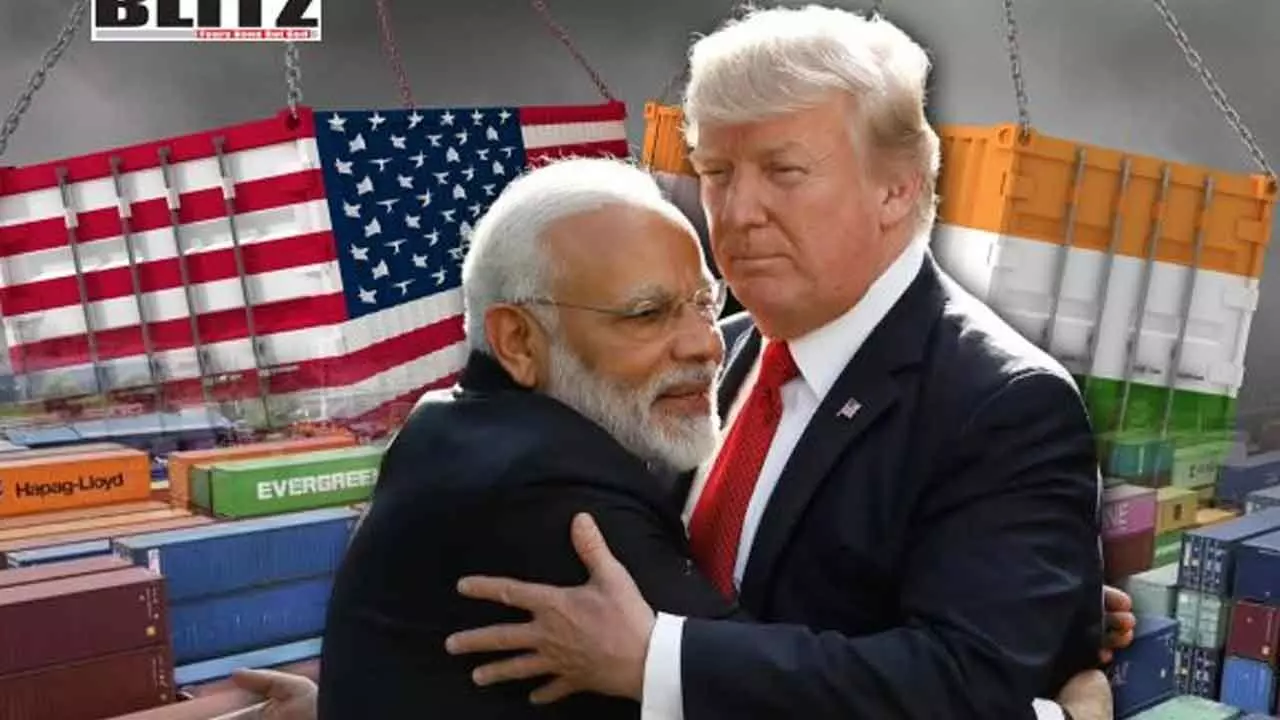
Parallel to developments with the EU, India has also reshaped its trade relationship with the United States. US tariffs on Indian goods were significantly reduced following a new bilateral trade deal announced by President Donald Trump on February 2, 2026, with immediate effect.
Previously, US tariffs on many Indian exports had risen to as high as 50 per cent, comprising a 10 per cent baseline duty, a 15 per cent reciprocal tariff, and an additional 25 per cent punitive levy, affecting over 55 per cent of India’s $87 billion exports to the US. Critical sectors such as pharmaceuticals, semiconductors, energy and critical minerals, however, were exempt.
Under the new arrangement, the reciprocal tariff has been reduced from 25 per cent to 18 per cent, while the additional 25 per cent punitive duty has been fully withdrawn. As a result, the effective tariff rate on most Indian goods now stands at 18 per cent.
In return, India has agreed to move toward zero tariffs and remove non-tariff barriers on US goods, reduce purchases of Russian crude oil, shift sourcing toward the US, adopt stronger “Buy American” policies, and commit to major future purchases of US energy, technology and agricultural products, estimated at over $500 billion.
Taken together, the India–EU FTA and the recalibrated India–US trade deal signal a new phase of strategic economic engagement for India. As these agreements take effect, analysts will closely track sector-wise performance to assess their long-term impact on the market and economy.





